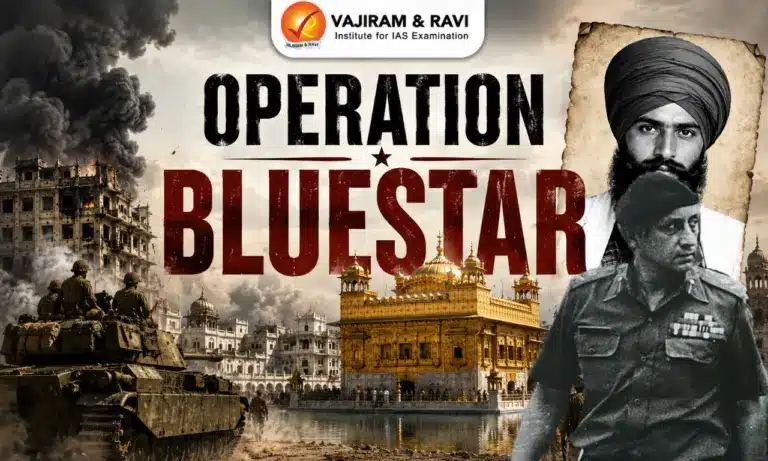
Operation Bluestar was a major Indian military operation carried out in June 1984 at the Golden Temple complex in Amritsar, Punjab. It was ordered by Prime Minister Indira Gandhi to remove heavily armed militants led by Jarnail Singh Bhindranwale, who had occupied the complex. The operation became one of the most significant events in modern Indian history because of its political, religious, security and social consequences, including widespread public reactions and long term impacts on Punjab.
What is Operation Bluestar 1984?
Operation Bluestar was the code name for the Indian Army operation launched between 1 and 8 June 1984 to regain control of the Golden Temple, the holiest shrine of Sikhism, from armed militants. The operation aimed to eliminate militant strongholds while trying to minimise civilian casualties. Although the Army achieved its objective, the operation caused heavy damage to the Akal Takht, resulted in significant loss of life and triggered far reaching political and social developments across India.
Operation Bluestar Historical Background
Operation Bluestar emerged from rising militancy and political tensions in Punjab during the decades after Independence.
- Punjab reorganisation: After the Independence in 1947, demands for a Punjabi speaking state continued. On 1 November 1966, Punjab was reorganised into Punjab and Haryana, but several political and regional issues remained unresolved.
- Growth of separatist demands: During the 1970s, sections of the Shiromani Akali Dal (SAD) and the All India Sikh Students’ Federation demanded greater autonomy, while some militant groups promoted the idea of Khalistan, an independent Sikh homeland.
- Anandpur Sahib Resolution: Adopted by the Shiromani Akali Dal in 1973, the resolution demanded greater state autonomy, wider powers for Punjab, an All India Gurdwara law and limited Union jurisdiction over defence, foreign affairs, communications and currency.
- Rise of Jarnail Singh Bhindranwale: Bhindranwale, former head of Damdami Taksal, gained influence after 1978 through religious mobilisation and later emerged as a prominent leader supporting stronger Sikh political rights and militant resistance.
- Escalation of violence: From 1981 onwards, Punjab witnessed increasing communal violence, targeted killings, bombings and attacks. Bhindranwale’s arrest in September 1981 and subsequent release further strengthened his public support.
- Occupation of the Golden Temple: By 1983, Bhindranwale and his followers shifted to the Akal Takht inside the Golden Temple complex, fortified the area with weapons and established it as their operational base.
- Breakdown of negotiations: Several rounds of talks between the Union Government and Akali leadership failed. Increasing violence and the stockpiling of arms inside the Golden Temple finally led the government to approve military action.


Operation Bluestar Reasons
Operation Bluestar was launched after multiple political, security and administrative efforts failed to restore normalcy.
- Militant occupation: Armed militants led by Jarnail Singh Bhindranwale had converted the Golden Temple complex into a fortified base with weapons, defensive positions and trained followers.
- Growing violence: Punjab experienced rising incidents of political assassinations, communal violence, attacks on civilians and intimidation, creating a serious internal security challenge.
- Failure of negotiations: Discussions between the Central Government and Akali leaders could not produce a lasting settlement, while Bhindranwale rejected negotiations and insisted on full implementation of his demands.
- Demand for greater autonomy: Political disagreements over the Anandpur Sahib Resolution, state autonomy, river water sharing, Chandigarh and other regional issues intensified tensions in Punjab.
- Need to restore government authority: The government decided that military intervention had become necessary to regain control of the Golden Temple complex and restore law and order.
Launch of Operation Bluestar
Operation Bluestar was conducted over several days through coordinated military action inside and around the Golden Temple complex.
- Operation launched: On 31 May 1984, Maj. Gen. Kuldip Singh Brar was assigned to lead Operation Bluestar. The Indian Army deployed troops around the Golden Temple from 1 June 1984.
- Security restrictions: A 36 hour curfew was imposed across Punjab from 3 June, while transport, communication, electricity and media access were heavily restricted to isolate the operation area.
- Pilgrims inside the complex: The curfew coincided with the martyrdom anniversary of Guru Arjan Dev, leaving thousands of pilgrims inside the Golden Temple complex during the military operation.
- Heavy resistance: Militants strongly resisted advancing troops using fortified positions inside the Akal Takht, resulting in prolonged gun battles and preventing an early capture of the complex.
- Major assault: Between 4 and 6 June, the Army intensified operations using heavy weapons, including artillery, helicopters, tanks and Vijayanta tanks, after facing strong resistance from militant positions.
- Capture of the complex: By 6 June 1984, the Indian Army had secured the Golden Temple complex. Bhindranwale, Shabeg Singh and several followers were killed during the operation.
- Damage during the operation: The Akal Takht suffered severe structural damage, bullet marks appeared across parts of the complex and an important Sikh library was destroyed in the fighting and fire.
Operation Bluestar Results and Impacts
Operation Bluestar had immediate security outcomes but also produced lasting political, social and religious consequences.
- Military success achieved: The Army removed armed militants from the Golden Temple complex and re-established government control over the site after several days of intense fighting.
- Religious impact: The damage to the Akal Takht and military action inside Sikhism’s holiest shrine deeply hurt the sentiments of many Sikhs in India and abroad.
- Casualties: According to the Indian Government, around 400 people were killed, including 87 soldiers, although several other estimates suggested significantly higher casualty figures.
- Political consequences: Instead of ending separatist sentiment, the operation strengthened support for the Khalistan movement among sections of the Sikh community and diaspora.
- Assassination of Indira Gandhi: On 31 October 1984, Prime Minister Indira Gandhi was assassinated by her two Sikh bodyguards in retaliation for Operation Bluestar.
- Anti-Sikh riots: Following the assassination, widespread anti-Sikh violence occurred, particularly around Delhi, resulting in approximately 3,000 Sikh deaths according to commonly cited estimates.
- Rise in militancy: Punjab experienced prolonged insurgency, increased militant activities, army mutinies by some Sikh personnel, resignations from government service and continuing violence during the following years.
- Further incidents: In 1985, the bombing of Air India Flight 182 was widely regarded as linked to extremist retaliation, while General A.S. Vaidya was assassinated by Sikh militants in 1986.
Rajiv- Longowal Accord 1985
The Rajiv-Longowal Accord, also called the Punjab Accord, was signed on 24 July 1985 between Prime Minister Rajiv Gandhi and Harchand Singh Longowal to address political issues in Punjab.
- Political settlement: The agreement aimed to restore peace by addressing long standing disputes through political dialogue instead of confrontation.
- Chandigarh issue: It proposed the transfer of Chandigarh to Punjab while appointing a commission to determine the transfer of selected Hindi speaking areas to Haryana.
- River water tribunal: An independent tribunal was proposed to resolve the long standing Punjab river water dispute through a legal and institutional mechanism.
- Fresh elections: The Accord provided for elections to the Punjab Legislative Assembly and the Parliament in September 1985 to restore democratic governance.
- Compensation measures: Financial assistance was proposed for families of innocent persons killed during the agitation and related incidents after 1 August 1982.
- Commission and reforms: The jurisdiction of the Ranganath Mishra Commission was extended, Centre-State issues were referred to the Sarkaria Commission, promotion of the Punjabi language was supported and an All India Gurdwara Act was proposed for better management of Sikh religious institutions.

 Last updated on Oct, 2026
→ UPSC 2027 Notification will be released on 13 January 2027 at upsconline.nic.in.
→ Asian Games 2026 are being held in Aichi-Nagoya, Japan, from 19 September to 4 October.
→ Check Nobel Prize 2026 Winners List here.
→ Download PIB PRiSM Monthly Magazine 2026 here.
→ Check UPSC Monthly Current Affairs Magazine The Recitals here.
→ Check out the latest UPSC Syllabus here.
→ Download UPSC Model Answers for Mains 2026
→ UPSC Mains Question Paper 2026 is out now for Essay & GS Paper 1, 2, 3 & 4.
→ UPSC Calendar 2027 has been released.
→ Enroll in Vajiram & Ravi’s UPSC Mains Test Series 2027 for structured answer writing practice, expert evaluation, and exam-oriented feedback.
→ Join Vajiram & Ravi’s UPSC Mentorship Program 2027 for personalized guidance, strategy planning, and one-to-one support from experienced mentors.
→ Go through the UPSC Mains Previous Year Papers to enhance your preparation.
→ UPSC has released UPSC Toppers List 2025 with the Civil Services final result on its official website.
→ Also check Best UPSC Coaching in India
Operation Bluestar 1984 FAQs
Q1. What was Operation Bluestar 1984?+
Q2. Why was Operation Bluestar launched?+
Q3. Was Operation Bluestar successful?+
Q4. What were the major consequences of Operation Bluestar?+
Q5. What was the Rajiv-Longowal Accord 1985?+
Tags: defence operation operation bluestar post independence