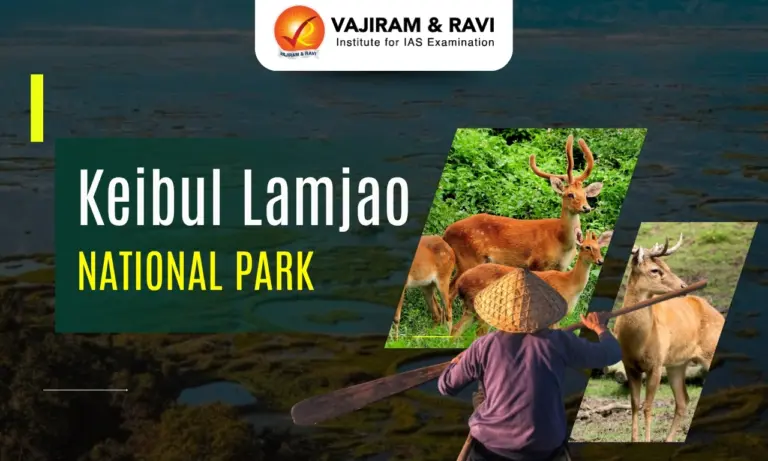
Keibul Lamjao National Park is a unique and beautiful national park located in the state of Manipur in Northeast India. It is widely known for being the only floating national park in the world, as it is made up of floating masses of vegetation called phumdis on Loktak Lake. The park is especially famous for being the natural home of the endangered Sangai deer, which is also known as the “dancing deer.” With its mix of water, greenery, and wildlife, the park offers a rare example of how nature can adapt in unusual ways.
What is Keibul Lamjao National Park?
- Keibul Lamjao National Park is a very unique and ecologically significant national park located in Manipur, and it is globally famous for being the only floating national park in the world. Unlike typical forests, this park is built on floating land masses, which makes it extremely rare and scientifically important.
- The park spreads over an area of about 40 square kilometers and is mainly composed of floating vegetation known as phumdis, which support a wide range of plant and animal life.
- It is especially important because it is the last natural habitat of the endangered Sangai deer, also known as the dancing deer of Manipur, making it a key site for wildlife conservation in India.
Where is Keibul Lamjao National Park Located?
- The park is located in the Bishnupur district of Manipur, in the southwestern part of Loktak Lake, which is the largest freshwater lake in Northeast India.
- Being situated on a lake, the park forms a unique wetland ecosystem, where land and water are closely connected and constantly interacting with each other.
- Its location makes it an important part of the Loktak Lake ecosystem, which supports both biodiversity and the livelihoods of local communities.


Why is Keibul Lamjao National Park Unique?
- The most special feature of the park is that it is the world’s only floating national park, formed by thick floating masses of vegetation called phumdis, which act like natural floating islands.
- These phumdis are strong enough to support animals, including the Sangai deer, which moves gracefully across them, giving it the name “dancing deer.”
- The park is also unique because it combines wetland, terrestrial, and aquatic ecosystems, creating a highly diverse and dynamic environment.
- Its rare ecosystem and limited habitat make it one of the most sensitive and important conservation areas in India.
What is the Historical Background of the Park?
- In the early 1950s, the Sangai deer was believed to be extinct, which raised serious concerns among conservationists and authorities.
- However, it was later rediscovered in Manipur, which became a turning point for wildlife conservation in the region.
- To protect the species, the area around Loktak Lake was first declared a protected sanctuary in 1953, and further steps were taken to restrict hunting and human interference.
- Eventually, the area was officially declared a National Park in 1977, ensuring stronger legal protection and conservation efforts under the Wildlife Protection Act, 1972.
- Over the years, continuous conservation work has helped in increasing the population of Sangai deer, showing the success of protection measures.
What are Phumdis and Why are They Important?
- Phumdis are floating masses made up of vegetation, soil, and decomposed organic matter, and they form the foundation of the park’s ecosystem.
- These floating structures remain partly above water and partly submerged, creating a stable yet flexible habitat for plants and animals.
- Phumdis play a very important role in maintaining the ecological balance of Loktak Lake, as they help in nutrient cycling and water purification.
- They also provide food, shelter, and breeding grounds for many species, including the Sangai deer, making them essential for survival in this ecosystem.
What Type of Vegetation is Found in the Park?
- The vegetation in the park is a mix of aquatic plants, grasses, and semi-terrestrial species, adapted to waterlogged and floating conditions.
- Common plant species include Saccharum munja, Zizania latifolia (wild rice), Erianthus procerus, Cynodon dactylon, and Discorea bulbifera, which thrive in wet environments.
- The phumdis themselves are covered with dense vegetation, creating a green floating landscape across the lake.
- This vegetation not only supports wildlife but also helps in maintaining water quality and preventing soil erosion.
What Flora is Found in Keibul Lamjao National Park?
- The park is home to around 145 to 233 plant species, including grasses, herbs, aquatic plants, and shrubs.
- Important plant species such as Phragmites karka, Alpinia galanga, and Erianthus species contribute to the diversity of the ecosystem.
- Many of these plants are specially adapted to wetland conditions, allowing them to survive in floating or semi-submerged environments.
- The rich plant diversity supports the entire food chain, from herbivores to predators, making the ecosystem stable and productive.
What Animals are Found in the Park?
- The park supports around 22 species of mammals, including Sangai deer, hog deer, wild boar, otters, civet cats, jungle cats, and golden cats.
- It also has a variety of reptiles and amphibians, such as turtles, snakes (cobra, python, viper), and frogs.
- The park is especially rich in bird life, with over 150 species of birds, including many migratory birds that visit during winter months.
- In addition, the lake supports numerous fish species, making it an important area for both biodiversity and local fisheries.
What are the Key Facts about Sangai Deer?
- The Sangai deer (Rucervus eldii) is an endangered species found only in Keibul Lamjao National Park, making it extremely rare and valuable.
- It is known for its graceful movement on floating phumdis, which gives it the nickname “dancing deer.”
- The deer has long, curved antlers and a reddish-brown coat, which changes with seasons.
- It is protected under Schedule I of the Wildlife Protection Act, 1972, and is listed as Endangered by the IUCN, highlighting the need for strict conservation.
- It is also the state animal of Manipur and holds deep cultural and emotional significance for the local people.
What are the Key Facts about Loktak Lake?
- Loktak Lake is the largest freshwater lake in Northeast India, and it plays a central role in the park’s ecosystem.
- It is famous for its phumdis, which are not found in such abundance anywhere else in the world.
- The lake is important for the local economy, as it provides water for irrigation, drinking, fishing, and hydropower generation.
- It was declared a Ramsar Site in 1990 due to its international ecological importance and later included in the Montreux Record in 1993 due to environmental concerns.
- However, human activities have put pressure on the lake, making conservation efforts even more important.
Why is Keibul Lamjao National Park Important?
- The park is extremely important as it is the only natural habitat of the Sangai deer, making it critical for the species’ survival.
- It protects a rare floating ecosystem, which is highly sensitive and unique in the world.
- The park helps in maintaining biodiversity, water resources, and ecological balance in the region.
- It also has cultural importance, as the Sangai deer is closely linked to the traditions and identity of Manipur.
- Overall, it is a great example of how wetland ecosystems and wildlife conservation can work together, while also supporting local communities.

 Last updated on Oct, 2026
→ UPSC 2027 Notification will be released on 13 January 2027 at upsconline.nic.in.
→ Asian Games 2026 are being held in Aichi-Nagoya, Japan, from 19 September to 4 October.
→ Check Nobel Prize 2026 Winners List here.
→ Download PIB PRiSM Monthly Magazine 2026 here.
→ Check UPSC Monthly Current Affairs Magazine The Recitals here.
→ Check out the latest UPSC Syllabus here.
→ Download UPSC Model Answers for Mains 2026
→ UPSC Mains Question Paper 2026 is out now for Essay & GS Paper 1, 2, 3 & 4.
→ UPSC Calendar 2027 has been released.
→ Enroll in Vajiram & Ravi’s UPSC Mains Test Series 2027 for structured answer writing practice, expert evaluation, and exam-oriented feedback.
→ Join Vajiram & Ravi’s UPSC Mentorship Program 2027 for personalized guidance, strategy planning, and one-to-one support from experienced mentors.
→ Go through the UPSC Mains Previous Year Papers to enhance your preparation.
→ UPSC has released UPSC Toppers List 2025 with the Civil Services final result on its official website.
→ Also check Best UPSC Coaching in India
Keibul Lamjao National Park FAQs
Q1. What is Keibul Lamjao National Park famous for?+
Q2. Where is Keibul Lamjao National Park located?+
Q3. Why is Keibul Lamjao called a floating national park?+
Q4. What are phumdis and why are they important?+
Q5. Which animal is Keibul Lamjao National Park known for?+
Q6. When was Keibul Lamjao declared a national park?+
Q7. What type of ecosystem is found in Keibul Lamjao National Park?+
Tags: environment environment notes keibul lamjao national park