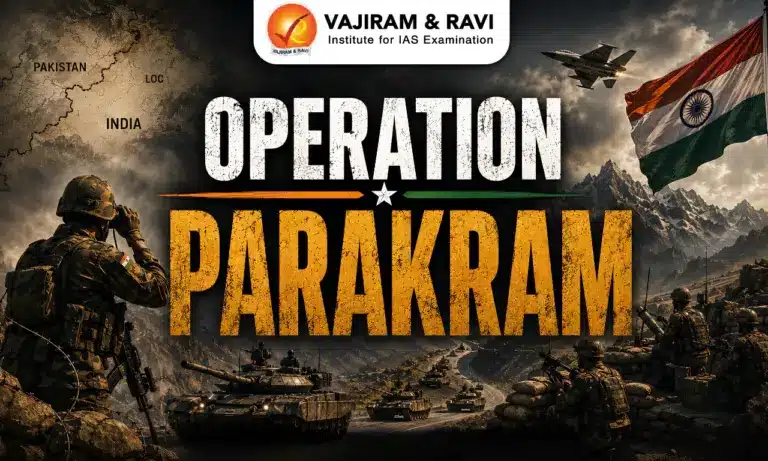
Operation Parakram was one of the largest military mobilizations undertaken by India after independence. Launched in December 2001 following the terrorist attack on the Indian Parliament, the operation aimed to demonstrate India’s military strength, deter cross-border terrorism, and exert diplomatic pressure on Pakistan. Although it did not result in a full-scale war, Operation Parakram had a lasting impact on India’s defence strategy, military preparedness, and national security policies.
Operation Parakram
Operation Parakram was a large-scale military mobilization launched by India on 18 December 2001 after the terrorist attack on the Indian Parliament. It involved the deployment of nearly 5 lakh troops along the India–Pakistan border to deter cross-border terrorism and strengthen national security. Although no full-scale war occurred, the operation significantly influenced India’s defence strategy, military preparedness, and security doctrine.
Operation Parakram Causes and Background
Operation Parakram was triggered by a series of terrorist incidents that significantly increased tensions between India and Pakistan.
- On 13 December 2001, terrorists attacked the Indian Parliament in New Delhi.
- Security forces successfully prevented the attackers from entering the Parliament building.
- India blamed Pakistan-based terrorist organizations Jaish-e-Mohammed (JeM) and Lashkar-e-Taiba (LeT) for the attack.
- India accused Pakistan of supporting cross-border terrorism.
- Diplomatic relations between the two countries deteriorated rapidly.
- The Indian government decided to undertake large-scale military mobilization to increase strategic pressure.
- International concerns grew over the possibility of a conventional war between two nuclear-armed nations.
- Continued infiltration across the Line of Control further intensified India’s security concerns.


Operation Parakram Events
Operation Parakram witnessed several important military and diplomatic developments throughout 2001-2002.
- 18 December 2001: India officially launched Operation Parakram.
- Massive deployment of Army formations, armoured divisions, artillery units, and air defence systems along the western border.
- The Indian Air Force maintained high operational readiness at forward air bases.
- The Indian Navy increased surveillance and strengthened maritime security in the Arabian Sea.
- Extensive troop movement took place towards Rajasthan, Punjab, Jammu and Kashmir, and Gujarat sectors.
- Border fencing, surveillance, and intelligence operations were intensified.
- Pakistan also mobilized its armed forces along the international border, resulting in a prolonged military standoff.
- Diplomatic efforts by the United States, United Kingdom, and other countries sought to reduce tensions.
- In May 2002, the Kaluchak terrorist attack further escalated tensions and reinforced India’s military posture.
- Despite repeated ceasefire violations and heightened alert, both countries avoided full-scale war.
- In October 2002, India gradually withdrew its forces, marking the end of Operation Parakram.
Operation Parakram Outcomes
Although Operation Parakram did not culminate in military conflict, it produced several strategic, diplomatic, and military outcomes.
- Demonstrated India’s ability to conduct large-scale military mobilization.
- Increased international diplomatic pressure on Pakistan to curb terrorist activities.
- Highlighted limitations in India’s slow mobilization process, as troop deployment required several weeks.
- Led to a comprehensive review of India’s military preparedness.
- Encouraged modernization of logistics, surveillance, intelligence, and communication systems.
- Contributed to the development of the Cold Start Doctrine, emphasizing rapid mobilization and swift, limited military operations.
- Strengthened coordination among the Army, Air Force, and Navy during joint operations.
- Exposed challenges such as high financial costs and logistical demands of prolonged deployment.
- Several casualties occurred due to landmine accidents, vehicle mishaps, and operational incidents during the deployment.
- Reinforced the importance of combining military preparedness with diplomatic engagement.
Operation Parakram Significance
Operation Parakram was a landmark military operation that strengthened India’s defence preparedness, strategic deterrence, and national security framework. It also influenced future military doctrines and defence reforms.
- Demonstrated India’s capability for large-scale military mobilization.
- Strengthened strategic deterrence against cross-border terrorism.
- Increased international diplomatic pressure on Pakistan to act against terrorist groups.
- Exposed delays in troop mobilization, leading to defence reforms.
- Contributed to the development of the Cold Start Doctrine for rapid military response.
- Enhanced joint operations among the Army, Air Force, and Navy.
- Accelerated modernization of military logistics, surveillance, and border infrastructure.
- Reinforced the importance of combining military preparedness with diplomatic efforts.
- Remains an important case study in national security, crisis management, and military strategy.

 Last updated on Oct, 2026
→ UPSC 2027 Notification will be released on 13 January 2027 at upsconline.nic.in.
→ Asian Games 2026 are being held in Aichi-Nagoya, Japan, from 19 September to 4 October.
→ Check Nobel Prize 2026 Winners List here.
→ Download PIB PRiSM Monthly Magazine 2026 here.
→ Check UPSC Monthly Current Affairs Magazine The Recitals here.
→ Check out the latest UPSC Syllabus here.
→ Download UPSC Model Answers for Mains 2026
→ UPSC Mains Question Paper 2026 is out now for Essay & GS Paper 1, 2, 3 & 4.
→ UPSC Calendar 2027 has been released.
→ Enroll in Vajiram & Ravi’s UPSC Mains Test Series 2027 for structured answer writing practice, expert evaluation, and exam-oriented feedback.
→ Join Vajiram & Ravi’s UPSC Mentorship Program 2027 for personalized guidance, strategy planning, and one-to-one support from experienced mentors.
→ Go through the UPSC Mains Previous Year Papers to enhance your preparation.
→ UPSC has released UPSC Toppers List 2025 with the Civil Services final result on its official website.
→ Also check Best UPSC Coaching in India
Operation Parakram FAQs
Q1. What was Operation Parakram?+
Q2. Why was Operation Parakram launched?+
Q3. When was Operation Parakram conducted?+
Q4. What triggered Operation Parakram?+
Q5. Did Operation Parakram lead to war?+
Tags: history history notes operation operation parakram