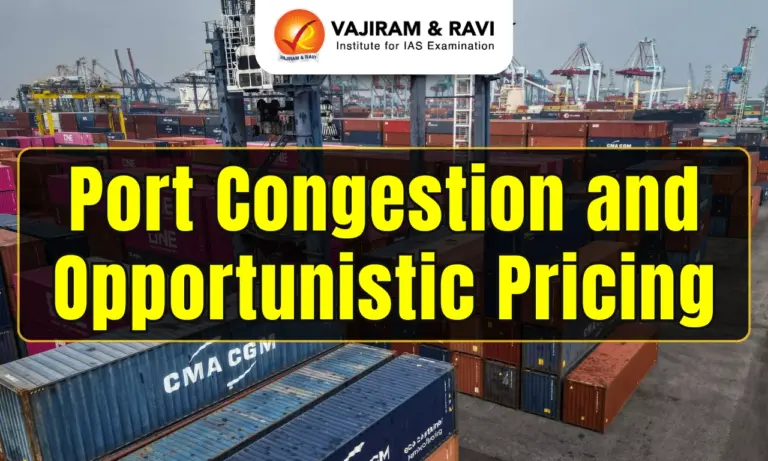
Port Congestion and Opportunistic Pricing Latest News
- The ongoing US-Iran conflict and near-closure of the Strait of Hormuz has created severe logistical disruption for Indian trade.
- India’s top export promotion body, the Federation of Indian Export Organisations (FIEO), has written to the ministries of Ports & Shipping and Commerce & Industry flagging two serious problems:
- opportunistic pricing by foreign shipping lines and non-transparent detention and
- demurrage charges by port authorities.
- The crisis has hit India’s western ports — JNPT, Kandla, and Mundra — particularly hard.
Understanding the Key Terms
- Detention charges – These are fees levied on exporters or importers when a shipping container is kept beyond the allowed free time outside the port — for example, at a factory or warehouse — before being returned to the shipping line.
- Demurrage charges – These are fees for keeping a container inside the port terminal beyond the permitted free period.
- War Risk Surcharge (WRS) is an additional freight charge levied by shipping lines when vessels pass through conflict zones — reflecting the higher insurance and operational risk.
- When these charges are applied non-transparently, inconsistently, or retroactively, they become a serious burden on exporters — especially during a crisis when they are already dealing with rising freight rates and port delays.


How the West Asia Crisis Triggered the Problem
- The chain of events is straightforward. The near-closure of the Strait of Hormuz — through which a large share of India’s trade with West Asia passes — disrupted shipping routes in March and April 2026.
- West Asia-bound containers that could not be delivered were diverted and temporarily stored at Indian western ports, primarily JNPT (Jawaharlal Nehru Port Trust).
- When the Iran-US ceasefire was announced in April 2026, these stranded shipments began flowing back into the system simultaneously.
- The sudden influx overwhelmed port capacity. JNPT, Kandla, and Mundra — which together form India’s biggest container gateway — became severely congested.
- Container evacuation slowed, backlogs piled up, and costs began rising sharply.
- As of June 6, 2026, Mundra Port congestion continues to persist, with the Central Warehousing Corporation (CWC) warning traders of delays in container evacuation, rail transit, and onward dispatch.
- CWC also noted that container loading is being done based on operational accessibility rather than the standard First-In-First-Out (FIFO) basis — adding unpredictability for exporters.
The Problem of Opportunistic Pricing
- The Directorate General of Shipping (DGS) had issued an advisory, asking all stakeholders to “refrain from predatory, non-transparent and opportunistic pricing practices, including levy of exorbitant charges.”
- However, FIEO’s letter to the government stated bluntly that this advisory is not being followed on the ground.
- Exporters continue to report:
- Unilateral and non-transparent imposition of detention and demurrage charges.
- War Risk Surcharge being applied inconsistently — with different shipping lines using different cut-off dates
- WRS being levied even on cargo already discharged before the conflict began
- Charges for basic port services like lift-on/lift-off having gone up several times
The Transparency Problem
- A particularly damaging issue is the format of invoices from foreign shipping lines.
- Many lines are merging WRS within the overall ocean freight rather than showing it as a separate line item.
- This prevents exporters from claiming relief under the government’s RELIEF support framework being implemented by ECGC (Export Credit Guarantee Corporation of India).
- FIEO has requested a uniform and transparent cut-off date for WRS applicability across all shipping lines, and standardised invoice formats that show WRS separately.
The Labour Shortage Problem
- Adding to port congestion is an acute shortage of trailer drivers at JNPT. This has seriously impeded the movement of import containers from terminals to Container Freight Stations (CFS).
- The Shipping Ministry confirmed there has been no strike, but acknowledged the driver shortage has caused delays.
What Exporters and Industry Are Demanding
- The industry’s demands are clear and practical. As per them, during a crisis, relief measures should be announced — not additional charges.
- Also, more storage space is needed so that cargo can be unloaded and moved without accumulating detention charges due to port-side delays that are beyond exporters’ control.
- A single point of contact comprising the Road, Shipping, Commerce, and Customs ministries is needed to coordinate crisis response.
- They called for making the entire port clearance system paperless to eliminate delays that compound during a crisis.
The Bigger Picture
- This crisis exposes a structural vulnerability in India’s export logistics — one that geopolitical disruptions can quickly turn into a financial crisis for exporters.
- India’s western ports are critically dependent on Gulf shipping routes. When those routes are disrupted, the entire export supply chain seizes up.
- There are no domestic shipping lines of sufficient scale to provide an alternative. Foreign shipping lines — which dominate India’s container trade — have little regulatory accountability during a crisis.
- The DGS advisory has no enforcement mechanism.
- The result is that Indian exporters — already facing high freight rates — also bear the cost of port congestion, arbitrary surcharges, and a system that has no single crisis management authority.
Source: IE

 Last updated on Oct, 2026
→ UPSC 2027 Notification will be released on 13 January 2027 at upsconline.nic.in.
→ Check Nobel Prize 2026 Winners List here.
→ Download PIB PRiSM Monthly Magazine 2026 here.
→ Check UPSC Monthly Current Affairs Magazine The Recitals here.
→ Check out the latest UPSC Syllabus here.
→ Download UPSC Model Answers for Mains 2026
→ UPSC Mains Question Paper 2026 is out now for Essay & GS Paper 1, 2, 3 & 4.
→ UPSC Calendar 2027 has been released.
→ Enroll in Vajiram & Ravi’s UPSC Mains Test Series 2027 for structured answer writing practice, expert evaluation, and exam-oriented feedback.
→ Join Vajiram & Ravi’s UPSC Mentorship Program 2027 for personalized guidance, strategy planning, and one-to-one support from experienced mentors.
→ Go through the UPSC Mains Previous Year Papers to enhance your preparation.
→ UPSC has released UPSC Toppers List 2025 with the Civil Services final result on its official website.
→ Also check Best UPSC Coaching in India
Port Congestion and Opportunistic Pricing FAQs
Q1. What is the significance of West Asia Crisis: Port Congestion and Opportunistic Pricing Hit Indian Exporters?+
Q2. How did the West Asia crisis affect Indian ports?+
Q3. What is meant by opportunistic pricing in this context? +
Q4. Why are exporters concerned about War Risk Surcharge (WRS)?+
Q5. What reforms are exporters demanding?+
Tags: mains articles Port Congestion and Opportunistic Pricing upsc current affairs upsc mains current affairs