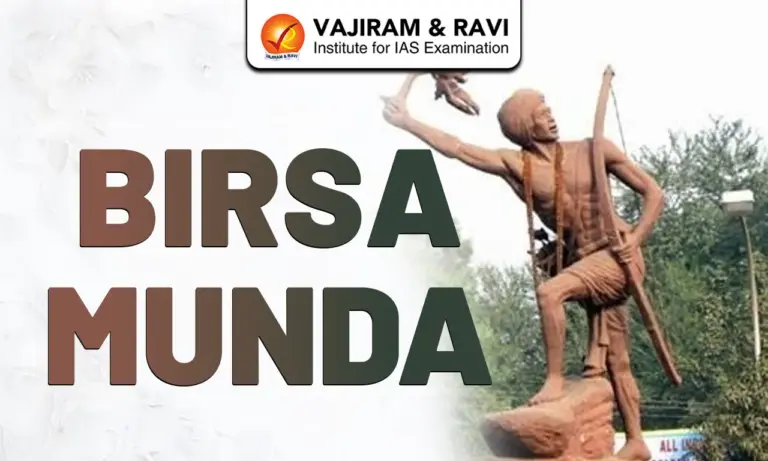
Birsa Munda Latest News
- On June 9, 2026 — the death anniversary of Birsa Munda — tribal organisations in Jharkhand took a public pledge to protect his legacy.
- This came in the backdrop of renewed demands for “delisting” of tribal converts to Christianity or Islam from the Scheduled Tribes (ST) list, most recently raised at a gathering attended by Union Home Minister.
- The controversy has reignited a fundamental question: what did Birsa Munda actually stand for?
Who Was Birsa Munda
- Birsa Munda was one of the most influential figures from the Chotanagpur plateau — the mineral-rich region spanning present-day Jharkhand and adjoining states.
- Revered as “Dharti Aba” (Father of the Earth), he led the Ulgulan (the “Great Tumult”) — a movement against colonial rule and diku (non-tribal outsider) zamindars who were encroaching upon Adivasi land and cultural life in the late 19th century.
- Historians described him as a religious reformer, social mobiliser, and political leader who transformed Munda tribal society.
- They contend that Birsa articulated a broader vision of Adivasi identity, autonomy, and self-rule (Adivasi disum), making him far more than just the leader of an agrarian uprising.


Early Life and Formative Influences
- Birsa was born on November 15, 1875, in Ulihatu village, present-day Khunti district of Jharkhand.
- His father, Sugna Munda, had embraced Christianity and was associated with the Sardari movement — an earlier Adivasi mobilisation against the erosion of traditional land rights and the growing influence of outsider landlords.
Colonial Disruption of Adivasi Land Systems
- Adivasi territories had been under pressure even before formal British rule.
- Colonial land policies, especially the Permanent Settlement of 1773, gave legal backing to revenue intermediaries (dikus) who displaced the traditional Khuntkatti system — the customary Munda practice of collective land ownership by the descendants of original forest-clearing settlers (Khuntkattidars).
- This led to a cascade of dispossession: growing indebtedness, forced labour, and the collapse of village self-governance.
- These grievances became the fertile ground for agrarian unrest across Chotanagpur.
Contact with Christian Education
- Birsa spent part of his early childhood at his uncle’s village before attending missionary schools in Chaibasa, where he was known by the Christian name “Daud” (or David).
- His association with missionary education later ended after a disagreement with church authorities over his remarks about the Munda community.
The Ulgulan: The Great Tumult
- Ulgulan (meaning “Great Tumult” or “Great Rebellion”) was the armed uprising led by Birsa Munda in the late 19th century against British colonial rule and diku (outsider) zamindars who were displacing Adivasi communities from their traditional lands.
Climax at Dombari Buru
- The Ulgulan reached its peak at Dombari Buru (a hill in Khunti) in January 1899, where thousands of Birsa’s followers gathered to assert land rights and challenge British authority.
- British forces surrounded the hill and fired on the crowd. Adivasi oral memory recalls this as a massacre that killed hundreds, though official colonial records estimate far fewer casualties.
Arrest and Death
- Birsa was arrested on February 3, 1900, in the forests of Porahat after months as a fugitive. He died in Ranchi Jail on June 9, 1900.
- Colonial records attributed his death to cholera and dysentery complications, but suspicions of poisoning have persisted in popular memory.
Legislative Outcome: CNT Act, 1908
- Though the uprising was militarily crushed, it compelled the colonial administration to act.
- The Chotanagpur Tenancy (CNT) Act, 1908 was enacted to legally recognise traditional land tenure systems like Khuntkatti and Bhuinhari, and to prevent transfer of Adivasi land to non-Adivasis.
- Missionary ethnographer Father J.B. Hoffmann is credited as one of its principal architects.
- Despite occasional misuse, the CNT Act remains one of the strongest legal protections against tribal land alienation in Jharkhand even today.
Religious Identity: The Birsait Faith
- After distancing himself from Christianity, Birsa came under the influence of Vaishnavism for a period. He was jailed in 1885 on charges of inciting people against the British, missionaries, and diku zamindars.
- After his release, he began preaching a distinct spiritual worldview centred on life, nature, and community.
- This evolved into the Birsait faith — a distinct religion separate from Sarnaism (traditional tribal faith), Christianity, and Hinduism.
- His followers revere him as a messiah, calling him “Bhagwan” and “Dharti Aba.”
Conclusion
- Historians note that the aspiration for Adivasi self-governance articulated during the Ulgulan was later channelled into the movement for a separate Jharkhand under Jaipal Singh Munda in the mid-20th century — a lineage that culminated in the creation of Jharkhand in 2000.
- Birsa Munda was not merely a rebel — he was a civilisational voice. His struggle reminds us that Adivasi identity is rooted in land, ancestry, and self-governance — not in religious labels imposed from outside.
Source: IE

 Last updated on Oct, 2026
→ UPSC 2027 Notification will be released on 13 January 2027 at upsconline.nic.in.
→ Check Nobel Prize 2026 Winners List here.
→ Download PIB PRiSM Monthly Magazine 2026 here.
→ Check UPSC Monthly Current Affairs Magazine The Recitals here.
→ Check out the latest UPSC Syllabus here.
→ Download UPSC Model Answers for Mains 2026
→ UPSC Mains Question Paper 2026 is out now for Essay & GS Paper 1, 2, 3 & 4.
→ UPSC Calendar 2027 has been released.
→ Enroll in Vajiram & Ravi’s UPSC Mains Test Series 2027 for structured answer writing practice, expert evaluation, and exam-oriented feedback.
→ Join Vajiram & Ravi’s UPSC Mentorship Program 2027 for personalized guidance, strategy planning, and one-to-one support from experienced mentors.
→ Go through the UPSC Mains Previous Year Papers to enhance your preparation.
→ UPSC has released UPSC Toppers List 2025 with the Civil Services final result on its official website.
→ Also check Best UPSC Coaching in India
Birsa Munda FAQs
Q1. Who was Birsa Munda?+
Q2. What was the Ulgulan movement?+
Q3. Why is Birsa Munda called Dharti Aba?+
Q4. What was the significance of the CNT Act, 1908?+
Q5. What is the Birsait faith?+
Tags: Birsa Munda mains articles upsc current affairs upsc mains current affairs