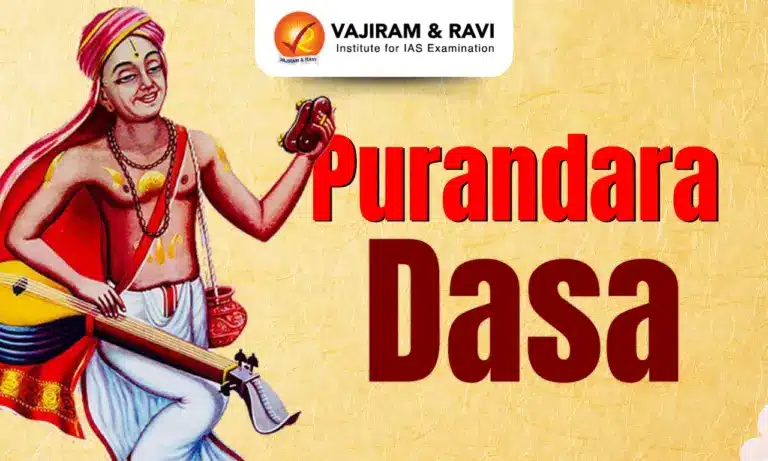
Purandara Dasa was a 16th-century saint-poet of Karnataka and a leading figure of the Haridasa movement under the Vijayanagara Empire. He is widely regarded as the “Pitamaha of Carnatic Music” because he systematised its pedagogy and transformed it into a structured, teachable discipline. At the same time, his compositions in Kannada played a crucial role in spreading Bhakti ideals among the masses, making him a key figure in both India’s musical and devotional traditions.
About Purandara Dasa
- Purandara Dasa was born as Srinivasa Nayaka, a wealthy merchant in a prosperous Vijayanagara society.
- His early life reflects the urban commercial culture of medieval South India before his spiritual transformation.
- He was initiated into the Haridasa tradition by Vyasatirtha, a prominent philosopher of the Dvaita Vedanta school.
- After initiation, he adopted the name Purandara Dasa and dedicated his life to devotion to Lord Vishnu (Vittala).
- He spent his final years in Hampi, which was a major cultural and religious centre of the Vijayanagara Empire.
About Haridasa Movement
- The Haridasa movement emerged from the Dvaita Vedanta philosophy of Madhvacharya, emphasizing dualism between God and soul.
- It aimed to popularise Bhakti through simple, accessible Kannada devotional literature known as Dasa Sahitya.
- The movement rejected excessive ritualism and Sanskrit exclusivity, promoting direct emotional devotion to God.
- Purandara Dasa, along with Sripadaraja and Kanakadasa, is considered part of the core trio that shaped the Haridasa tradition in Karnataka.
- The movement represented a broader democratisation of religion and spirituality in medieval India.


Purandara Dasa Contributions to Carnatic Music
Purandara Dasa’s most significant contribution lies in the systematisation of Carnatic music education, which continues to form its foundation today.
- He transformed Carnatic music from an informal oral tradition into a structured pedagogical system.
- He introduced graded exercises — Svaravalis and Alankaras — as the foundational curriculum for beginners in Carnatic music.
- He standardized Mayamalavagowla raga as the basic scale for early musical training, ensuring pedagogical uniformity.
- He composed simple Gitas to bridge the gap between basic exercises and advanced compositions.
- He laid the foundation of the systematic Carnatic music learning tradition that continues in modern practice.
- He used the signature “Purandara Vittala” in his compositions.
- His compositions are primarily in Kannada, making classical music accessible beyond Sanskrit literary circles.
- Tradition attributes nearly 4,75,000 compositions to him, of which about 1,000 survive today, forming the core of early Carnatic repertoire.
Social Reform and Bhakti Philosophy
Purandara Dasa’s works reflect a strong egalitarian and reformist spirit within the Bhakti tradition.
- He emphasized bhakti (devotion) over ritualistic practices, making spirituality more personal and emotional.
- By composing in Kannada, he ensured that religious and philosophical ideas reached ordinary people.
- He strongly opposed caste discrimination and social exclusion prevalent in medieval society.
- His teachings highlight that spiritual merit is independent of birth, wealth, or social status.
- He promoted values of humility, moral conduct, compassion, and surrender to God.
- His compositions reflect early ideas of spiritual democratization and social inclusivity in South India.
Purandara Dasa Association with Vijayanagara Empire
- Purandara Dasa lived during the golden age of the Vijayanagara Empire, which supported art, literature, and religion.
- The empire created a strong environment for Bhakti movement and devotional temple activities.
- He is believed to have been associated with the court of Krishnadevaraya, but he remained spiritually independent.
- His songs often gave messages on good governance, moral responsibility of rulers, and the temporary nature of power.
- The Vittala Temple in Hampi became an important centre for Haridasa music and devotional performances.
Literary and Cultural Contributions
- He is a key figure in the development of Dasa Sahitya (devotional literature in Kannada).
- His works include kirtanas, padams, suladis, and ugabhogas, blending poetry with music.
- His compositions are collectively referred to as “Purandaropanishat”, reflecting their philosophical depth.
- He played a major role in strengthening Kannada as a language of high literary and spiritual expression.
- His work helped bridge the gap between classical music, philosophy, and popular devotion.
Purandara Dasa Legacy and Significance
- He is universally acknowledged as the Pitamaha (Grandfather) of Carnatic Music.
- He is traditionally regarded as an incarnation of sage Narada, symbolizing divine association with music.
- His pedagogical framework became the foundation for later Carnatic composers, including the Carnatic Trinity—Tyagaraja, Muthuswami Dikshitar, and Syama Sastri.
- His influence continues through the annual Purandara Dasa Aradhana, celebrated across South India.
- His legacy represents the integration of devotion, music, and social reform in Indian culture.

 Last updated on Oct, 2026
→ UPSC 2027 Notification will be released on 13 January 2027 at upsconline.nic.in.
→ Check Nobel Prize 2026 Winners List here.
→ Download PIB PRiSM Monthly Magazine 2026 here.
→ Check UPSC Monthly Current Affairs Magazine The Recitals here.
→ Check out the latest UPSC Syllabus here.
→ Download UPSC Model Answers for Mains 2026
→ UPSC Mains Question Paper 2026 is out now for Essay & GS Paper 1, 2, 3 & 4.
→ UPSC Calendar 2027 has been released.
→ Enroll in Vajiram & Ravi’s UPSC Mains Test Series 2027 for structured answer writing practice, expert evaluation, and exam-oriented feedback.
→ Join Vajiram & Ravi’s UPSC Mentorship Program 2027 for personalized guidance, strategy planning, and one-to-one support from experienced mentors.
→ Go through the UPSC Mains Previous Year Papers to enhance your preparation.
→ UPSC has released UPSC Toppers List 2025 with the Civil Services final result on its official website.
→ Also check Best UPSC Coaching in India
Purandara Dasa FAQs
Q1. Who was Purandara Dasa?+
Q2. What is the significance of the Haridasa movement in which Purandara Dasa participated?+
Q3. What are the major contributions of Purandara Dasa to Carnatic music?+
Q4. How did Purandara Dasa contribute to social reform?+
Q5. What is Purandara Dasa’s legacy in Indian cultural history?+
Tags: purandara dasa