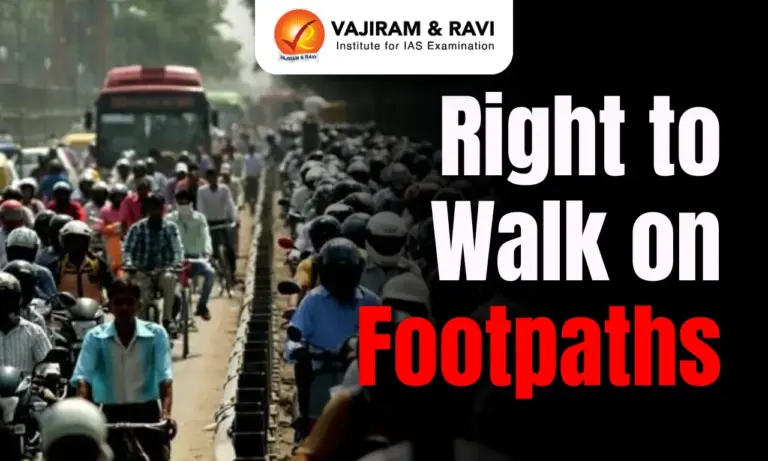
Right to Walk on Footpaths Latest News
- The Supreme Court of India, in its judgment in Maniyar Iliyaz @ Shaik Riyaz vs. P. Ayyappan, declared the right to walk on safe, demarcated footpaths as a fundamental right — one that takes priority over the movement of motor vehicles.
- The immediate trigger was the death of a 5-year-old boy, struck by a tanker while walking to school with his father. But the court used the occasion to address a much larger civilisational failure.
The Crisis on the Ground: Data That Demands Attention
- India’s pedestrian death figures are alarming.
- Between 2015 and 2024, while total road fatalities rose by 21.24%, pedestrian deaths surged by nearly 163% — from 13,894 in 2015 to 36,526 in 2024.
- Their share in total road deaths more than doubled, from 9.5% to 20.61%.
- Pedestrians now account for the second-highest share of road fatalities, after two-wheeler users.
- Deaths rose even during the Covid-19 pandemic years — a telling sign of structural failure.
- The cause is not just speed or recklessness. It is the systematic denial of pedestrian space.
- Footpaths across Indian cities are routinely encroached by two-wheelers, vendors, parked vehicles, and garbage. In many places, they simply do not exist.


What the Court Said: Beyond Accident Law
- The judgment makes a sharp conceptual break. It divorces the footpath from the narrow lens of motor accident law.
- A footpath is not merely a safety buffer to prevent accidents. It has an identity and purpose of its own.
- The court held that the right to walk is the most fundamental of human activities — predating motorised transport by millennia.
- Road infrastructure built overwhelmingly for vehicles has effectively pushed walkers to the margins, treating them, in the court’s words, as a “nuisance for drivers.”
- This, the court said, was elitism encoded in infrastructure. Motorised vehicles were once the preserve of the rich.
- As they became cheaper and widespread, the entire road design paradigm shifted to serve them — at the cost of the walker.
Constitutional and Legal Foundations
- Article 21 — Right to Life: The court grounded the right to walk in Article 21. A safe, unobstructed footpath is essential to the dignified exercise of the right to life and personal liberty.
- Article 39(b) — Directive Principle: Footpaths are material resources of the community. Article 39(b) mandates that such resources must be distributed to serve the common good — not monopolised by the motorised class. Urban land allocated for roads must balance the needs of both pedestrians and vehicle users.
- Tragedy of the Commons: The court invoked this concept from environmental law. Footpaths — like other shared public resources — degrade when they are encroached upon by many without accountability. Safe footpaths have become a scarce resource in Indian cities.
- Walking and Constitutional Freedoms: The court went further, linking walking to freedom of speech, peaceful protest, and the right to form associations. From Gandhi’s Dandi March to modern political rallies, walking has been a form of democratic expression in India.
The Problem with the Motor Vehicles Act, 1988
- The Motor Vehicles Act, 1988 is the primary legislation governing roads in India. The court was scathing in its assessment: the Act treats “vehicle” as its subject and human interests as incidental.
- Pedestrians appear in the law only as entities that drivers must avoid hitting — nothing more.
- The 2017 MoRTH regulations on driving do ask drivers to take precautions around vulnerable road users.
- But the court held that these are merely guiding principles — they do not recognise any fundamental right to walk, nor do they give pedestrians priority over vehicles.
- The Supreme Court noted that since 2012, it has been trying to squeeze pedestrian rights into the Motor Vehicles Act — with limited success.
Who Are the Duty-Bearers
- The court identified the primary duty-bearers for footpath protection as urban local bodies — urban development authorities, municipal corporations, municipalities, and panchayats.
- Footpaths are held in trust by these bodies for public benefit. Their failure to maintain, protect, and enforce footpath space is a constitutional failure, not merely an administrative lapse.
The Court’s Key Directions and Recommendations
- Statutory Law: The court was not satisfied with just declaring a right. It recommended that Parliament and State legislatures enact a dedicated statutory law — similar to the Right to Education Act — to give this fundamental right legal teeth on the ground.
- A Dedicated Regulator: The court called for establishing a full-time regulatory body to plan, enforce, and implement pedestrian rights. Such a body would embed expertise, ensure accountability, and provide a forum for aggrieved pedestrians — much like the National Commission for Protection of Child Rights does for children’s rights.
- On Compensation: In the original case, the Supreme Court reversed the High Court’s reduction of compensation and recalculated it upward to Rs. 11.44 lakh, to be paid within two months. It held that violation of the right to walk on demarcated footpaths entitles citizens to invoke constitutional and legal remedies beyond what the Motor Vehicles Act provides.
Conclusion
- This judgment marks a decisive reversal of the hierarchy on Indian roads. For decades, road design, urban planning, and legislation privileged the motorised user.
- The Supreme Court has now established that the pedestrian’s right is not subordinate — it takes priority.
- For municipal bodies and road agencies, maintaining safe, unobstructed footpaths is no longer a discretionary good practice. It is now a constitutional duty wherever a motorised road exists.

 Last updated on Oct, 2026
→ UPSC 2027 Notification will be released on 13 January 2027 at upsconline.nic.in.
→ Asian Games 2026 are being held in Aichi-Nagoya, Japan, from 19 September to 4 October.
→ Check Nobel Prize 2026 Winners List here.
→ Download PIB PRiSM Monthly Magazine 2026 here.
→ Check UPSC Monthly Current Affairs Magazine The Recitals here.
→ Check out the latest UPSC Syllabus here.
→ Download UPSC Model Answers for Mains 2026
→ UPSC Mains Question Paper 2026 is out now for Essay & GS Paper 1, 2, 3 & 4.
→ UPSC Calendar 2027 has been released.
→ Enroll in Vajiram & Ravi’s UPSC Mains Test Series 2027 for structured answer writing practice, expert evaluation, and exam-oriented feedback.
→ Join Vajiram & Ravi’s UPSC Mentorship Program 2027 for personalized guidance, strategy planning, and one-to-one support from experienced mentors.
→ Go through the UPSC Mains Previous Year Papers to enhance your preparation.
→ UPSC has released UPSC Toppers List 2025 with the Civil Services final result on its official website.
→ Also check Best UPSC Coaching in India
Right to Walk on Footpaths FAQs
Q1. Why did the Supreme Court recognise the Right to Walk on Footpaths?+
Q2. How is the Right to Walk on Footpaths linked to Article 21?+
Q3. What challenges affect the Right to Walk on Footpaths in India?+
Q4. Who is responsible for protecting the Right to Walk on Footpaths?+
Q5. What reforms did the Court recommend for the Right to Walk on Footpaths?+
Tags: mains articles Right to Walk on Footpaths upsc current affairs upsc mains current affairs