Indian Navy Triple Commissioning Latest News
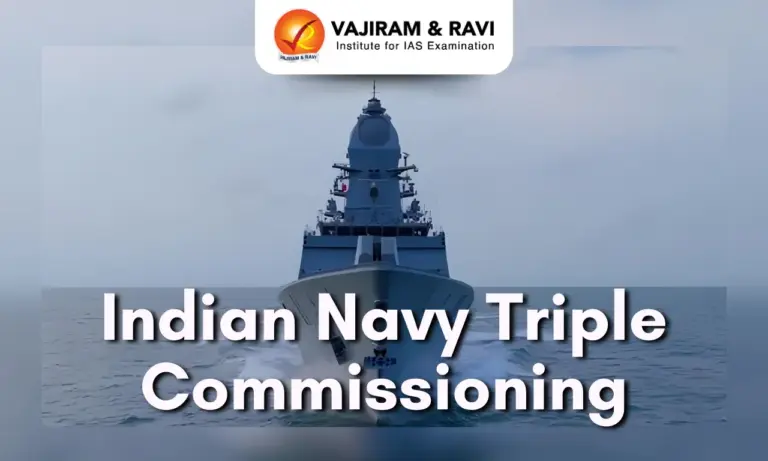
- The Indian Navy commissioned three indigenously built warships—INS Dunagiri, INS Sanshodhak, and INS Agray, in Kolkata.
- The significance of this “tri-commissioning” lies in the fact that each ship performs a distinct strategic role, collectively enhancing India’s blue-water capability, maritime domain awareness, and coastal security.
- More than 75% of the components are indigenous, reflecting the growing success of the Aatmanirbhar Bharat initiative in defence manufacturing.
The Three Ships at a Glance
INS Dunagiri — The Blue-Water Warrior
- Dunagiri is a stealth guided-missile frigate under Project 17A. It is the largest of the three (149 m, 6,670 tonnes).
- ‘Stealth’ here means reduced radar and sensor visibility — not complete invisibility.
- Key weapons and systems: BrahMos surface-to-surface missiles, Medium-Range Surface-to-Air Missile (MRSAM) system, MFSTAR radar, sonar, electronic warfare systems, and anti-submarine weapons.
- Its role is blue-water operations — fighting far out at sea against both conventional and non-conventional threats.
- Sister ships in Project 17A include INS Nigiri, Himgiri, Taragiri, Udaygiri, and Vindhyagiri.
INS Sanshodhak — The Eye Beneath the Sea
- Sanshodhak is a Survey Vessel — Large (SVL). Its job is to measure and map the sea: water depth, seabed features, navigational routes, port approach channels, and oceanographic data.
- It is equipped with autonomous underwater vehicles (AUVs), remotely operated vehicles (ROVs), and multi-beam echo sounders.
- It is the last ship of the Sandhayak-class SVLs (contract signed October 2018).
- The other three are INS Sandhayak (Feb 2024), INS Nirdeshak (Dec 2024), and INS Ikshak (Nov 2025).
- Why it matters: Submarines and warships don’t operate in empty water. Knowing the underwater terrain — depths, currents, seabed clutter — is essential for safe navigation, submarine route planning, port management, disaster relief, and coastal development.
INS Agray — The Coastal Submarine-Hunter
- Agray is the smallest (77 m, 900 tonnes) but most specialised of the three. It is an Anti-Submarine Warfare Shallow Water Craft (ASW SWC) of the Arnala-class.
- Its weapons: lightweight torpedoes, indigenous anti-submarine rocket launchers, and sonar systems.
- Its role is to detect and destroy submarines in littoral waters — shallow coastal zones near ports, naval bases, and sea approaches.
- Coastal waters are especially tricky for sub-detection because fishing boats, merchant vessels, and seabed clutter create a noisy, cluttered acoustic environment. That is precisely where Agray operates.


Strategic Significance
- Layered Naval Capability
- The triple-commissioning is significant because it adds three distinct capabilities in one ceremony: blue-water strike power, maritime domain awareness, and coastal anti-submarine defence.
- This reflects a layered approach to naval capability-building.
- Geopolitical Context
- The Indian Ocean is increasingly contested. China and Pakistan are expanding their naval presence.
- India’s maritime responsibilities now span the Arabian Sea, Bay of Bengal, island territories (Andaman & Nicobar, Lakshadweep), and the broader Indo-Pacific.
- The Navy is therefore developing capabilities at multiple layers:
- Deep-sea combat platforms.
- Maritime surveillance assets.
- Coastal defence systems.
- Atmanirbhar Bharat in Defence
- All three ships were built domestically by GRSE, Kolkata.
- Three technologically distinct vessels — a stealth frigate, a survey ship, and an ASW craft — being built and commissioned together signals the maturing of India’s naval shipbuilding ecosystem.
- The involvement of 200+ MSMEs underlines the depth of the domestic defence-industrial base.
Conclusion
- The simultaneous induction of INS Dunagiri, INS Sanshodhak, and INS Agray marks a significant milestone in India’s naval modernisation.
- Together, they strengthen combat capability, maritime awareness, and coastal defence while showcasing the growing maturity of India’s indigenous defence manufacturing ecosystem.

 Last updated on Oct, 2026
→ UPSC 2027 Notification will be released on 13 January 2027 at upsconline.nic.in.
→ Asian Games 2026 are being held in Aichi-Nagoya, Japan, from 19 September to 4 October.
→ Check Nobel Prize 2026 Winners List here.
→ Download PIB PRiSM Monthly Magazine 2026 here.
→ Check UPSC Monthly Current Affairs Magazine The Recitals here.
→ Check out the latest UPSC Syllabus here.
→ Download UPSC Model Answers for Mains 2026
→ UPSC Mains Question Paper 2026 is out now for Essay & GS Paper 1, 2, 3 & 4.
→ UPSC Calendar 2027 has been released.
→ Enroll in Vajiram & Ravi’s UPSC Mains Test Series 2027 for structured answer writing practice, expert evaluation, and exam-oriented feedback.
→ Join Vajiram & Ravi’s UPSC Mentorship Program 2027 for personalized guidance, strategy planning, and one-to-one support from experienced mentors.
→ Go through the UPSC Mains Previous Year Papers to enhance your preparation.
→ UPSC has released UPSC Toppers List 2025 with the Civil Services final result on its official website.
→ Also check Best UPSC Coaching in India
Indian Navy Triple Commissioning FAQs
Q1. Why is the Indian Navy Triple Commissioning considered significant?+
Q2. What role does INS Dunagiri play in the Indian Navy Triple Commissioning?+
Q3. How does INS Sanshodhak contribute to the Indian Navy Triple Commissioning?+
Q4. What is the strategic importance of INS Agray in the Indian Navy Triple Commissioning? +
Q5. How does the Indian Navy Triple Commissioning support Aatmanirbhar Bharat?+
Tags: Indian Navy Triple Commissioning mains articles upsc current affairs upsc mains current affairs