Crude Language and the Law Latest News
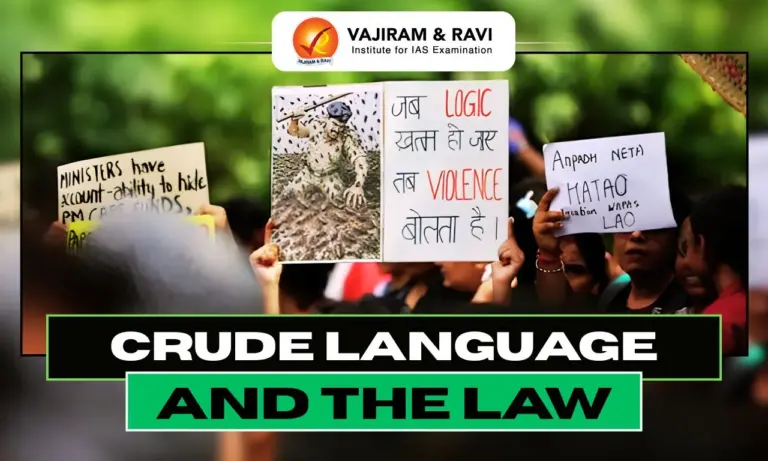
- Recently, Noida Police registered a Zero FIR against 25-year-old Ruchika Singh over remarks she allegedly made against PM Modi during a protest at Delhi’s Jantar Mantar on July 23.
- The case, filed on a complaint by a Supreme Court advocate, has reignited debate on whether crude language against public figures constitutes a crime in India — and the legal answer is narrower than public sentiment suggests.
The Case: Key Facts
- The Zero FIR was filed at Expressway police station, Noida, on a complaint by advocate Smriti Singh, who found the language in a video of the incident objectionable.
- Zero FIR: An FIR that can be filed at any police station regardless of jurisdiction, later transferred to the station with actual jurisdiction.
- It invokes Sections 352, 353(1), and 356(1) of the Bharatiya Nyaya Sanhita (BNS) — covering intentional insult, public mischief, and defamation respectively.
- Since the alleged incident occurred in Delhi, the case has been transferred to Delhi Police for investigation.


Obscenity as a Legal Concept: How the Test Evolved
- The commonly invoked provision in such disputes — Section 296, BNS (Section 294 of the Indian Penal Code, or IPC) — punishes obscene acts or words in public “to the annoyance of others” with up to three months’ jail.
- Notably, this section was not invoked in the Noida case.
- 1965 — Ranjit D. Udeshi v State of Maharashtra: The SC banned Lady Chatterley’s Lover, adopting the Hicklin test (1868, English origin) — whether isolated passages could corrupt the “most vulnerable reader.”
- 2006 — Doordarshan v Anand Patwardhan: SC cleared the broadcast of a censored documentary, ruling obscenity must be judged by viewing a work as a whole, through an average viewer’s eyes.
- 2014 — Aveek Sarkar v State of West Bengal: SC discarded the Hicklin test entirely, adopting a “community standards” test (drawn from the US case Roth v United States, 1957) — material is obscene only if it tends to arouse sexual/lustful feelings by contemporary community standards.
Criticism of 2014 Judgement
- Legal scholars contend that the original American test (Roth case) had three parts.
- For something to be called “obscene” in the US, it had to fail all three checks:
- It goes against community standards;
- It’s clearly and obviously offensive (not just borderline);
- It has no redeeming value — no artistic, literary, scientific, or social worth at all.
- However, SC borrowed only the first part — “community standards” — and left out the other two safety checks.
- By dropping the other two parts, India’s test became much looser and easier to misuse.
- Something could now be called obscene just because it seems to go against “community standards” — even if it has genuine artistic or social value, and even if it’s not blatantly offensive.
Profanity Is Not Obscenity: Recent Rulings
- The Supreme Court has repeatedly clarified that vulgar or abusive language, however distasteful, does not automatically amount to obscenity:
- 2024 — College Romance case: SC quashed an IT Act case against the web series, holding that swear words reflect emotions like anger or frustration, not sexual intent.
- April 2026 — Sivakumar v State: SC acquitted a man for calling someone “bastard” during an argument, holding it insufficient to constitute obscenity.
- July 2026 — Mani v State: SC reiterated, “obscenity is not synonymous with vulgarity, abuse or profanity.”
- Legal test: For speech to be obscene, it must be shown to be lascivious (expressing inappropriate sexual desire). Mere insult or vulgarity falls short of this threshold.
Why the Noida Case Involves a Different, Higher Bar
- The sections invoked against Ruchika Singh are unrelated to obscenity and each carry a stricter test:
- Section 352 (Insult): Requires proof the accused intended, or knew it was likely, that the insult would provoke an actual breach of public peace — not merely that someone felt offended.
- Section 353(1) (Public Mischief): Aimed at incitement — such as mutiny, enmity between communities, or offences against the state — a considerably higher threshold than criticism of a leader.
- Section 356(1) (Defamation): Carries long-standing exceptions for good-faith comment on a public figure’s conduct in their public role.
Conclusion
- Indian courts have consistently narrowed the scope of “obscenity” from the archaic Hicklin test to a contemporary community-standards approach, while clarifying that mere vulgarity or insult does not meet this threshold.
- In the Noida case, the actual charges — insult, public mischief, and defamation — demand proof of intent to breach public peace or incite unrest, not just offensive language, placing the burden on investigators and courts to distinguish sharp political criticism from genuine criminal conduct.

 Last updated on Oct, 2026
→ UPSC 2027 Notification will be released on 13 January 2027 at upsconline.nic.in.
→ Asian Games 2026 are being held in Aichi-Nagoya, Japan, from 19 September to 4 October.
→ Check Nobel Prize 2026 Winners List here.
→ Download PIB PRiSM Monthly Magazine 2026 here.
→ Check UPSC Monthly Current Affairs Magazine The Recitals here.
→ Check out the latest UPSC Syllabus here.
→ Download UPSC Model Answers for Mains 2026
→ UPSC Mains Question Paper 2026 is out now for Essay & GS Paper 1, 2, 3 & 4.
→ UPSC Calendar 2027 has been released.
→ Enroll in Vajiram & Ravi’s UPSC Mains Test Series 2027 for structured answer writing practice, expert evaluation, and exam-oriented feedback.
→ Join Vajiram & Ravi’s UPSC Mentorship Program 2027 for personalized guidance, strategy planning, and one-to-one support from experienced mentors.
→ Go through the UPSC Mains Previous Year Papers to enhance your preparation.
→ UPSC has released UPSC Toppers List 2025 with the Civil Services final result on its official website.
→ Also check Best UPSC Coaching in India
Crude Language and the Law FAQs
Q1. What does Crude Language and the Law explain about the Noida FIR?+
Q2. How has the Supreme Court shaped Crude Language and the Law on obscenity?+
Q3. Why does Crude Language and the Law distinguish profanity from obscenity?+
Q4. Which legal provisions are discussed in Crude Language and the Law?+
Q5. Why is Crude Language and the Law important for understanding free speech?+
Tags: Crude Language and the Law mains articles upsc current affairs upsc mains current affairs