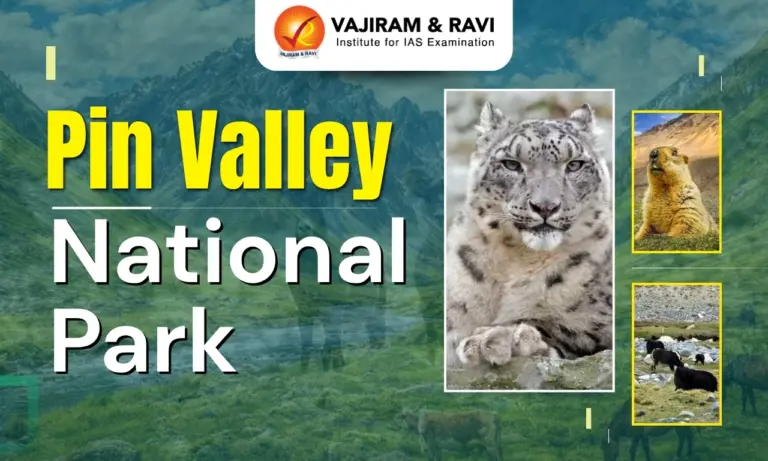
Pin Valley National Park is a protected natural area located in the cold desert region of northern India. It is known for its scenic landscapes, rugged mountains, and unique ecosystem. The park has a harsh climate but supports a variety of specially adapted plants and animals. It plays an important role in biodiversity conservation and preserving the high-altitude Himalayan environment.
Pin Valley National Park Location
- Pin Valley National Park is located in the Lahaul and Spiti district of Himachal Pradesh, in the cold desert region of the Spiti Valley, which is known for its harsh yet beautiful environment.
- The park is surrounded by major mountain ranges like the Pir Panjal Range and Parvati Range, giving it a dramatic landscape of snow-covered peaks, glaciers, and rocky cliffs.
- It is part of the Cold Desert Biosphere Reserve, making it ecologically very important, and it is also the only national park in Himachal Pradesh located in a cold desert region.
- The park lies at a very high altitude, ranging from about 3,500 metres to over 6,000 metres, which creates extreme climatic conditions and unique biodiversity.
- These mountain ranges act as natural barriers, influencing climate and restricting the movement of species.
- They also create rain-shadow conditions, which is why the region remains dry and forms a cold desert.
- Snow accumulation in these mountains feeds glaciers and rivers in the park.
- It forms an important part of the Trans-Himalayan region, which is very different from the greener Himalayan landscapes.
Pin Valley National Park History and Cultural Significance
- The Pin Valley has been inhabited for centuries by the indigenous Spitian people, who follow Tibetan Buddhist culture and have a deep connection with nature.
- The region is culturally rich, with several ancient monasteries (gompas) and temples that act as important centers of spirituality and tradition.
- One of the well-known monasteries is located in Kungri village, where traditional dances like Cham and Buchen are performed by monks.
- The area was declared a National Park in 1987 to protect its fragile ecosystem and endangered wildlife, especially the snow leopard.
- Over time, the park has gained importance not only for conservation but also for eco-tourism and cultural tourism.
- Local traditions and religious beliefs often promote respect for nature and wildlife, which indirectly supports conservation.
- Festivals and rituals in the region reflect the strong link between culture and environment.
- Monasteries in and around the park also serve as centers for learning, meditation, and preservation of ancient knowledge.


Pin Valley National Park Area and Landscape Features
- Pin Valley National Park covers a core area of about 675 sq. km and a buffer zone of around 1150 sq. km, making it a large protected region.
- The landscape includes alpine meadows, barren cliffs, glaciers, river valleys, and dry slopes, which together create a unique cold desert ecosystem.
- The terrain is rugged and dry, with very little vegetation compared to other Himalayan regions due to low rainfall.
- The park is influenced by glacial activity and extreme weather, which shape its landforms and ecological conditions.
- Despite its harsh environment, the park supports life that is specially adapted to survive in low oxygen and extreme cold conditions.
- Many areas in the park remain snow-covered for most of the year, limiting human access and preserving natural habitats.
- The presence of glaciers and snowfields plays a key role in water supply to downstream regions.
- The dry landscape also reduces soil fertility, making plant growth slow and limited.
Pin Valley National Park River System
- The park is named after the Pin River, which flows through the valley and is a major source of water in this dry region.
- The Pin River is a tributary of the Spiti River, which eventually joins the Sutlej River, forming an important river system.
- Originating from high-altitude glaciers near the Pin-Parvati Pass, the river flows through narrow valleys and supports both wildlife and local communities.
- In such a cold desert environment, this river plays a crucial role in maintaining life and vegetation.
- The river also supports agriculture in nearby villages, where water is scarce.
- Seasonal variations in river flow affect both wildlife movement and human activities.
- Riverbanks often have slightly better vegetation compared to the surrounding dry areas.
Pin Valley National Park Human Settlements
- Around 17 villages are located near the park, with a small population of about 1600 people, mostly belonging to Scheduled Tribes.
- The people follow Buddhist traditions and depend on agriculture, livestock, and natural resources for their livelihood.
- There are also seasonal settlements (Dogharies) inside the park, used during summer for grazing and farming.
- The local communities have traditionally lived in harmony with nature, but increasing pressure on resources is becoming a concern.
- Livestock grazing is an important activity but can sometimes lead to pressure on vegetation and wildlife habitats.
- People depend on natural resources for fuel, fodder, and medicinal plants, which affects the ecosystem.
- Cultural practices often encourage sustainable use of resources, helping maintain ecological balance.
Pin Valley National Park Flora (Vegetation)
- The vegetation in the park is specially adapted to cold and dry conditions, consisting mainly of alpine and tundra vegetation.
- Alpine meadows (bugyals) are found during summer, filled with grasses and colorful flowers like asters, gentians, and primroses.
- Trees like juniper, willow, poplar, and birch grow in limited areas, especially near water sources.
- At higher altitudes, vegetation becomes sparse, with mosses, lichens, and dwarf shrubs dominating the landscape.
- The region is also rich in medicinal plants, which are used by local people for traditional healing practices.
- Vegetation growth is slow due to low temperatures and short growing seasons.
- Overgrazing by livestock can reduce plant diversity and affect ecological balance.
- Certain plant species are adapted to conserve water and survive in extreme dryness.
Pin Valley National Park Fauna (Wildlife Diversity)
- Pin Valley National Park is home to several rare and endangered animals, with the snow leopard being the most important and top predator.
- Other mammals include Siberian ibex, Bharal (blue sheep), red fox, weasel, and marten, all adapted to mountainous terrain.
- The park is especially important as it supports one of the remaining populations of Bharal in India, which is a key prey species for snow leopards.
- Bird species such as golden eagle, snow cock, bearded vulture, chukor, and Himalayan chough are commonly found here.
- Reptiles like Himalayan pit viper and Tibetan sand boa are also present, though less visible due to cold conditions.
- Many animals here have thick fur, strong limbs, and camouflage abilities to survive harsh conditions.
- Wildlife sightings are rare but special due to the elusive nature of species like the snow leopard.
- The park is recognized as an important bird area, highlighting its role in avian conservation.
Pin Valley National Park Climatic Conditions
- The park experiences an extreme cold desert climate, with long winters and very short summers.
- Winters (November to March) are extremely harsh, with temperatures dropping to -40°C and heavy snowfall.
- Summers (July-August) are short and relatively mild, allowing vegetation to grow and animals to be more active.
- Due to heavy snow, the park remains inaccessible during winter months, and travel becomes difficult and risky.
- Rainfall is very low, and most precipitation occurs in the form of snow rather than rain.
- Strong winds and dry air make the climate even more challenging for both humans and wildlife.
- Seasonal migration of animals occurs depending on temperature and food availability.
Pin Valley National Park Ecological Significance
- Pin Valley National Park is a key area for conserving the Trans-Himalayan ecosystem, which is fragile and unique.
- It acts as a habitat for endangered species like the snow leopard, which is also a flagship species under conservation programs.
- The park is connected to other protected areas like the Great Himalayan National Park and Rupi-Bhaba Wildlife Sanctuary, forming a large conservation landscape.
- It supports both wildlife and local communities by providing water, grazing land, and medicinal plants.
- However, challenges like climate change, overgrazing, and human pressure are affecting the ecosystem, making conservation efforts very important.
- Conservation programs focus on protecting wildlife while supporting local livelihoods.
- Scientific research and monitoring help in understanding ecosystem changes and species behavior.
- Sustainable tourism can play a role in promoting awareness and conservation funding.

 Last updated on Oct, 2026
→ UPSC 2027 Notification will be released on 13 January 2027 at upsconline.nic.in.
→ Asian Games 2026 are being held in Aichi-Nagoya, Japan, from 19 September to 4 October.
→ Check Nobel Prize 2026 Winners List here.
→ Download PIB PRiSM Monthly Magazine 2026 here.
→ Check UPSC Monthly Current Affairs Magazine The Recitals here.
→ Check out the latest UPSC Syllabus here.
→ Download UPSC Model Answers for Mains 2026
→ UPSC Mains Question Paper 2026 is out now for Essay & GS Paper 1, 2, 3 & 4.
→ UPSC Calendar 2027 has been released.
→ Enroll in Vajiram & Ravi’s UPSC Mains Test Series 2027 for structured answer writing practice, expert evaluation, and exam-oriented feedback.
→ Join Vajiram & Ravi’s UPSC Mentorship Program 2027 for personalized guidance, strategy planning, and one-to-one support from experienced mentors.
→ Go through the UPSC Mains Previous Year Papers to enhance your preparation.
→ UPSC has released UPSC Toppers List 2025 with the Civil Services final result on its official website.
→ Also check Best UPSC Coaching in India
Pin Valley National Park FAQs
Q1. Where is Pin Valley National Park located?+
Q2. What is Pin Valley National Park famous for?+
Q3. Which animals are found in Pin Valley National Park?+
Q4. What type of vegetation is found in Pin Valley National Park?+
Q5. What is the climate of Pin Valley National Park?+
Tags: environment environment notes Pin Valley National Park