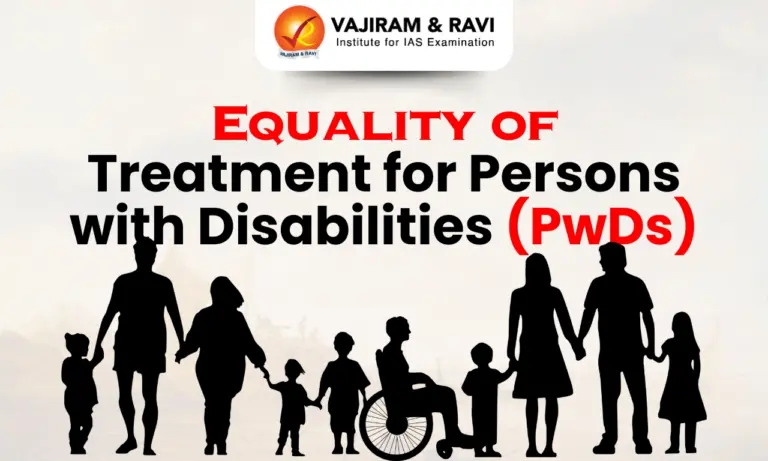
Despite India’s progress in building a digital welfare state through initiatives such as Digital India, DBT, Aadhaar and UPI, ensuring equality of treatment for Persons with Disabilities (PwDs) remains a major challenge. Fragmented disability pensions, regional disparities and limited social security continue to deny many PwDs equal access to welfare, highlighting the need for a rights-based, nationally uniform and inclusive social protection system.
About Persons with Disabilities (PwDs) in India
Persons with Disabilities (PwDs) are individuals with long-term physical, mental, intellectual or sensory impairments that limit their full and equal participation in society due to various social and physical barriers. India follows a rights-based approach to disability through the Rights of Persons with Disabilities (RPwD) Act, 2016, in line with the UN Convention on the Rights of Persons with Disabilities (UNCRPD).
Current Status of Persons with Disabilities in India
- According to the 2011 Census, India had 2.68 crore Persons with Disabilities, while current estimates place the figure between 4.5 crore and 6 crore owing to population growth and changing disease patterns.
- The Indira Gandhi National Disability Pension Scheme (IGNDPS) covers only a small proportion of eligible beneficiaries.
- Disability pensions vary widely across States, with most providing only ₹300-₹500 per month, while a few States provide between ₹1,000 and ₹3,000. Disability pensions are largely determined by State policies, domicile requirements and administrative procedures, resulting in significant regional disparities.
- India spends only 0.02% of GDP on disability welfare, far below countries such as South Africa (0.12-0.15%), Brazil (0.45-0.50%), Australia (0.35-0.40%), and the OECD average (2.2%).


Need of Equality of Treatment for Persons with Disabilities
Ensuring equal treatment for Persons with Disabilities is essential not only from a human rights perspective but also for inclusive economic development and constitutional governance.
- Constitutional Mandate: Upholds the principles of equality (Article 14), dignity and the right to life (Article 21), while Article 41 directs the State to provide public assistance to persons with disabilities.
- Rights-Based Social Security: Implements Section 24 of the RPwD Act, 2016, which guarantees adequate social security and pension benefits.
- Inclusive Growth: Ensures that economic development benefits all sections of society without discrimination.
- Economic Productivity: According to the World Bank and UNDP, exclusion of PwDs from education, employment and social security results in economic losses of 3-7% of GDP in low- and middle-income countries.
- Household Stability: Disability income improves household consumption, financial security and labour force participation.
- High Economic Returns: Studies estimate fiscal multipliers of 1.4–1.6, while the 2025 Pro Bono Economics Report found that the socio-economic returns from disability pensions exceed their costs by nearly 48%.
- Digital Inclusion: Complements India’s expanding digital welfare infrastructure by ensuring that technology translates into meaningful inclusion.
- International Commitments: Supports India’s obligations under the UNCRPD, ILO Recommendation No. 202, SDG Target 1.3, and the G20 New Delhi Leaders’ Declaration.
Minimum Universal Disability Pension Floor Rate (MUDPFR)
The Minimum Universal Disability Pension Floor Rate (MUDPFR) is a proposed national social security framework that seeks to guarantee a uniform minimum disability pension for all eligible Persons with Disabilities (PwDs), irrespective of their State of residence.
It aims to operationalise Article 41 of the Constitution and Section 24 of the Rights of Persons with Disabilities Act, 2016, by transforming disability pensions from a discretionary welfare measure into a rights-based entitlement while allowing States to provide additional top-up benefits.
Key Features
- Uniform National Pension: Guarantees a minimum disability pension for all eligible PwDs, irrespective of domicile or State policies.
- State Top-ups: Allows States to provide additional financial assistance above the nationally prescribed minimum.
- Rights-based Social Security: Shifts disability pensions from a welfare-based approach to a constitutional and legal entitlement.
- Uniformity and Portability: Ensures equal access and portability of benefits across the country.
- Digital Delivery: Utilises Direct Benefit Transfer (DBT), Aadhaar and UPI for transparent, efficient and timely pension disbursement.
Fiscal Feasibility
- Providing ₹8,000 per month to 40 lakh beneficiaries would cost about ₹38,400 crore annually (around 0.08% of GDP).
- Providing ₹10,000 per month to 65 lakh beneficiaries would cost around ₹78,000 crore annually.
- Even a pension of ₹15,000 per month would keep total expenditure below 0.2% of GDP, making it fiscally feasible compared to expenditure on food subsidies, rural development and infrastructure.
International Best Practices
Several countries have established nationally administered disability income support systems that ensure uniform benefits across regions.
- South Africa: National disability grants administered through the South African Social Security Agency (SASSA).
- Brazil: Benefício de Prestação Continuada (BPC) guarantees a nationally uniform minimum income.
- Australia: Nationwide disability support through the National Disability Insurance Agency (NDIA).
- New Zealand: Universal disability support programmes with national eligibility standards.
- Kenya, Rwanda, Thailand and Indonesia: National disability income support systems promoting portability and universal coverage.
Institutional Reforms Needed
Strengthening institutional mechanisms is essential to ensure a uniform, transparent and efficient disability pension system across the country.
- National Disability Pension Authority: Establish a dedicated authority to oversee implementation, monitoring and policy coordination.
- National Disability Registry: Develop a unified national database for accurate identification and timely delivery of benefits.
- Portability of Benefits: Enable beneficiaries to receive disability pensions seamlessly across States, irrespective of domicile.
- Digital Integration: Integrate disability pension delivery with digital platforms to ensure efficient, transparent and hassle-free service delivery.
- Grievance Redressal: Create robust and accessible mechanisms for timely resolution of beneficiary grievances.
- Performance Monitoring: Regularly monitor and evaluate State-wise implementation through transparent performance indicators.
- Inter-ministerial Coordination: Strengthen coordination between the Ministry of Rural Development and the Department of Empowerment of Persons with Disabilities to reduce duplication, delays and improve accountability.
Government Initiatives
India has undertaken several initiatives to promote the welfare and empowerment of Persons with Disabilities.
- Rights of Persons with Disabilities Act, 2016
- Indira Gandhi National Disability Pension Scheme (IGNDPS)
- Accessible India Campaign (Sugamya Bharat Abhiyan)
- Unique Disability ID (UDID) Project
- Deendayal Disabled Rehabilitation Scheme (DDRS)
- PM-DAKSH Scheme
- National Apprenticeship Promotion Scheme (NAPS)
- Skill India Mission
- Direct Benefit Transfer (DBT) enabled through Aadhaar and UPI
Challenges
Despite legal protections, several barriers continue to prevent full inclusion of Persons with Disabilities.
- Wide interstate disparities in pension eligibility and benefit amounts.
- Low public expenditure on disability welfare.
- Fragmented institutional framework resulting in duplication and delays.
- Limited pension coverage.
- Complex administrative procedures.
- Inadequate employment opportunities and workplace accessibility.
- Weak implementation of disability rights legislation.
- Poor physical and digital accessibility.
- Limited public awareness and persistent social stigma.
- Absence of a nationally uniform disability social security framework.
Way Forward
A rights-based, inclusive and technology-enabled approach is essential to ensure equality of treatment for Persons with Disabilities.
- Introduce a Minimum Universal Disability Pension Floor Rate (MUDPFR) applicable across India.
- Establish a National Disability Pension Authority for uniform implementation and monitoring.
- Increase public expenditure on disability welfare in line with international best practices.
- Strengthen DBT-enabled, portable and transparent pension delivery.
- Integrate disability pensions with employment, skill development and livelihood support.
- Improve accessibility in education, healthcare, transport, workplaces and digital services.
- Promote inclusive employment through incentives for employers.
- Strengthen implementation of the RPwD Act, 2016.
- Enhance Centre-State coordination for effective delivery of disability welfare programmes.
- Adopt a rights-based approach that recognises Persons with Disabilities as equal citizens rather than beneficiaries of charity.

 Last updated on Sep, 2026
→ UPSC 2027 Notification will be released on 13 January 2027 at upsconline.nic.in.
→ UPSC Mains Question Paper 2026 is out now for Essay & GS Paper 1, 2, 3 & 4.
→ UPSC Mains GS Paper 1 2026 is out now.
→ UPSC Mains GS Paper 2 2026 is out now.
→ UPSC Mains GS Paper 3 2026 is out now.
→ UPSC Mains GS Paper 4 2026 is out now.
→ UPSC Mains Indian Language Paper & English Compulsory Paper are out now.
→ Check out the latest UPSC Syllabus 2026 here.
→ UPSC Mains Admit Card 2026 is now out.
→ Enroll in Vajiram & Ravi’s UPSC Mains Test Series 2027 for structured answer writing practice, expert evaluation, and exam-oriented feedback.
→ Join Vajiram & Ravi’s UPSC Mentorship Program 2027 for personalized guidance, strategy planning, and one-to-one support from experienced mentors.
→ Go through the UPSC Mains Previous Year Papers to enhance your preparation.
→ Download UPSC Mains Essay Paper 2025, UPSC Mains GS Paper-I 2025, UPSC Mains GS Paper-II 2025, UPSC Mains GS Paper-III 2025, UPSC Mains GS Paper-IV 2025, UPSC Mains English (Compulsory) Paper 2025, UPSC Mains Hindi (Qualifying) Paper 2025 here.
→ UPSC has released UPSC Toppers List 2025 with the Civil Services final result on its official website.
→ UPSC Calendar 2027 has been released.
→ Also check Best UPSC Coaching in India
Equality of Treatment for Persons with Disabilities FAQs
Q1. Who are Persons with Disabilities (PwDs)?+
Q2. What is the constitutional basis for protecting the rights of Persons with Disabilities?+
Q3. Which legislation protects the rights of Persons with Disabilities in India?+
Q4. What are the major challenges faced by Persons with Disabilities in India?+
Q5. What measures can strengthen equality of treatment for Persons with Disabilities?+
Tags: equality of treatment for persons with disabilities