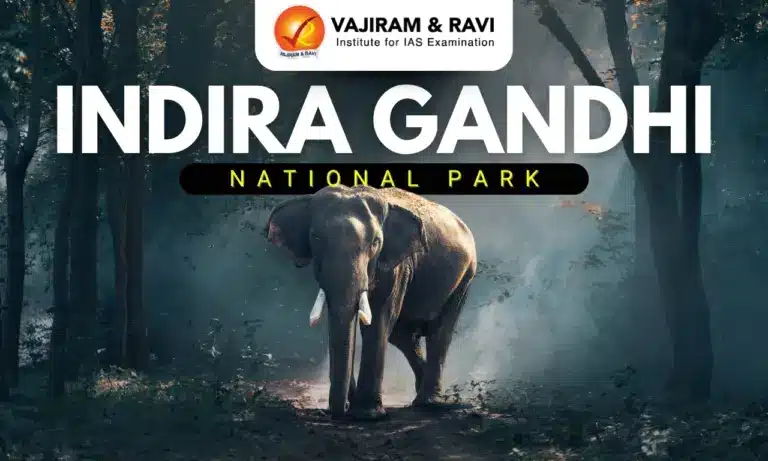
Indira Gandhi National Park is a well-known protected area located in the state of Tamil Nadu, India. Surrounded by hills, forests, and rich natural landscapes, it provides a safe habitat for a wide variety of plants and animals. The park is known for its diverse wildlife and scenic beauty, making it an important site for conservation and nature study. It attracts nature lovers, researchers, and tourists who come to experience its peaceful environment and explore its rich biodiversity.
Indira Gandhi National Park Location
- Indira Gandhi National Park is situated in the Coimbatore and Tiruppur districts of Tamil Nadu. Indira Gandhi National Park, also known as Anamalai National Park, is one of the most important protected areas in southern India.
- It is located in the Anamalai Hills of the Western Ghats in Tamil Nadu, a region famous for its exceptional biodiversity and scenic beauty.
- The park is located in the southern section of the Nilgiri Biosphere Reserve, making it an important link between several protected forests in Tamil Nadu, Kerala, and Karnataka.
- The park was renamed in honor of former Prime Minister Indira Gandhi for her efforts towards wildlife conservation and environmental protection. It is also a part of the Nilgiri Biosphere Reserve, which has been recognized by UNESCO as a World Heritage Site due to its rich ecological importance.
- The park plays a vital role in protecting endangered wildlife, especially the Bengal Tiger, while also conserving forests, rivers, and the unique ecosystem of the Western Ghats.
Also Read : Anamalai Tiger Reserve
Indira Gandhi National Park History
- The area was first declared as the Anamalai Wildlife Sanctuary in 1976 to conserve the rich biodiversity of the Western Ghats and protect its forests and wildlife.
- In 1987, the sanctuary was renamed Indira Gandhi Wildlife Sanctuary and National Park as a tribute to former Prime Minister Indira Gandhi, recognizing her commitment to nature conservation.
- In 2007, the protected area became part of Project Tiger, one of India’s major wildlife conservation programmes. This gave additional protection to the Bengal tiger and strengthened conservation efforts within the park.
- Today, the park is considered one of the most important tiger habitats in southern India and continues to play a key role in wildlife research, habitat conservation, and eco-tourism.


Indira Gandhi National Park Area
- Indira Gandhi National Park covers an area of about 958 square kilometres, making it one of the largest protected forests in Tamil Nadu.
- Out of the total area, around 387 square kilometres fall within Tiruppur district, while the remaining portion lies in Coimbatore district.
- The park contains a variety of landscapes, including dense evergreen forests, deciduous forests, rolling grasslands, rocky hills, valleys, rivers, and reservoirs. This diverse terrain supports a large number of plant and animal species.
- Since it forms part of the much larger Nilgiri Biosphere Reserve, the park contributes significantly to maintaining ecological balance in the Western Ghats.
Indira Gandhi National Park Hills
- The park is located in the Anamalai Hills, also known as the Elephant Hills, one of the major hill ranges of the Western Ghats.
- These hills extend along the border of Tamil Nadu and Kerala and are known for their breathtaking landscapes, dense forests, waterfalls, and rich wildlife.
- The rugged hills create different climatic conditions, allowing many rare and endemic species of plants and animals to survive.
- The nearby Anamudi Peak, standing at about 2,695 metres, is the highest peak in South India and adds to the geographical importance of the region.
Indira Gandhi National Park Rivers
- Several rivers and streams flow through or around the park, providing a continuous supply of water for wildlife and maintaining the health of the forest ecosystem.
- Aliyar River is one of the major rivers in the region. It originates in the Anamalai Hills and flows through the tiger reserve before reaching the picturesque Aliyar Dam, which also serves as an important water source.
- The Chinnar River, flowing through the nearby Chinnar Wildlife Sanctuary, supports diverse vegetation and provides water to many wild animals.
- The Thirumoorthy River flows through the Thirumoorthy Dam, creating a peaceful natural environment surrounded by forests and hills.
- Although located slightly outside the park, the Amaravathi River and Amaravathi Dam are ecologically important as they support nearby forests and wildlife habitats.
Indira Gandhi National Park Tribal Communities
- Several indigenous tribal communities have lived in and around the Anamalai Hills for generations. They possess valuable traditional knowledge about forests, medicinal plants, and wildlife.
- The Kadar tribe is well known for its deep understanding of forest resources and medicinal plants. Traditionally, they depended on hunting and gathering for their livelihood.
- The Malasar (Malai Malasar) community has a close relationship with the forests and is known for its traditional farming methods and knowledge of local biodiversity.
- Other important tribes living in the region include the Pulaiyar, Mudugar (Mudugars), and Eravalar (Eravallan) communities. They continue to preserve their unique customs, traditions, handicrafts, and sustainable ways of living.
- Today, many conservation programmes involve these tribal communities, recognizing their important role in protecting the forests and wildlife.
Indira Gandhi National Park Flora (Vegetation)
- Indira Gandhi National Park has an exceptionally rich variety of plant life because of its varied climate and altitude. It contains tropical evergreen forests, moist deciduous forests, grasslands, and shola forests.
- The evergreen forests are dense and receive heavy rainfall throughout the year. Important tree species found here include rosewood, ebony, teak, vengai, and magnolia.
- The moist deciduous forests contain species such as bamboo, Terminalia, Indian laurel, and banyan, which shed their leaves during the dry season.
- Open grasslands within the park provide grazing grounds for herbivores such as deer, gaur, and elephants, helping maintain the ecological balance.
- The park is also rich in medicinal plants, many of which have been traditionally used by local tribal communities for healthcare.
- Numerous species of orchids, ferns, mosses, and lichens grow throughout the forests, adding to the park’s botanical diversity.
Indira Gandhi National Park Fauna (Wildlife)
- Indira Gandhi National Park is one of the richest wildlife habitats in the Western Ghats and supports a remarkable diversity of mammals, birds, reptiles, amphibians, and insects.
- The park is especially famous for the Bengal Tiger, which is the flagship species of the reserve. Other important mammals include the Asian Elephant, Leopard, Sloth Bear, Wild Boar, Indian Pangolin, Sambar Deer, Spotted Deer, Mouse Deer, and Barking Deer.
- It is also home to several rare and endemic species such as the Lion-tailed Macaque, Nilgiri Langur, Nilgiri Tahr, Malabar Giant Squirrel, and Grizzled Giant Squirrel, which are found mainly in the Western Ghats.
- More than 250 species of birds have been recorded in the park. Some of the notable birds include the Malabar Pied Hornbill, Black Eagle, Paradise Flycatcher, Emerald Dove, Fairy Bluebird, Green Pigeon, and Racket-tailed Drongo.
- The park also supports many reptiles such as the King Cobra, Indian Rock Python, and Indian Monitor Lizard, along with numerous species of frogs, butterflies, and insects.
- Because of its rich biodiversity and healthy ecosystem, Indira Gandhi National Park is regarded as one of India’s most significant conservation areas and remains an important centre for wildlife protection, scientific research, and eco-tourism.
Significance of Indira Gandhi National Park
- Major Biodiversity Hotspot: The park is one of the richest biodiversity regions in India, located in the Western Ghats, and supports a wide variety of plants, animals, birds, reptiles, and insects, including many rare and endangered species
- Key Tiger and Elephant Habitat: It provides a safe habitat for Bengal tigers and Asian elephants, playing a vital role in maintaining their population and ensuring long-term survival
- Part of Nilgiri Biosphere Reserve: The park is an important part of the Nilgiri Biosphere Reserve, forming ecological connections with forests across Tamil Nadu, Kerala, and Karnataka for smooth wildlife movement
- Maintains Ecological Balance: Its forests help in climate regulation, soil conservation, and water protection, while rivers from the park support nearby villages and agriculture
- Home to Endemic Species: It protects unique and region-specific species like the Lion-tailed Macaque, Nilgiri Tahr, and Nilgiri Langur, preserving the natural heritage of the Western Ghats
- Centre for Research and Education: The park serves as a hub for scientific research and environmental studies, helping improve conservation strategies and ecological understanding
- Supports Eco-tourism and Livelihoods: Responsible eco-tourism creates awareness and provides employment opportunities for local communities through guiding and nature-based activities
Conservation Efforts
- Project Tiger Initiative: Indira Gandhi National Park was included under Project Tiger in 2007, which strengthened the protection of Bengal tigers through regular monitoring, habitat management, and anti-poaching efforts
- Strict Wildlife Protection: The Forest Department conducts regular patrols to prevent poaching, illegal logging, forest fires, and encroachment, using tools like camera traps and GPS-based monitoring systems
- Habitat Restoration: Efforts are made to restore degraded forest areas by planting native species, removing invasive plants, improving grasslands, and conserving water sources to support wildlife
- Wildlife Corridors Protection: The park is connected to nearby forests through wildlife corridors, allowing animals like elephants and tigers to move safely and maintain genetic diversity
- Community Participation: Local communities are involved in eco-development and conservation programmes, helping reduce pressure on forest resources while supporting sustainable livelihoods
- Research and Monitoring: Continuous scientific research and wildlife monitoring help track animal populations, forest health, and environmental changes for better management decisions
- Awareness and Education: Awareness programmes, nature camps, and educational activities are organized to promote environmental responsibility and conservation awareness
- Sustainable Eco-tourism: Tourism is regulated through controlled visitor access and managed safari routes, ensuring minimal disturbance to wildlife and natural habitats
- Conservation of Endemic Species: Special attention is given to protecting endemic and endangered species like the Lion-tailed Macaque, Nilgiri Tahr, and Nilgiri Langur
- Long-term Ecosystem Conservation: Focus is on protecting the entire ecosystem, including forests, rivers, and grasslands, to maintain ecological balance in the Western Ghats.

 Last updated on Oct, 2026
→ UPSC 2027 Notification will be released on 13 January 2027 at upsconline.nic.in.
→ Check Nobel Prize 2026 Winners List here.
→ Download PIB PRiSM Monthly Magazine 2026 here.
→ Check UPSC Monthly Current Affairs Magazine The Recitals here.
→ Check out the latest UPSC Syllabus here.
→ Download UPSC Model Answers for Mains 2026
→ UPSC Mains Question Paper 2026 is out now for Essay & GS Paper 1, 2, 3 & 4.
→ UPSC Calendar 2027 has been released.
→ Enroll in Vajiram & Ravi’s UPSC Mains Test Series 2027 for structured answer writing practice, expert evaluation, and exam-oriented feedback.
→ Join Vajiram & Ravi’s UPSC Mentorship Program 2027 for personalized guidance, strategy planning, and one-to-one support from experienced mentors.
→ Go through the UPSC Mains Previous Year Papers to enhance your preparation.
→ UPSC has released UPSC Toppers List 2025 with the Civil Services final result on its official website.
→ Also check Best UPSC Coaching in India
Indira Gandhi National Park FAQs
Q1. Where is Indira Gandhi National Park located?+
Q2. Why is Indira Gandhi National Park important?+
Q3. What is another name of Indira Gandhi National Park?+
Q4. What is the total area of Indira Gandhi National Park?+
Q5. When did Indira Gandhi National Park become part of Project Tiger?+
Q6. Which animals are found in Indira Gandhi National Park?+
Q7. What type of forests are found in the park?+
Q8. Why is Indira Gandhi National Park part of the Nilgiri Biosphere Reserve?+
Tags: environment environment notes indira gandhi national park