Char Kaman Restoration Latest News
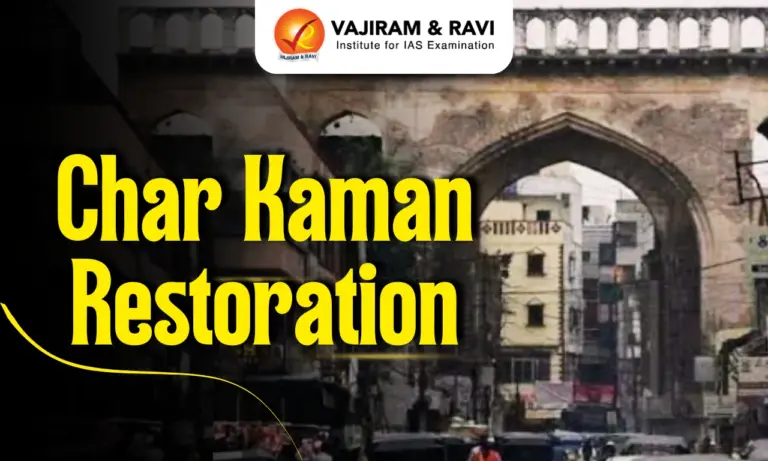
- The Telangana government has announced that the Char Kaman — four ornamental gateways near Hyderabad’s Charminar — will soon undergo restoration.
- The project has received a major boost, with administrative sanction granted to invite tenders and appoint a consultant for the work.
What Is the Char Kaman
- While Hyderabad’s Charminar is widely known as a symbol of the Qutb Shahi dynasty’s architectural legacy, fewer people are aware of the four ornamental gateways surrounding it, collectively called the Char Kaman.
- These arches once marked the entrances to the old city of Hyderabad.
- Basically, the Char Kaman public square enclosed by four large archways was built as a garden at the entry to the Qutb Shahi Palace complex to the north of the Charminar area with Dad Mahal inside the enclosure.
- The Char-Su-Ka-Houz (tank of four directions) or Gulzar Houz was the freshwater fountain in the centre of this square.
- The four Kamans are namely Kali Kaman to the east, Sher-e-Batil ki Kaman to the west, Machili Kaman to the north and Charminar Kaman to the south of Gulzar Houz.
- There are three floors on each end of the arch, originally constructed as chambers for royal guards.
Historical Background
- The Charminar was built between 1589 and 1591 by Muhammad Quli Qutb Shah, the fifth ruler of the Qutb Shahi dynasty.
- According to Hyderabad historian Mohammed Safiullah, the Char Kaman were likely constructed a few years later, around 1594.
- Historian Syed Ali Asghar Bilgrami, in his 1927 book Landmarks of Deccan, notes that after completing the Charminar, Shah commissioned these four surrounding arches.
Original Names and Their Meanings
- The four gateways originally had different names from what they’re known by today:
- West Arch — Daulat Khanae Ali: Meant “the gate of the royal residence.”
- East Arch — Naqqar Khana: Meant “gate of the palace where drums are beaten.”
- The central area enclosed by all four arches was called Jilau Khana, or the royal vestibule.


How the Present Names Came About
- North Arch — Machli Kaman (Fish Arch): This arch was tall enough for “a huge elephant with a canopied litter” to pass through. It got its name because a large bamboo-and-paper fish, resembling a miniature aeroplane, was suspended at its centre every lunar new year.
- South Arch — Charminar Kaman
- East Arch — Kali Kaman (or Kaman of Shambhoo Pershad): Meaning the “black arch.”
- West Arch — Kaman Sher Dil (or Sihr Batil): Meaning “gateway for the lion-hearted” or “magic breaker.”
- These names continue to be used in Hyderabad today. Historians also note that the Qutb Shahi palaces were originally located near the western arch, though these structures have since been lost to time.
Historical Role of the Gateways
- During the Qutb Shahi period, the Char Kaman witnessed heavy traffic and served an important administrative function.
- Nearby outhouses served as sitting areas for nobles and officials. Each morning, noblemen would arrive with their retinue and attendants.
- Upon reaching the royal vestibule at the centre of the four arches, they would leave their attendants behind and proceed alone for an audience with the king.
What Does the Restoration Plan Involve
- The restoration work will primarily focus on:
- Structural repairs
- Conservation of heritage features
- The broader goal is to improve the overall physical condition of the monuments while carefully preserving their historical character.
- Heritage conservationists have long advocated for this restoration, citing damage caused over the years by growing urbanisation and the resulting pollution in the area.

 Last updated on Sep, 2026
→ UPSC 2027 Notification will be released on 13 January 2027 at upsconline.nic.in.
→ Check out the latest UPSC Syllabus here.
→ Download UPSC Model Answers for Mains 2026
→ UPSC Mains Question Paper 2026 is out now for Essay & GS Paper 1, 2, 3 & 4.
→ UPSC Calendar 2027 has been released.
→ Enroll in Vajiram & Ravi’s UPSC Mains Test Series 2027 for structured answer writing practice, expert evaluation, and exam-oriented feedback.
→ Join Vajiram & Ravi’s UPSC Mentorship Program 2027 for personalized guidance, strategy planning, and one-to-one support from experienced mentors.
→ Go through the UPSC Mains Previous Year Papers to enhance your preparation.
→ UPSC has released UPSC Toppers List 2025 with the Civil Services final result on its official website.
→ Also check Best UPSC Coaching in India
Char Kaman Restoration FAQs
Q1. Why is the Char Kaman Restoration project significant?+
Q2. What are the four gateways covered under the Char Kaman Restoration?+
Q3. What historical role did the monuments play before the Char Kaman Restoration?+
Q4. What activities are planned under the Char Kaman Restoration project?+
Q5. Why is the Char Kaman Restoration important for heritage conservation?+
Tags: Char Kaman Restoration mains articles upsc current affairs upsc mains current affairs