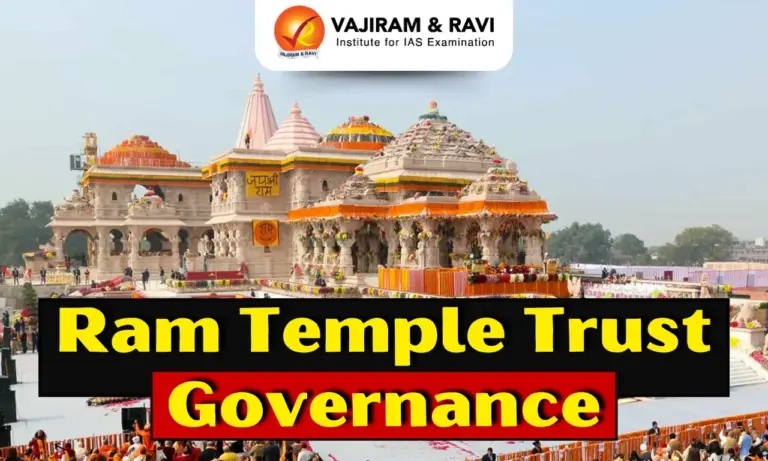
Ram Temple Trust Governance Latest News
- The Ram Temple Trust has accepted the resignations of its two most influential office-bearers — General Secretary Champat Rai and trustee Anil Mishra.
- Along with this, the Trust has announced it will appoint a Chief Executive Officer (CEO) for the first time.
- This marks the biggest administrative overhaul of the body since it was set up in 2020. The move comes in the wake of a donation-theft controversy that exposed serious gaps in the temple’s management system.
How Did the Trust Come Into Being
- The Shri Ram Janmabhoomi Teerth Kshetra Trust owes its existence to the Supreme Court’s November 2019 Ayodhya judgment.
- The Court had directed the government to formulate a scheme within three months to set up a trust and transfer the disputed land to it.
- The Central government constituted the Trust on February 5, 2020, and transferred the acquired land to it through a Gazette notification.
- Unlike major temples such as Tirupati, Jagannath, Vaishno Devi, or Kashi Vishwanath, the Ram Temple is not governed by a dedicated state legislation.
- Instead, its legal foundation rests on a combination of four things: the Supreme Court’s 2019 judgment, the 1993 Ayodhya Acquisition Act, the Central government’s scheme and notification, and the Trust’s own deed.
- This makes the Ram Temple Trust legally unique — it is neither a conventional private religious trust nor a statutory temple board created through legislation.
- Instead, it is a public religious trust brought into existence through executive action, in implementation of a judicial mandate.


Who Runs the Trust
- The Trust has 15 members and functions as the temple’s highest decision-making body. It is chaired by Mahant Nritya Gopal Das.
- However, due to his age and health issues, day-to-day leadership had gradually shifted to General Secretary Champat Rai, who became the institution’s public face.
- The Trust deed provides for a mix of permanent members, nominated members, and ex-officio representatives. This ensures representation from the religious community, as well as from the Central and Uttar Pradesh governments.
- Temple construction was supervised by a separate committee headed by Nripendra Mishra, former Principal Secretary to the Prime Minister, as an ex-officio member.
How Is the Ram Temple Different From Other Major Temples
- A useful comparison emerges when we look at how India’s other major temples are governed:
- This comparison shows a key structural gap: unlike these other temples, which are run by government-appointed executive officers under statutory frameworks, the Ram Temple has so far been managed directly by its trustees and office-bearers themselves.
How Was the Temple Managed Day-to-Day
- Unlike Tirupati or Vaishno Devi, the Ram Temple did not have a professional chief executive until now.
- Instead, administrative responsibilities were informally divided among individual office-bearers
- This “founder-led” model worked reasonably well during the temple’s construction phase.
- However, it came under severe strain once the temple became one of India’s busiest pilgrimage sites, receiving around one lakh devotees daily.
What Went Wrong: The Donation Controversy
- Investigations into a donation-theft case exposed serious governance weaknesses. Many temple staff had been engaged for daily work in an ad hoc manner, with appointment letters missing for several employees.
- Notably, six outsourced counting agents — officially hired by the State Bank of India for counting donations — had actually been recommended by Trust office-bearers themselves.
- While a Standard Operating Procedure (SOP) for temple operations had been drafted, its actual implementation was found lacking.
- Notably, a private internal audit conducted back in 2020 had already flagged the temple’s management as “highly unprofessional,” citing the absence of SOPs, systematic financial records, defined reporting hierarchies, HR processes, and maker-checker controls.
Why Appoint a CEO Now
- The decision to appoint a CEO represents the Trust’s biggest administrative restructuring since its formation.
- Under this new arrangement, the CEO will handle day-to-day administration, allowing the Trust and its members to focus primarily on policy decisions.
- This move brings the Ram Temple’s governance model closer to that of other major Indian temples — where professional executive officers or chief administrators handle operations, separate from the trustee body.
Why Does the Trust’s Rulebook Remain Largely Unknown
- Unlike most major Indian temple institutions, much of the Ram Temple Trust’s internal rulebook remains outside the public domain.
- While the Centre notified the Trust’s creation in February 2020, the detailed government scheme and Trust Deed under which it operates have never been made public.
- When an RTI applicant sought these documents, the Ministry of Home Affairs told the Central Information Commission (CIC) that they formed part of a “confidential file” due to the sensitivity of the matter.
- The CIC further ruled that the Trust does not qualify as a “public authority” under the RTI Act.
- This stands in sharp contrast to institutions like Tirupati, Jagannath, Vaishno Devi, and Kashi Vishwanath, whose governing Acts and administrative structures are all publicly available.

 Last updated on Oct, 2026
→ UPSC 2027 Notification will be released on 13 January 2027 at upsconline.nic.in.
→ Asian Games 2026 are being held in Aichi-Nagoya, Japan, from 19 September to 4 October.
→ Check Nobel Prize 2026 Winners List here.
→ Download PIB PRiSM Monthly Magazine 2026 here.
→ Check UPSC Monthly Current Affairs Magazine The Recitals here.
→ Check out the latest UPSC Syllabus here.
→ Download UPSC Model Answers for Mains 2026
→ UPSC Mains Question Paper 2026 is out now for Essay & GS Paper 1, 2, 3 & 4.
→ UPSC Calendar 2027 has been released.
→ Enroll in Vajiram & Ravi’s UPSC Mains Test Series 2027 for structured answer writing practice, expert evaluation, and exam-oriented feedback.
→ Join Vajiram & Ravi’s UPSC Mentorship Program 2027 for personalized guidance, strategy planning, and one-to-one support from experienced mentors.
→ Go through the UPSC Mains Previous Year Papers to enhance your preparation.
→ UPSC has released UPSC Toppers List 2025 with the Civil Services final result on its official website.
→ Also check Best UPSC Coaching in India
Ram Temple Trust Governance FAQs
Q1. Why is Ram Temple Trust Governance being restructured?+
Q2. How is Ram Temple Trust Governance different from other major temple administrations?+
Q3. What role will the CEO play in Ram Temple Trust Governance?+
Q4. Why has transparency become an issue in Ram Temple Trust Governance?+
Q5. What is the significance of the CEO appointment in Ram Temple Trust Governance?+
Tags: mains articles Ram Temple Trust Governance upsc current affairs upsc mains current affairs