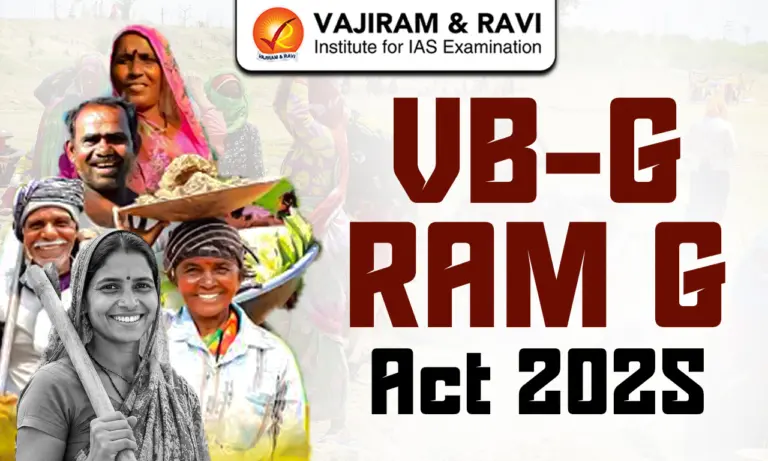
The VB-G RAM G Act, 2025 is a new rural employment guarantee law that replaces the Mahatma Gandhi National Rural Employment Guarantee Act (MGNREGA), 2005 after two decades. The Act aims to strengthen rural livelihoods, improve the quality of public assets, and introduce technology-driven implementation. Along with increasing the annual employment guarantee from 100 days to 125 days, the Act raises the minimum daily wage to ₹300, introduces a mandatory 60-day agricultural pause, and brings AI, GPS, and biometric-based monitoring into rural employment.
VB-G RAM G Act 2025 Objectives
The VB-G RAM G Act, 2025 aims to strengthen rural livelihoods by enhancing employment opportunities, supporting agriculture, and promoting sustainable rural development.
- To provide guaranteed wage employment to eligible rural households.
- To enhance livelihood security and reduce rural unemployment.
- To improve the income and financial stability of rural families.
- To support agricultural productivity by ensuring adequate labour availability during peak farming seasons.
- To create durable rural infrastructure and productive community assets.
- To promote sustainable management of natural resources, including water and forests.
- To strengthen climate resilience through environmentally sustainable public works.
- To ensure timely employment and protect workers’ rights.
- To increase transparency, accountability, and efficiency in programme implementation.
- To encourage inclusive and equitable rural development across the country.
VB-G RAM G Act 2025 Key Features
The VB-G RAM G Act, 2025 introduces several reforms to strengthen rural employment, improve transparency, and promote sustainable rural development through technology-driven implementation.
- 125 Days of Guaranteed Employment: Increases the statutory employment guarantee from 100 days to 125 days per rural household annually.
- Minimum Daily Wage of ₹300: Raises the base daily wage to ₹300, with average earnings around ₹327.
- 60-Day Agricultural Pause: Introduces a mandatory 60-day suspension of public works during peak sowing and harvesting seasons to ensure farm labour availability.
- AI-Based Work Planning: Uses Artificial Intelligence (AI) for efficient project planning and prioritisation.
- Real-Time GPS Monitoring: Tracks worksites through GPS-enabled monitoring to improve transparency and prevent irregularities.
- Mandatory eKYC and Biometric Authentication: Requires eKYC and biometric verification to ensure genuine beneficiary identification and reduce fraud.
- Unemployment Allowance: Makes it mandatory for State Governments to pay a daily unemployment allowance if work is not provided within 15 days of demand.
- Centrally Sponsored Scheme: Operates with a 60:40 Centre-State funding ratio for most states and 90:10 for special category states.
- Higher Administrative Expenditure: Increases the administrative expense limit to 9% for better implementation and monitoring.
- Focus on Durable Assets: Prioritises projects related to water conservation, rural infrastructure, irrigation, roads, and renewable energy.
- Climate Resilience Projects: Supports flood management, drought mitigation, forest fire prevention, afforestation, and watershed development.
- Digital Governance: Promotes paperless administration, online record management, geo-tagging of assets, and real-time progress tracking for greater accountability.


Infrastructure and Asset Creation under VB-G RAM G Act 2025
The VB-G RAM G Act, 2025 focuses on creating durable and productive rural assets that improve infrastructure, strengthen livelihoods, conserve natural resources, and enhance climate resilience.
- Water conservation projects such as check dams, farm ponds, rainwater harvesting structures, and watershed development.
- Rural infrastructure development, including village roads, bridges, drainage systems, and community buildings.
- Irrigation and agricultural support through canals, land development, soil conservation, and groundwater recharge works.
- Livelihood enhancement projects related to horticulture, livestock, fisheries, and common property resources.
- Climate resilience initiatives such as flood management, drought mitigation, afforestation, forest fire prevention, and wetland restoration.
- Renewable energy and public utility infrastructure, including rural energy projects, drinking water facilities, and sanitation systems.
- Community asset creation like Anganwadi centres, Panchayat buildings, village markets, and other public infrastructure to improve rural living standards.
VB-G RAM G Act 2025 Benefits
The VB-G RAM G Act, 2025 aims to improve rural livelihoods, strengthen agricultural productivity, and promote sustainable development through enhanced employment opportunities and better governance.
- Increases rural employment by guaranteeing 125 days of wage employment to eligible rural households.
- Enhances household income through a minimum daily wage of ₹300, improving financial security.
- Supports agriculture by introducing a 60-day pause in public works during peak sowing and harvesting seasons.
- Promotes transparency with AI-based planning, GPS monitoring, eKYC, and biometric authentication.
- Creates durable rural assets, including water conservation structures, roads, irrigation facilities, and community infrastructure.
- Strengthens climate resilience through projects focused on flood management, drought mitigation, afforestation, and natural resource conservation.
- Protects workers’ rights by ensuring a mandatory unemployment allowance if work is not provided within 15 days of demand.
- Improves governance and accountability through digital monitoring, better fund utilisation, and efficient programme implementation.
- Boosts rural infrastructure, leading to better connectivity, irrigation, and public services.
- Encourages sustainable rural development by balancing employment generation with long-term economic and environmental growth.
VB-G RAM G Act 2025 vs MGNREGA 2005
The VB-G RAM G Act, 2025 replaces the MGNREGA, 2005 with several structural reforms aimed at increasing rural employment, improving transparency, integrating technology, and supporting agricultural productivity.
| VB-G RAM G Act 2025 vs MGNREGA 2005 | ||
|
Parameter |
MGNREGA, 2005 |
VB-G RAM G Act, 2025 |
|
Year of Enactment |
2005 |
2025 |
|
Objective |
Provide livelihood security through guaranteed rural employment |
Strengthen rural livelihoods through enhanced employment, technology, sustainable development, and agricultural support |
|
Employment Guarantee |
100 days per rural household annually |
125 days per rural household annually |
|
Daily Wage |
State-specific MGNREGA wage rates |
Minimum base wage of ₹300, with average earnings around ₹327 |
|
Agricultural Labour Availability |
No provision for seasonal work suspension |
Mandatory 60-day pause during peak sowing and harvesting seasons |
|
Work Planning |
Manual and Panchayat-led planning |
AI-based project planning and prioritisation |
|
Monitoring System |
Physical inspections and MIS |
Real-time GPS monitoring, geo-tagging, and digital tracking |
|
Worker Verification |
Job card and Aadhaar (where applicable) |
Mandatory eKYC and biometric authentication |
|
Attendance System |
Manual or digital attendance |
Biometric and digital attendance |
|
Unemployment Allowance |
Payable if work is not provided within 15 days |
Mandatory State-funded unemployment allowance if work is not provided within 15 days |
|
Funding Pattern |
Centrally Sponsored Scheme with Centre-State cost sharing |
60:40 Centre-State funding (General States) and 90:10 for Special Category States |
|
Administrative Expenditure |
Lower administrative expenditure limit |
Administrative expense limit increased to 9% |
|
Major Focus Areas |
Rural employment and basic asset creation |
Rural employment, water conservation, climate resilience, agriculture, and digital governance |
|
Infrastructure Creation |
Roads, ponds, canals, land development, water conservation |
Water conservation, irrigation, rural roads, renewable energy, climate adaptation, flood management, and community infrastructure |
|
Technology Integration |
Limited use of digital tools |
AI, GPS, eKYC, biometric authentication, geo-tagging, and online monitoring |
|
Transparency Measures |
Social audits and Management Information System (MIS) |
AI-enabled monitoring, digital compliance, biometric verification, and real-time reporting |

 Last updated on Sep, 2026
→ UPSC 2027 Notification will be released on 13 January 2027 at upsconline.nic.in.
→ Check out the latest UPSC Syllabus here.
→ Download UPSC Model Answers for Mains 2026
→ UPSC Mains Question Paper 2026 is out now for Essay & GS Paper 1, 2, 3 & 4.
→ UPSC Calendar 2027 has been released.
→ Enroll in Vajiram & Ravi’s UPSC Mains Test Series 2027 for structured answer writing practice, expert evaluation, and exam-oriented feedback.
→ Join Vajiram & Ravi’s UPSC Mentorship Program 2027 for personalized guidance, strategy planning, and one-to-one support from experienced mentors.
→ Go through the UPSC Mains Previous Year Papers to enhance your preparation.
→ UPSC has released UPSC Toppers List 2025 with the Civil Services final result on its official website.
→ Also check Best UPSC Coaching in India
VB-G RAM G Act 2025 FAQs
Q1. What is the VB-G RAM G Act, 2025?+
Q2. How many days of employment are guaranteed under the VB-G RAM G Act, 2025?+
Q3. What is the minimum daily wage under the VB-G RAM G Act, 2025?+
Q4. What is the purpose of the 60-day agricultural pause?+
Q5. What happens if employment is not provided within 15 days?+
Tags: vb-g ram g act 2025