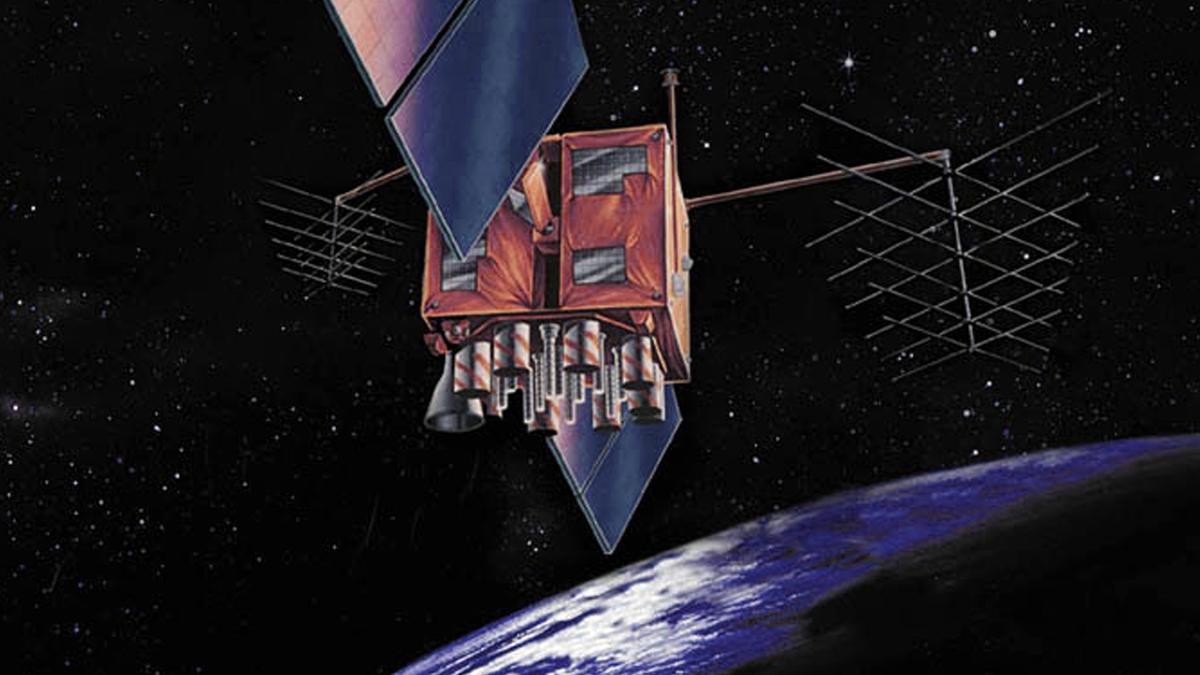
About Global Positioning System (GPS)
- The U.S. Department of Defence started the GPS programme in 1973 and launched the first satellite in 1978.
- The modern GPS satellite constellation consists of 24 satellites moving around the earth in six orbits.
- Each satellite completes two orbits in a single day.
- The overall programme has three main components:
- Space segment: It consists of 24 satellites. The six orbits they occupy are all 20,200 km above the earth, and each orbit has four satellites at all times. In this configuration, anyone on the earth will be able to ‘see’ at least four satellites at a time.
- Control segment: It consists of a global network of ground-brd control stations and antennae that track the 24 satellites, make sure their performance is as expected at all times, and transmit commands.
- User segment: It pertains to the use of GPS in various sectors and applications. The major sectors include agriculture, construction, surveying, logistics, telecommunications, power transmission, search and rescue, air travel, meteorology, seismology, and military operations.
How does GPS work?
- Each GPS satellite continuously broadcasts a radio signal containing information about its location in orbit, operational status, and the time at which the signal is emitted.
- The signals are transmitted at the L1 (1,575.42 MHz) and the L2 (1,227.6 MHz) frequencies at 50 bits/second.
- The signals are encoded with code-division multiple access.
- This allows multiple signals to be transmitted in the same channel and for a receiver to be able to disentangle them.
- There are two encoding types: the coarse/acquisition mode, which civilians can use to access coarse GPS data, and the precise mode, which is encrypted and is for military use.
- Being an electromagnetic signal, the radio waves travel at the speed of light.
- If the receiver has access to signals from four satellites, it will have the information required to calculate its location in four dimensions (three of space plus one of time relative to the satellite clock) – and can thus accurately triangulate its location on the ground.
- This informs the need for every point on the earth being able to ‘see’ four satellites at a time.
Q1) What is Radio wave?
These are waves from the portion of the electromagnetic spectrum at lower frequencies than microwaves. The wavelengths of radio waves range from thousands of metres to 30 cm. These correspond to frequencies as low as 3 Hz and as high as 1 gigahertz (109 Hz). Radio-wave communications signals travel through the air in a straight line, reflect off of clouds or layers of the ionosphere, or are relayed by satellites in space.
Source: How does GPS work? | Explained


 Last updated on Oct, 2026
→ UPSC 2027 Notification will be released on 13 January 2027 at upsconline.nic.in.
→ Asian Games 2026 are being held in Aichi-Nagoya, Japan, from 19 September to 4 October.
→ Check Nobel Prize 2026 Winners List here.
→ Download PIB PRiSM Monthly Magazine 2026 here.
→ Check UPSC Monthly Current Affairs Magazine The Recitals here.
→ Check out the latest UPSC Syllabus here.
→ Download UPSC Model Answers for Mains 2026
→ UPSC Mains Question Paper 2026 is out now for Essay & GS Paper 1, 2, 3 & 4.
→ UPSC Calendar 2027 has been released.
→ Enroll in Vajiram & Ravi’s UPSC Mains Test Series 2027 for structured answer writing practice, expert evaluation, and exam-oriented feedback.
→ Join Vajiram & Ravi’s UPSC Mentorship Program 2027 for personalized guidance, strategy planning, and one-to-one support from experienced mentors.
→ Go through the UPSC Mains Previous Year Papers to enhance your preparation.
→ UPSC has released UPSC Toppers List 2025 with the Civil Services final result on its official website.
→ Also check Best UPSC Coaching in India