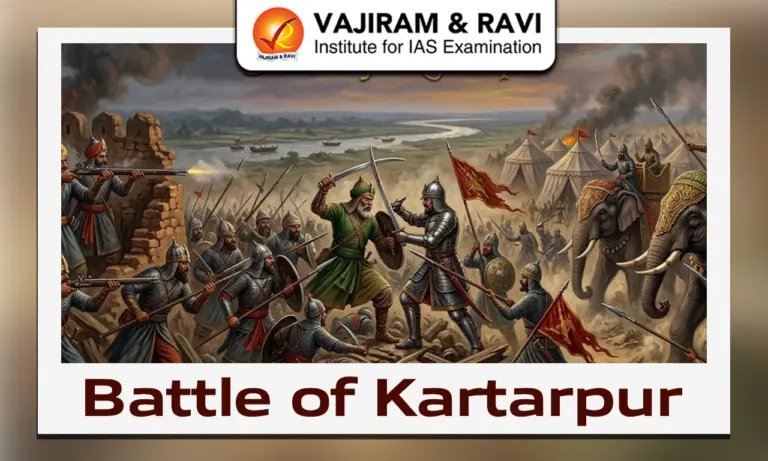
The Battle of Kartarpur was an important conflict in early Indian history that took place during a time of political change and regional struggles for power. It is generally associated with the period of the Mughal Empire and the resistance offered by local rulers and forces. The battle reflects the ongoing attempts of different powers to establish control over strategic regions. It highlights the dynamic nature of warfare and politics in medieval India.
Battle of Kartarpur
- The Battle of Kartarpur (1634-35) was an important event in Sikh history that took place during the time of Guru Hargobind Ji, the sixth Sikh Guru.
- It was not just a military fight, but also a symbol of resistance against injustice and oppression.
- This battle happened during a period when tensions between the Sikh community and the Mughal Empire were increasing.
- The growing strength and influence of the Sikhs made the ruling powers uncomfortable, leading to repeated conflicts.
- The battle reflects how the Sikh community moved from being only spiritual followers to becoming strong defenders of their faith, rights, and identity.
Also Read : Sikhism
Battle of Kartarpur Background
- The roots of the conflict go back to the martyrdom of Guru Arjan Dev Ji in 1606, after which the Sikh community began facing increasing pressure and hostility from the Mughal authorities.
- Guru Hargobind Ji understood that spiritual teachings alone would not be enough to protect his followers. As a result, he introduced the concept of Miri-Piri, which combined spiritual authority with political and military strength.
- Under this idea, Sikhs were encouraged to remain spiritually strong while also being ready to defend themselves.
- This marked a major turning point in Sikh history and laid the foundation for future battles like Kartarpur.


Causes of the Battle of Kartarpur
- The Battle of Kartarpur took place in 1634 during the time of Guru Hargobind Sahib, and its main cause was the betrayal of Painde Khan, a Pathan who was once a close friend, disciple, and trusted associate of the Guru. His shift from loyalty to hostility became the immediate trigger of the conflict.
- Painde Khan, after turning against the Guru, approached Qutab Khan, the Subedar (governor) of Jalandhar. Together, they went to the Mughal court and complained against the Guru, presenting him as a threat to imperial authority.
- Influenced by these complaints, the Mughal Emperor decided to act and sent a large and powerful army to suppress Guru Hargobind Sahib. The command of this army was given to Kale Khan, the brother of Mukhlis Khan, who had earlier been defeated by the Guru.
- Along with Kale Khan, several commanders including Qutab Khan, Painde Khan, Anwar Khan, and Asman Khan were appointed to lead different divisions of the army. The force consisted of nearly 50,000 soldiers, mainly Pathans, showing the seriousness of the Mughal response.
Preparations by the Sikhs
- As soon as Guru Hargobind Sahib learned about the approaching Mughal army, he began preparing for defense. The Guru’s leadership ensured that the Sikhs remained organized, confident, and spiritually motivated.
- Prominent Sikh warriors such as Bhai Bidhi Chand, Bhai Jati Mal, Bhai Lakhu, and Bhai Rai Jodh took charge of arranging troops strategically around Kartarpur, guarding all four sides of the city.
- The Sikh army, though much smaller in number, was highly disciplined and driven by strong faith, courage, and loyalty to their Guru. Their preparation reflected both military skill and spiritual determination.
Also Read : Guru Nanak
Battle of Kartarpur Course
- When the Mughal forces attacked, a fierce battle began. Despite being outnumbered, the Sikhs fought bravely and managed to overpower the enemy through courage, unity, and strategic fighting.
- Bhai Bidhi Chand directly confronted Kale Khan, while Baba Gurditta, the eldest son of Guru Hargobind Sahib, engaged Asman Khan in combat, showing remarkable leadership and bravery.
- A significant moment in the battle was the participation of Tegh Mal, the young son of the Guru, who was only 14 years old. His extraordinary courage and swordsmanship impressed everyone, and he later earned the name Tegh Bahadur, meaning “Brave of the Sword.”
Duel Between Guru Hargobind Sahib and Painde Khan
- During the battle, Painde Khan came face to face with Guru Hargobind Sahib. Filled with anger, he used harsh and disrespectful words towards the Guru.
- The Guru calmly responded, showing both courage and compassion. He invited Painde Khan to strike first, saying that a true warrior should fight with dignity rather than words.
- Painde Khan attacked the Guru multiple times, but each time his blows failed. The Guru skillfully defended himself and allowed him repeated chances, reflecting patience and confidence.
- Finally, Guru Hargobind Sahib struck a powerful blow that mortally wounded Painde Khan. As he lay dying, Painde Khan realized his mistake and expressed devotion, saying that the Guru’s sword itself was his path to salvation.
- Even at that moment, the Guru showed kindness and forgiveness. He shaded Painde Khan from the sun with his shield and prayed for his soul, highlighting his compassion, humanity, and spiritual greatness.
Battle of Kartarpur Final Phase
- After the death of Painde Khan, Kale Khan personally entered the battlefield and challenged the Guru. He fired arrows, one of which slightly injured the Guru’s forehead.
- The Guru responded with precision, first killing Kale Khan’s horse and then engaging him in a sword fight. The clash was intense, with sparks flying as their swords struck each other.
- Demonstrating superior skill, Guru Hargobind Sahib eventually delivered a decisive blow that beheaded Kale Khan, bringing the battle close to its end.
- Seeing their commanders defeated, the Mughal soldiers lost morale and fled the battlefield. Sikh warriors like Bhai Bidhi Chand and Bhai Jati Mal raised victory slogans, marking their triumph.
Battle of Kartarpur Outcome
- The Battle of Kartarpur ended in a clear victory for the Sikhs, even though they were fewer in number compared to the Mughal army.
- The battle proved that strong leadership, unity, and courage can overcome even larger and more powerful forces.
- It is believed that many Mughal soldiers were killed, while the Sikhs also made sacrifices, showing the intensity of the conflict.
Significance of the Battle of Kartarpur
- The battle is important because it showed the success of the Miri-Piri doctrine, where spiritual strength was combined with the power to defend justice.
- It marked the transformation of the Sikh community into a group that was not only spiritual but also capable of protecting itself against oppression.
- The bravery shown by warriors, especially Guru Tegh Bahadur in his youth, became an inspiration for future generations.
- The Battle of Kartarpur stands as a symbol of courage, resistance, faith, and moral strength, and it continues to hold great importance in Sikh history.

 Last updated on Sep, 2026
→ UPSC 2027 Notification will be released on 13 January 2027 at upsconline.nic.in.
→ Check out the latest UPSC Syllabus here.
→ Download UPSC Model Answers for Mains 2026
→ UPSC Mains Question Paper 2026 is out now for Essay & GS Paper 1, 2, 3 & 4.
→ UPSC Calendar 2027 has been released.
→ Enroll in Vajiram & Ravi’s UPSC Mains Test Series 2027 for structured answer writing practice, expert evaluation, and exam-oriented feedback.
→ Join Vajiram & Ravi’s UPSC Mentorship Program 2027 for personalized guidance, strategy planning, and one-to-one support from experienced mentors.
→ Go through the UPSC Mains Previous Year Papers to enhance your preparation.
→ UPSC has released UPSC Toppers List 2025 with the Civil Services final result on its official website.
→ Also check Best UPSC Coaching in India
Battle of Kartarpur FAQs
Q1. What was the Battle of Kartarpur?+
Q2. When did the Battle of Kartarpur take place?+
Q3. Who fought in the Battle of Kartarpur?+
Q4. What was the main cause of the Battle of Kartarpur?+
Q5. Who was Painde Khan and why is he important?+
Q6. What role did Guru Tegh Bahadur play in the battle?+
Q7. How did Guru Hargobind Sahib defeat Painde Khan?+
Tags: battle of kartarpur history history notes