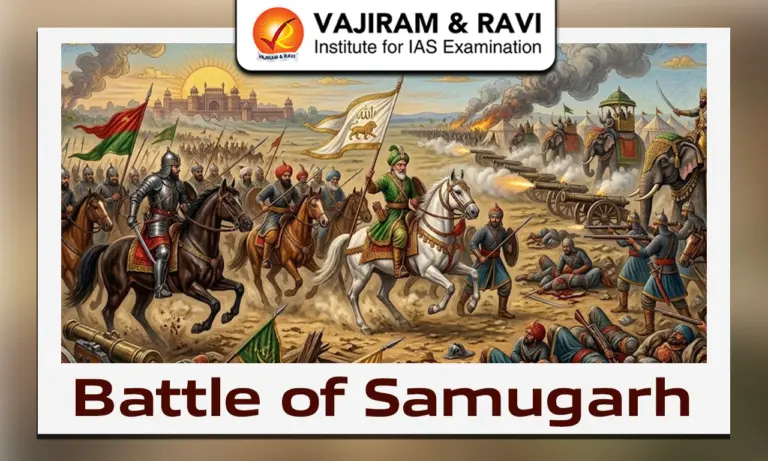
The Battle of Samugarh was an important event in Indian history that took place during the Mughal period. It was fought between the sons of Emperor Shah Jahan, who were competing for power and the throne. This battle was part of a larger struggle for succession within the royal family. It played a major role in deciding who would become the next ruler of the Mughal Empire and had a lasting impact on its future. The conflict shows how internal rivalry and ambition could shape the course of history.
When and Where Was the Battle of Samugarh Fought?
- The Battle of Samugarh was one of the most decisive battles of the Mughal War of Succession, fought after Emperor Shah Jahan fell seriously ill in 1657.
- It took place on 29 May 1658 near Agra, at a place called Samugarh, between Dara Shikoh and Aurangzeb.
- The battle ended in a decisive victory for Aurangzeb, which paved the way for his accession to the Mughal throne.
What Were the Causes of the Battle of Samugarh?
- The Mughal Empire did not follow primogeniture (fixed rule of succession), which meant all sons could claim the throne, leading to intense rivalry.
- After Shah Jahan’s illness, rumours of his death created urgency among his four sons – Dara Shikoh, Shuja, Murad Baksh, and Aurangzeb, to capture power.
- Dara Shikoh, being the eldest son and his father’s favourite, was already handling administration at Agra and was seen as the natural successor.
- Dara was known for his liberal outlook, interest in Sufism, and promotion of Hindu-Muslim intellectual exchange, which gained him both support and opposition.
- Aurangzeb, in contrast, believed in military discipline, political authority, and religious orthodoxy, and viewed Dara as unfit to rule a vast empire.
- Aurangzeb formed an alliance with Murad Baksh and advanced from the Deccan, while Shuja declared himself emperor in Bengal but was defeated earlier.
- The final and most decisive struggle for power took place at Samugarh between Dara Shikoh and Aurangzeb.


Battle of Samugarh Was Fought Between?
- Dara Shikoh commanded a large imperial army, supported by Mughal nobles, strong artillery, and Rajput allies, especially Raja Jaswant Singh of Jodhpur.
- His army relied more on loyalty and numbers rather than strict military discipline and battlefield experience.
- Aurangzeb and Murad Baksh led a combined force of battle-hardened Deccan troops, known for their experience and discipline.
- Aurangzeb’s army was well-organised, strategically positioned, and guided by careful planning and leadership.
- Both sides had armies of over 50,000 soldiers, including cavalry, infantry, and artillery units.
What Happened in the Battle of Samugarh?
- The armies met at Samugarh, about 10 km from Agra, after several days of skirmishes and positioning.
- Dara Shikoh placed his artillery at the centre, with himself on an elephant, and Rajput forces on the flanks.
- Aurangzeb positioned himself at the centre, Murad Baksh on the right, and Mir Jumla on the left wing.
- In the early phase, Dara’s artillery gave him an advantage and pushed Aurangzeb’s troops slightly backward.
- However, Dara made a major tactical mistake by leaving his defensive position and advancing into open combat.
- His movement created confusion among his troops, who mistakenly thought he was retreating from the battlefield.
- Aurangzeb quickly used this opportunity and launched a decisive cavalry charge, turning the situation in his favour.
- Murad’s forces attacked aggressively, while the Rajput contingents were outflanked and weakened.
- Dara’s army soon lost coordination, many nobles deserted, and soldiers began to flee the battlefield.
- Realising defeat, Dara Shikoh escaped toward Delhi, and the battle ended in a complete victory for Aurangzeb.
Battle of Samugarh Was Won by Whom?
- The defeat completely destroyed Dara Shikoh’s chances of becoming emperor, and he fled north but was later captured and executed in 1659.
- Aurangzeb entered Agra and placed Shah Jahan under house arrest in Agra Fort, effectively taking control of the empire.
- In July 1658, Aurangzeb crowned himself as emperor with the title “Alamgir”.
- He later defeated Shuja and executed Murad Baksh, thereby ending the War of Succession.
- The victory at Samugarh firmly established Aurangzeb as the supreme ruler of the Mughal Empire.
Why Did Aurangzeb Win the Battle of Samugarh?
- Superior military strategy and planning allowed Aurangzeb to control the battlefield effectively.
- Dara Shikoh’s tactical errors, especially leaving a secure position, led to confusion and defeat.
- Aurangzeb’s army was more disciplined, experienced, and battle-ready, unlike Dara’s relatively less organised forces.
- Aurangzeb gained support from orthodox and conservative sections, strengthening his political legitimacy.
What Was the Significance of the Battle of Samugarh?
- The battle represented not just a political struggle but a clash of ideologies within the Mughal Empire.
- Dara Shikoh symbolised tolerance, pluralism, and cultural synthesis, while Aurangzeb represented orthodoxy and centralised authority.
- Aurangzeb’s victory marked a shift towards religious conservatism and stronger imperial control.
- His reign (1658-1707) became one of the longest in Mughal history, marked by territorial expansion.
- However, his policies also led to administrative rigidity and social tensions, which later contributed to the decline of the Mughal Empire.

 Last updated on Sep, 2026
→ UPSC 2027 Notification will be released on 13 January 2027 at upsconline.nic.in.
→ Check out the latest UPSC Syllabus here.
→ Download UPSC Model Answers for Mains 2026
→ UPSC Mains Question Paper 2026 is out now for Essay & GS Paper 1, 2, 3 & 4.
→ UPSC Calendar 2027 has been released.
→ Enroll in Vajiram & Ravi’s UPSC Mains Test Series 2027 for structured answer writing practice, expert evaluation, and exam-oriented feedback.
→ Join Vajiram & Ravi’s UPSC Mentorship Program 2027 for personalized guidance, strategy planning, and one-to-one support from experienced mentors.
→ Go through the UPSC Mains Previous Year Papers to enhance your preparation.
→ UPSC has released UPSC Toppers List 2025 with the Civil Services final result on its official website.
→ Also check Best UPSC Coaching in India
Battle of Samugarh FAQs
Q1. When was the Battle of Samugarh fought?+
Q2. Where did the Battle of Samugarh take place?+
Q3. Who fought in the Battle of Samugarh?+
Q4. Who won the Battle of Samugarh?+
Q5. Why was the Battle of Samugarh fought?+
Q6. What was the main cause of Aurangzeb’s victory?+
Q7. What happened to Dara Shikoh after the battle?+
Tags: battle of samugarh battles battles in india history history notes Important Battles in Indian Important Battles in Modern Indian History