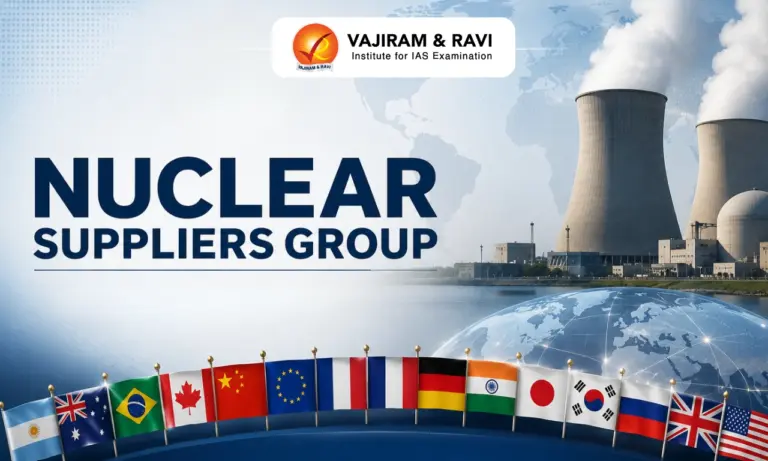
The Nuclear Suppliers Group (NSG) is a group of countries that work together to ensure that nuclear materials and technology are used only for peaceful purposes, such as energy and research. It was created to prevent the spread of nuclear weapons and to promote responsible nuclear trade among nations. Through common rules and international cooperation, the NSG helps maintain global security while allowing countries to benefit from nuclear technology in a safe and controlled manner.
Nuclear Suppliers Group
- The Nuclear Suppliers Group (NSG) is a group of countries that cooperate to ensure that nuclear materials, equipment, and technology are used only for peaceful purposes, such as energy generation, medical research, and scientific development.
- It plays a crucial role in preventing the spread of nuclear weapons (nuclear proliferation) while still allowing countries to benefit from nuclear technology in a safe and regulated manner.
- The NSG operates through common guidelines and mutual understanding among member countries, ensuring that nuclear trade does not lead to security risks.
- It is a transnational export control regime, meaning it regulates how nuclear-related materials and technologies are transferred across countries.
- Nuclear Suppliers Group contributes to global peace, stability, and responsible nuclear cooperation.
Nuclear Suppliers Group Members and Basic Features
- The NSG consists of 48 member countries, mainly nuclear supplier nations that have the capability to export nuclear materials and technologies.
- India is currently not a member, although it actively seeks membership to participate in decision-making.
- Membership requires countries to meet strict eligibility criteria, especially related to nuclear non-proliferation commitments and export control systems.
- Member countries must ensure that any nuclear export is accompanied by clear assurances from the importing country that it will not be used for weapons development.
- The group functions on a consensus basis, meaning decisions are taken collectively with agreement from all members.
| Nuclear Suppliers Group Member Countries | ||
|
S. No. |
Participating Government |
Year of Adherence |
|
1 |
Argentina |
1994 |
|
2 |
Cyprus |
2000 |
|
3 |
Ireland |
1984 |
|
4 |
New Zealand |
1994 |
|
5 |
South Africa |
1995 |
|
6 |
Australia |
1978 |
|
7 |
Czech Republic |
1978* |
|
8 |
Italy |
1978 |
|
9 |
Norway |
1989 |
|
10 |
Spain |
1988 |
|
11 |
Austria |
1991 |
|
12 |
Denmark |
1984 |
|
13 |
Japan |
1974 |
|
14 |
Poland |
1978 |
|
15 |
Sweden |
1978 |
|
16 |
Belarus |
2000 |
|
17 |
Estonia |
2004 |
|
18 |
Kazakhstan |
2002 |
|
19 |
Portugal |
1986 |
|
20 |
Switzerland |
1978 |
|
21 |
Belgium |
1978 |
|
22 |
Finland |
1980 |
|
23 |
Latvia |
1997 |
|
24 |
Romania |
1990 |
|
25 |
Türkiye |
2000 |
|
26 |
Brazil |
1996 |
|
27 |
France |
1974 |
|
28 |
Lithuania |
2004 |
|
29 |
Rep. of Korea |
1995 |
|
30 |
Ukraine |
1996 |
|
31 |
Bulgaria |
1984 |
|
32 |
Germany |
1974 |
|
33 |
Luxembourg |
1984 |
|
34 |
Russia |
1974 |
|
35 |
U.K. |
1974 |
|
36 |
Canada |
1974 |
|
37 |
Greece |
1984 |
|
38 |
Malta |
2004 |
|
39 |
Serbia |
2013 |
|
40 |
U.S. |
1974 |
|
41 |
China |
2004 |
|
42 |
Hungary |
1985 |
|
43 |
Mexico |
2012 |
|
44 |
Slovakia |
1978* |
|
45 |
Croatia |
2005 |
|
46 |
Iceland |
2009 |
|
47 |
Netherlands |
1978 |
|
48 |
Slovenia |
2000 |
(Czechoslovakia later split into the Czech Republic and Slovakia; original participation dates back to 5 March 1993.)


Nuclear Suppliers Group Objectives
- The primary objective is to prevent nuclear materials and technologies from being diverted for military or weapon purposes.
- It aims to ensure that nuclear trade is conducted only for peaceful and civilian applications.
- The NSG works to strengthen international safeguards and verification mechanisms, especially through cooperation with global institutions.
- It promotes transparency, accountability, and trust among countries involved in nuclear commerce.
- Another important goal is to close loopholes in global nuclear trade that could be exploited for proliferation activities.
Nuclear Suppliers Group History and Formation
- The need for regulating nuclear trade emerged after the Nuclear Non-Proliferation Treaty (NPT), 1968, which allowed peaceful nuclear use but also raised concerns about possible misuse for weapons development.
- In 1971, the Zangger Committee was formed by nuclear supplier countries to create a “Trigger List” of items that required safeguards before export.
- India’s 1974 nuclear test demonstrated that nuclear technology supplied for peaceful purposes could be diverted to develop nuclear weapons, highlighting gaps in existing controls.
- In response to this, the Nuclear Suppliers Group was established in 1975 to strengthen export controls, expand the list of regulated items, and ensure stricter global coordination.
Nuclear Suppliers Group Guidelines
- The NSG has developed a set of comprehensive guidelines that all member countries must follow while exporting nuclear-related materials, equipment, and technologies to other countries.
- These guidelines are divided into two important parts, based on the nature and risk level of the items being exported:
- Part I (Trigger List Items)
- This part includes items that are specifically designed or prepared for nuclear use, such as nuclear reactors, fuel, enrichment, and reprocessing equipment.
- These are called “Trigger List Items” because their export automatically triggers the need for strict safeguards, monitoring, and international inspections.
- Part II (Dual-Use Items)
- This part includes dual-use items and technologies, which have both civilian and potential military applications, such as certain machine tools, materials, and advanced technologies.
- Although these items can contribute to nuclear fuel cycles or explosive activities, they are allowed for peaceful purposes under strict regulation and safeguards.
- Part I (Trigger List Items)
Role of International Atomic Energy Agency (IAEA)
- The International Atomic Energy Agency (IAEA) is responsible for ensuring that nuclear materials are not diverted for weapon purposes.
- It conducts inspections, monitoring, and verification activities in countries receiving nuclear imports.
- Tools used include on-site inspections, remote surveillance, seals, and data analysis.
- Countries must accept IAEA safeguards agreements to engage in nuclear trade with NSG members.
- The IAEA acts as a global watchdog, strengthening trust and compliance in nuclear activities.
Nuclear Suppliers Group Working and Operations
- The NSG functions on a voluntary and cooperative basis, where countries agree to follow common export control standards.
- Member countries exchange information about denied exports to prevent unauthorized transfers.
- A key feature is the “catch-all” provision (introduced in 2004), which allows members to block suspicious exports even if they are not listed in guidelines.
- The NSG ensures coordination and consistency in nuclear export policies across countries.
- Regular meetings are held to review guidelines, discuss challenges, and update control measures.
Nuclear Suppliers Group and India
- India is not a member of the Nuclear Suppliers Group mainly because it has not signed the Treaty on the Non-Proliferation of Nuclear Weapons (NPT). India formally applied for membership in May 2016, but its entry was blocked due to lack of consensus.
- In 2008, India received a “clean waiver” from the NSG after the India-US Civil Nuclear Agreement, allowing it to participate in global civil nuclear trade despite being a non-NPT state.
- India seeks membership for long-term access to nuclear materials, fuel, and advanced technology, which are essential for energy security and expanding its nuclear power capacity.
- Membership would boost “Make in India”, increase domestic nuclear production, and reduce dependence on fossil fuels, helping India move toward clean energy goals.
- It also supports India’s three-stage nuclear program, especially its thorium-based energy strategy, and enables opportunities for plutonium trade and advanced research.
- Joining NSG would give India strategic legitimacy, recognizing it as a responsible nuclear power, and allow participation in framing global nuclear export rules.
- The biggest challenge is India’s non-signatory status to the NPT, as most NSG members expect adherence to this treaty.
- Another major obstacle is opposition from China, since NSG decisions are based on consensus, meaning even one country can block membership. China demands a criteria-based approach for all non-NPT countries.
- Historically, the NSG was formed after India’s 1974 nuclear test, and India earlier viewed such regimes as discriminatory and restrictive, creating long-term trust issues.
- India has strong backing from major powers like the United States, Russia, France, United Kingdom, and Australia, which support its inclusion as a responsible nuclear state.
- The 2016 bid, led by PM Narendra Modi, involved intense diplomacy, including talks with Xi Jinping, but failed due to lack of unanimous agreement.
- The failure was seen as a diplomatic setback, with criticism that India overestimated support and invested heavily in a consensus-based system where even minor opposition matters.
- Although the United States supports India, changing global power dynamics, especially the rise of China, have made NSG consensus more difficult.
- India continues to push for NSG membership to strengthen its energy security, economic growth, clean energy transition, and global strategic position, even though it already benefits from the 2008 NSG waiver.

 Last updated on Sep, 2026
→ UPSC 2027 Notification will be released on 13 January 2027 at upsconline.nic.in.
→ Asian Games 2026 are being held in Aichi-Nagoya, Japan, from 19 September to 4 October.
→ Check out the latest UPSC Syllabus here.
→ Download UPSC Model Answers for Mains 2026
→ UPSC Mains Question Paper 2026 is out now for Essay & GS Paper 1, 2, 3 & 4.
→ UPSC Calendar 2027 has been released.
→ Enroll in Vajiram & Ravi’s UPSC Mains Test Series 2027 for structured answer writing practice, expert evaluation, and exam-oriented feedback.
→ Join Vajiram & Ravi’s UPSC Mentorship Program 2027 for personalized guidance, strategy planning, and one-to-one support from experienced mentors.
→ Go through the UPSC Mains Previous Year Papers to enhance your preparation.
→ UPSC has released UPSC Toppers List 2025 with the Civil Services final result on its official website.
→ Also check Best UPSC Coaching in India
Nuclear Suppliers Group FAQs
Q1. What is the Nuclear Suppliers Group (NSG)?+
Q2. What is the main objective of the Nuclear Suppliers Group?+
Q3. Why was the Nuclear Suppliers Group formed?+
Q4. How many countries are members of the NSG?+
Q5. What is the role of the IAEA in NSG?+
Q6. Why is India not a member of the NSG?+
Tags: international relations international relations notes nuclear suppliers group