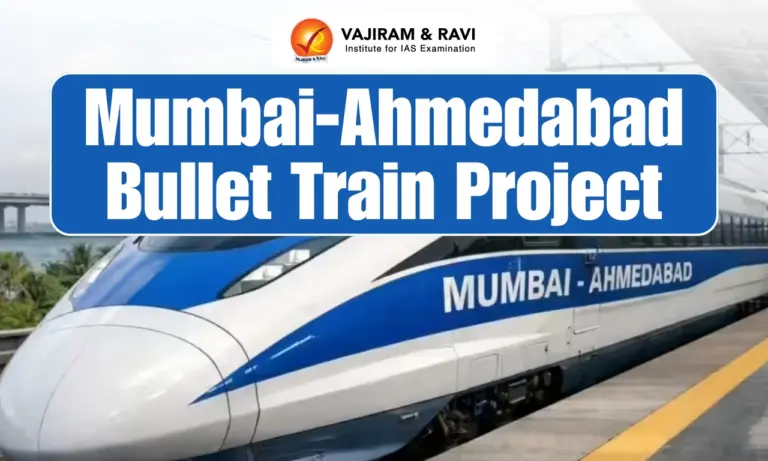
The Mumbai-Ahmedabad High-Speed Rail (MAHSR) Project is India’s first high speed rail corridor and one of the largest transport infrastructure projects of India. It is spread across 508 km and connects Maharashtra, Gujarat and Dadra & Nagar Haveli using Japanese Shinkansen technology. The project is currently progressing with the first section targeted to open in 2027.
Mumbai-Ahmedabad Bullet Train Project 2026
The Mumbai-Ahmedabad Bullet Train is designed for a maximum speed of 350 kmph. The MAHSR project aims to reduce travel time between Mumbai and Ahmedabad to about 1 hour 58 minutes. Recent India-Japan discussions have confirmed that operations will initially begin with an indigenously developed Indian high speed train, while Japan will supply the next generation E10 Shinkansen trains in the early 2030s.
Mumbai-Ahmedabad High-Speed Rail (MAHSR) Project
The Mumbai-Ahmedabad High-Speed Rail Project is India’s first dedicated Bullet Train Corridor and marks the beginning of high speed rail services in the country.
- Project Overview: The MAHSR corridor is 508 km long and passes through Maharashtra, Gujarat and Dadra & Nagar Haveli, connecting Mumbai and Ahmedabad through dedicated high speed rail infrastructure.
- Foundation of the Project: The foundation stone for the project was laid in September 2017, marking India’s entry into the era of high speed railway transportation with Japanese cooperation.
- Operational Speed: The corridor has a design speed of 350 kmph and will operate at a maximum commercial speed of 320 kmph, far higher than existing Indian passenger trains.
- Travel Time: The project will reduce the Mumbai-Ahmedabad journey to about 1 hour 58 minutes, significantly improving inter-city passenger connectivity and reducing travel time.
- Japanese Partnership: Japan is supporting the project through financial assistance, technology transfer, engineering expertise and Shinkansen based operational standards, making it India’s largest international rail technology partnership.
- Dedicated High Speed Infrastructure: The project includes dedicated tracks, viaducts, tunnels, bridges, stations, signalling systems, electrification, power supply, depots and specialised maintenance facilities built exclusively for high speed operations.


Mumbai-Ahmedabad Bullet Train Features
The Mumbai-Ahmedabad High-Speed Rail (MAHSR) Corridor combines advanced engineering, modern safety systems and world class railway technology to establish India’s first complete high speed rail network.
- Stations: The corridor includes 12 stations at Mumbai (BKC), Thane, Virar, Boisar, Vapi, Bilimora, Surat, Bharuch, Vadodara, Anand, Ahmedabad and Sabarmati with multimodal connectivity.
- Elevated Alignment: Around 90% of the corridor is elevated and constructed using the Full Span Launching Method (FSLM), which is nearly ten times faster than conventional segmental construction.
- Ballastless Track System: The project uses Japanese J-Slab ballastless track technology for the first time in India, providing greater stability, durability, reduced maintenance and smoother high speed operations.
- Electrification System: More than 20,000 overhead electrification masts using the 2×25 kV Shinkansen traction system are being installed along the entire corridor.
- Power Infrastructure: The project includes 12 traction substations, two depot traction substations and sixteen distribution substations to ensure uninterrupted power supply for train operations.
- Bridge Infrastructure: The corridor contains 25 river bridges and 28 steel bridges crossing highways, railway lines, rivers and canals, making it one of India’s largest railway bridge construction programmes.
- India’s First Undersea Rail Tunnel: A 21 km tunnel section in Maharashtra includes India’s first approximately 7 km undersea high speed rail tunnel beneath Thane Creek using advanced TBM and NATM technologies.
- Advanced Tunnel Engineering: Two large Tunnel Boring Machines are constructing the 16 km underground section, while the remaining tunnel is being built using the New Austrian Tunnelling Method.
- Modern Safety Systems: The corridor incorporates earthquake detection, rainfall monitoring, wind speed monitoring and automated operational control systems to ensure safe high speed train operations.
Mumbai-Ahmedabad High-Speed Rail Project Recent Developments
Construction has accelerated significantly during 2026, while India and Japan continue close cooperation on technology, operations and future high speed train deployment.
- India-Japan E10 Discussions: India and Japan confirmed that discussions on the MAHSR project are progressing well, with Japan agreeing to provide the next generation E10 Shinkansen trains in the early 2030s.
- First Section Opening: The first operational section of the MAHSR corridor is planned to open in 2027, while civil construction is progressing rapidly across the entire 508 km route.
- Interim Operations: Both countries agreed that operations will initially begin with an indigenously developed Indian high speed train until the arrival of Japan’s E10 trainsets.
- Signalling System: Siemens has been awarded the signalling contract and the corridor will use the European Train Control System (ETCS), which supports international interoperability and advanced digital train control.
- E10 Compatibility: Railway officials confirmed that Japan’s E10 Shinkansen trains are fully compatible with the ETCS signalling system already selected for the corridor.
- Largest Railway TBM: The Mixshield type Tunnel Boring Machine, among the largest used for railway tunnelling in India, employs advanced slurry technology to minimise ground disturbance in Mumbai’s urban areas.
- Major Engineering Progress: During 2026, important milestones included mountain tunnel breakthroughs, steel bridge launches, Sabarmati bridge construction, portal beam installation, TBM assembly, cutterhead lowering and commencement of track installation on the viaduct.
Mumbai-Ahmedabad Bullet Trains
The MAHSR corridor will initially use an indigenous train before transitioning to Japan’s next generation Shinkansen technology.
B28
- High Speed Train: B28 is India’s first indigenous bullet train being jointly developed by BEML Limited and the Integral Coach Factory, with the prototype targeted for completion by March 2027 before extensive testing.
- Performance: The Bharat made B28 train has a design speed of 280 kmph and an operational speed of 250 kmph, enabling the first commercial services on the MAHSR corridor.
- Indian Operational Phase: The indigenous train will operate on the Surat-Bilimora section from 2027, allowing Indian Railways to gain operational experience before introducing higher speed Japanese trainsets.
E10
- Shinkansen: Japan will provide the next generation E10 series Shinkansen in the early 2030s. The train is currently under development and will become the long term rolling stock for the corridor.
- Performance: The E10 Shinkansen is expected to operate at 320 kmph on the MAHSR corridor and represents Japan’s latest generation of high speed railway technology.
7 High-Speed Rail Corridors in Budget 2026
The Union Budget 2026-27 expanded India’s high speed rail vision beyond the Mumbai-Ahmedabad corridor with several new proposed routes. The Budget announced seven proposed high speed rail corridors covering nearly 4,000 km across different regions of India. The proposed high speed rail network is expected to attract investments of around ₹16 lakh crore for infrastructure creation and long term economic development.
The 7 High-Speed Rail Corridors announced in the Union Budget 2026-27 are:
- Delhi-Varanasi: Proposed travel time is about 3 hours 50 minutes, improving connectivity between the National Capital Region and eastern Uttar Pradesh.
- Varanasi-Patna-Siliguri: The proposed corridor will reduce travel time to around 2 hours 55 minutes while strengthening connectivity across eastern India.
- Chennai-Bengaluru: This high speed corridor aims to connect two major technology and industrial centres in about 1 hour 13 minutes.
- Bengaluru-Hyderabad: The proposed corridor will reduce travel time between the two major metropolitan cities to nearly 2 hours.
- Chennai-Hyderabad: Planned travel time on this high speed route is approximately 2 hours 55 minutes, improving regional mobility in southern India.
- Mumbai-Pune: The proposed high speed corridor will reduce travel time between the two cities to only 48 minutes.
- Pune-Hyderabad: This proposed corridor is expected to connect Pune and Hyderabad in approximately 1 hour 55 minutes through dedicated high speed rail infrastructure.
MAHSR Bullet Train Project Significance
The MAHSR Project is transforming India’s railway sector through modern infrastructure, advanced technology, industrial development and faster regional connectivity.
- Rail Modernisation: The project introduces India’s first complete high speed rail ecosystem covering rolling stock, track systems, signalling, electrification, tunnelling, bridge construction and specialised railway operations.
- Employment Generation: The project is expected to create around 4,000 direct jobs, 35,000-40,000 indirect jobs and engage nearly 40,000 workers during construction.
- Skill Development: A dedicated High-Speed Rail Training Institute at Vadodara is preparing Indian engineers and technicians in advanced railway technologies and high speed rail operations.
- Make in India: Technology transfer, domestic manufacturing and participation of Indian companies are strengthening capabilities in sectors such as steel, cement, electrical equipment, rolling stock and railway engineering.
- Regional Development: Improved connectivity between major industrial centres such as Mumbai, Surat, Vadodara and Vapi is expected to strengthen supply chains, business activities, tourism and urban development.

 Last updated on Sep, 2026
→ UPSC 2027 Notification will be released on 13 January 2027 at upsconline.nic.in.
→ Asian Games 2026 are being held in Aichi-Nagoya, Japan, from 19 September to 4 October.
→ Check out the latest UPSC Syllabus here.
→ Download UPSC Model Answers for Mains 2026
→ UPSC Mains Question Paper 2026 is out now for Essay & GS Paper 1, 2, 3 & 4.
→ UPSC Calendar 2027 has been released.
→ Enroll in Vajiram & Ravi’s UPSC Mains Test Series 2027 for structured answer writing practice, expert evaluation, and exam-oriented feedback.
→ Join Vajiram & Ravi’s UPSC Mentorship Program 2027 for personalized guidance, strategy planning, and one-to-one support from experienced mentors.
→ Go through the UPSC Mains Previous Year Papers to enhance your preparation.
→ UPSC has released UPSC Toppers List 2025 with the Civil Services final result on its official website.
→ Also check Best UPSC Coaching in India
Mumbai-Ahmedabad High-Speed Rail (MAHSR) Project FAQs
Q1. What is the Mumbai-Ahmedabad High-Speed Rail (MAHSR) Project?+
Q2. When will the Mumbai-Ahmedabad Bullet Train start operations?+
Q3. Which train will run first on the MAHSR corridor?+
Q4. What is the E10 Shinkansen train in the MAHSR Project?+
Q5. Which states does the Mumbai-Ahmedabad High-Speed Rail corridor pass through?+
Q6. How many high speed rail corridors are proposed in the Union Budget 2026-27?+
Q7. How many high-speed rail corridors in India 2026?+
Tags: mumbai ahmedabad high speed rail corridor mumbai-ahmedabad bullet train project transport sector in india