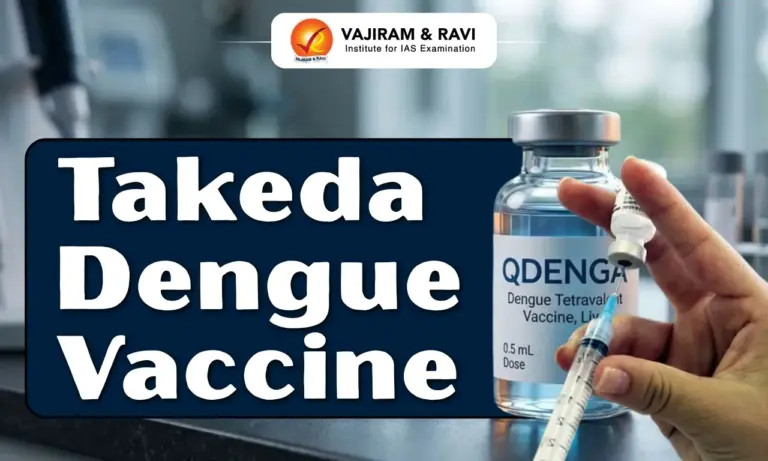
India has approved the Takeda dengue vaccine (QDENGA/TAK-003), marking a significant milestone in the country’s fight against dengue. The Drug Controller General of India (DCGI) has granted market authorisation to Takeda Biopharmaceuticals India’s QDENGA, making it the first dengue vaccine approved in India. The vaccine is authorised for individuals aged 4 to 60 years, offering a new preventive tool against one of the country’s most widespread mosquito-borne diseases.
Why is the Takeda Dengue Vaccine in News?
The Takeda dengue vaccine is in the news because the DCGI has approved QDENGA (TAK-003) for use in India. This is the first dengue vaccine to receive market authorisation in the country, providing an important advancement in dengue prevention.
Importance of the Takeda Dengue Vaccine Approval
The approval of the Takeda dengue vaccine is a major public health milestone that strengthens India’s efforts to prevent dengue and reduce the impact of recurring outbreaks.
- First dengue vaccine in India: QDENGA (TAK-003) is the first dengue vaccine to receive market authorisation in the country.
- Protects a broad age group: Approved for individuals aged 4 to 60 years, expanding preventive coverage.
- Reduces disease burden: Has the potential to lower dengue infections, hospitalisations, and severe cases.
- Supports public health initiatives: Complements existing mosquito control, surveillance, and awareness programmes.
- Improves outbreak preparedness: Provides an additional tool to manage seasonal dengue outbreaks more effectively.
- Enhances healthcare resilience: May help reduce pressure on hospitals and healthcare systems during peak dengue seasons.
- Advances preventive healthcare: Reflects India’s growing focus on vaccination as a key strategy against vector-borne diseases.


What is Dengue?
Dengue is a mosquito-borne viral disease caused by the dengue virus and transmitted mainly through the bite of infected Aedes mosquitoes. It is one of the fastest-spreading vector-borne diseases and is common in tropical and subtropical regions, including India.
- Caused by the dengue virus (DENV).
- Spread mainly by Aedes aegypti mosquitoes.
- Common during the monsoon and post-monsoon seasons.
- Symptoms include high fever, headache, muscle pain, joint pain, and rash.
- Severe cases can lead to dengue haemorrhagic fever and dengue shock syndrome.
- Prevention focuses on mosquito control and avoiding mosquito bites.
Dengue Prevention Measures
Preventing dengue mainly involves controlling mosquito breeding and protecting individuals from mosquito bites, as these are the most effective ways to reduce the spread of the disease.
- Eliminate stagnant water: Empty and clean water containers, coolers, flower pots, tyres, and other places where mosquitoes can breed.
- Use mosquito repellents: Apply approved mosquito repellents on exposed skin, especially during the day.
- Wear protective clothing: Wear full-sleeved shirts, long pants, and light-coloured clothing to minimize mosquito bites.
- Install mosquito screens and nets: Use window screens, door screens, and mosquito nets to keep mosquitoes out of homes.
- Maintain clean surroundings: Keep drains, water tanks, and public spaces clean to prevent mosquito breeding.
- Cover water storage containers: Ensure all water tanks and containers are tightly covered.
- Promote community participation: Encourage neighbourhood clean-up drives and awareness campaigns to eliminate breeding sites.
- Seek early medical care: Consult a healthcare provider promptly if symptoms such as high fever, severe headache, or body pain develop.
- Follow public health advisories: Adhere to government guidelines during dengue outbreaks and support vector-control measures.

 Last updated on Oct, 2026
→ UPSC 2027 Notification will be released on 13 January 2027 at upsconline.nic.in.
→ Asian Games 2026 are being held in Aichi-Nagoya, Japan, from 19 September to 4 October.
→ Check Nobel Prize 2026 Winners List here.
→ Download PIB PRiSM Monthly Magazine 2026 here.
→ Check UPSC Monthly Current Affairs Magazine The Recitals here.
→ Check out the latest UPSC Syllabus here.
→ Download UPSC Model Answers for Mains 2026
→ UPSC Mains Question Paper 2026 is out now for Essay & GS Paper 1, 2, 3 & 4.
→ UPSC Calendar 2027 has been released.
→ Enroll in Vajiram & Ravi’s UPSC Mains Test Series 2027 for structured answer writing practice, expert evaluation, and exam-oriented feedback.
→ Join Vajiram & Ravi’s UPSC Mentorship Program 2027 for personalized guidance, strategy planning, and one-to-one support from experienced mentors.
→ Go through the UPSC Mains Previous Year Papers to enhance your preparation.
→ UPSC has released UPSC Toppers List 2025 with the Civil Services final result on its official website.
→ Also check Best UPSC Coaching in India
Takeda Dengue Vaccine FAQs
Q1. What is the Takeda dengue vaccine?+
Q2. Who approved the Takeda dengue vaccine in India?+
Q3. Who is eligible to receive the Takeda dengue vaccine?+
Q4. Why is the Takeda dengue vaccine significant?+
Tags: dengue diseases takeda dengue vaccine