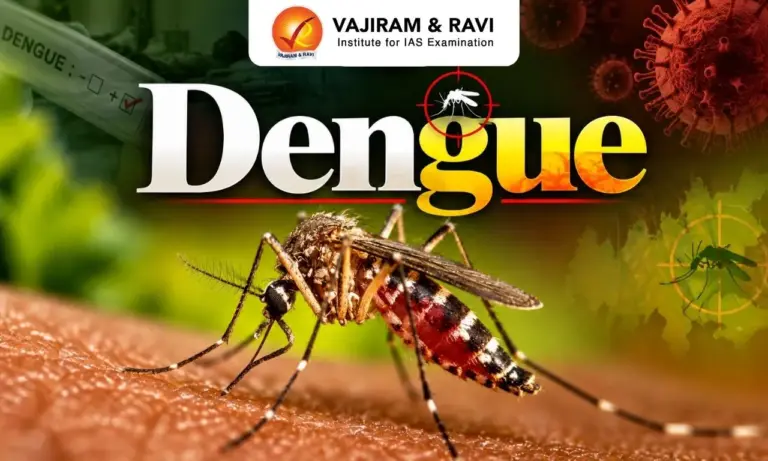
Dengue Latest News
Kerala scientists recently developed a Dengue Early Warning System (DEWS) using machine learning, six years of case data, and weather variables to forecast district-level dengue trends and help health authorities act before outbreaks intensify.
About Dengue
- Dengue (break-bone fever) is a mosquito-borne viral infection caused by the dengue virus (DENV).
- While many dengue infections are asymptomatic or produce only mild illness, the virus can occasionally cause more severe cases and even death.
- The virus is most common in tropical and subtropical regions, including Central and South America, Africa, parts of Asia, and the Pacific Islands, mostly in urban and semi-urban areas.
- Dengue epidemics tend to have seasonal patterns, with transmission often peaking during and after rainy seasons.


Dengue Transmission
- It is transmitted to humans through the bite of infected Aedes mosquitoes carrying one of four types of dengue virus (DENV).
- It isn’t contagious from person to person except when passed from a pregnant person to their child.
- An estimated 400 million dengue infections occur worldwide each year, with about 96 million resulting in illness.
- A person can be infected with dengue multiple times in their life.
Dengue Symptoms
- The most common symptoms are high fever, headache, body aches, nausea, and rash. Most will get better in 1–2 weeks.
- A very small portion of people with dengue fever get a severe case. It’s called dengue hemorrhagic fever.
- This severe form of dengue fever happens when the infection harms blood vessels and causes them to leak.
- The number of clot-forming cells, called platelets, in the bloodstream drops.
- This can lead to shock, bleeding inside the body, organ failure, and death.
- Individuals who are infected for the second time are at greater risk of severe dengue.
Dengue Treatment
- There is no specific medicine to treat dengue. The focus is on treating pain symptoms.
- It is generally treated with supportive care such as pain relievers, bed rest, and fluids.
News: NDTV

 Last updated on Oct, 2026
→ UPSC 2027 Notification will be released on 13 January 2027 at upsconline.nic.in.
→ Asian Games 2026 are being held in Aichi-Nagoya, Japan, from 19 September to 4 October.
→ Check Nobel Prize 2026 Winners List here.
→ Download PIB PRiSM Monthly Magazine 2026 here.
→ Check UPSC Monthly Current Affairs Magazine The Recitals here.
→ Check out the latest UPSC Syllabus here.
→ Download UPSC Model Answers for Mains 2026
→ UPSC Mains Question Paper 2026 is out now for Essay & GS Paper 1, 2, 3 & 4.
→ UPSC Calendar 2027 has been released.
→ Enroll in Vajiram & Ravi’s UPSC Mains Test Series 2027 for structured answer writing practice, expert evaluation, and exam-oriented feedback.
→ Join Vajiram & Ravi’s UPSC Mentorship Program 2027 for personalized guidance, strategy planning, and one-to-one support from experienced mentors.
→ Go through the UPSC Mains Previous Year Papers to enhance your preparation.
→ UPSC has released UPSC Toppers List 2025 with the Civil Services final result on its official website.
→ Also check Best UPSC Coaching in India
Dengue FAQs
Q1. What is dengue?+
Q2. How is dengue primarily transmitted to humans?+
Q3. In which regions of the world is dengue most common?+
Q4. Can dengue normally spread directly from one person to another?+
Q5. Is there a specific medicine that cures dengue?+
Tags: dengue prelims pointers upsc current affairs upsc prelims current affairs