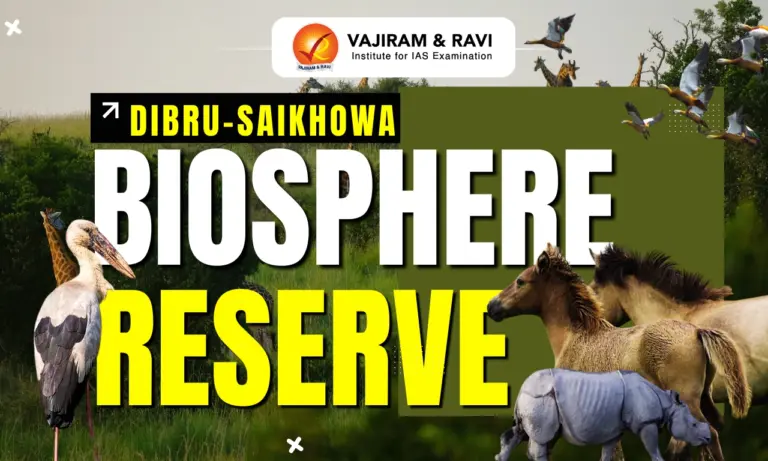
The Dibru-Saikhowa Biosphere Reserve is one of India’s most ecologically significant protected areas, located in the northeastern state of Assam. Known for its riverine ecosystems, wetlands, grasslands, and tropical forests, the biosphere reserve supports a remarkable diversity of wildlife, including several endangered and endemic species. It also serves as an important habitat for migratory birds and is recognized for its unique feral horse population.
Dibru-Saikhowa Biosphere Reserve
The Dibru-Saikhowa Biosphere Reserve is located in the Tinsukia and Dibrugarh districts of Assam, in northeastern India. It lies between the Brahmaputra and Lohit rivers, forming one of the country’s most important riverine ecosystems. Established as a Biosphere Reserve in 1997, it covers approximately 765 sq. km. and includes the Dibru-Saikhowa National Park as its core area.
Dibru-Saikhowa Biosphere Reserve Geographical Features
The Dibru-Saikhowa Biosphere Reserve is distinguished by its dynamic riverine landscape, floodplains, wetlands, and swamp forests, making it one of India’s most diverse and ecologically important biosphere reserves.
- Located in the Tinsukia and Dibrugarh districts of Assam, between the Brahmaputra and Lohit rivers.
- Covers an area of approximately 765 sq. km., including the Dibru-Saikhowa National Park as its core zone.
- Characterized by alluvial floodplains formed through continuous deposition of sediments by major rivers.
- Comprises river islands (chars), sandbars, oxbow lakes, marshes, wetlands, and swamp forests.
- Home to India’s largest Salix (willow) swamp forest, a rare riverine forest ecosystem.
- Receives heavy annual rainfall, resulting in seasonal flooding that replenishes soil fertility and supports biodiversity.
- The landscape is constantly reshaped by river erosion and sediment deposition, creating new habitats for wildlife.
- Dominated by tropical moist deciduous forests, semi-evergreen forests, tall grasslands, and reed beds.
- The extensive network of rivers and wetlands provides ideal breeding grounds for fish, amphibians, reptiles, and migratory birds.
- The reserve plays a crucial role in maintaining the ecological balance of the Brahmaputra floodplain ecosystem.


Dibru-Saikhowa Biosphere Reserve Flora
The Dibru-Saikhowa Biosphere Reserve supports a rich variety of riverine, swamp, grassland, and forest vegetation, creating ideal habitats for numerous wildlife species and maintaining the ecological health of the Brahmaputra floodplain.
- It contains India’s largest Salix (willow) swamp forest, one of its most distinctive ecological features.
- Hollong (Dipterocarpus macrocarpus), the State Tree of Assam, is one of the dominant tree species.
- Other important tree species include Nahor (Mesua ferrea), Simul (Bombax ceiba), Sissoo (Dalbergia sissoo), Kadam (Neolamarckia cadamba), and Khair (Acacia catechu).
- The reserve has extensive riverine grasslands dominated by elephant grass, reeds, and canes, which provide food and shelter for herbivores.
- Dense bamboo and cane brakes are widely distributed throughout the reserve.
- Wetlands and marshes support a variety of aquatic plants, grasses, and floating vegetation.
- The fertile alluvial soil and seasonal flooding promote the rapid regeneration of vegetation.
- Several medicinal plants, shrubs, climbers, and herbs are naturally found in the reserve.
- The diverse plant communities play a vital role in soil conservation, flood control, carbon sequestration, and sustaining the reserve’s rich biodiversity.
Dibru-Saikhowa Biosphere Reserve Fauna
The Dibru-Saikhowa Biosphere Reserve is renowned for its rich wildlife diversity, supporting a wide range of mammals, birds, reptiles, amphibians, and aquatic species. Its forests, wetlands, grasslands, and river systems provide ideal habitats for several rare, endangered, and migratory species.
- The reserve is best known for its feral horses, one of the few wild populations of free-ranging horses found in India.
- Important mammal species include the Royal Bengal Tiger, Asian Elephant, Clouded Leopard, Leopard Cat, Fishing Cat, Jungle Cat, Wild Boar, Chinese Pangolin, Hoolock Gibbon, Capped Langur, Rhesus Macaque, and Slow Loris.
- It is recognized as an Important Bird Area (IBA) and is home to more than 500 bird species, including both resident and migratory birds.
- Notable bird species include the White-winged Duck, Greater Adjutant Stork, Lesser Adjutant, Spot-billed Pelican, Black-necked Stork, Grey-headed Fish Eagle, Marsh Babbler, and Swamp Francolin.
- During winter, thousands of migratory waterfowl visit the reserve’s wetlands and floodplains.
- Reptiles found in the reserve include the King Cobra, Indian Python, Water Monitor Lizard, Common Monitor Lizard, and several species of freshwater turtles.
- The rivers and wetlands support a rich diversity of freshwater fish, amphibians, and aquatic invertebrates, which are essential for maintaining the ecosystem.
- Seasonal flooding creates productive habitats that support breeding and feeding grounds for many wildlife species.
Dibru-Saikhowa Biosphere Reserve Conservation Efforts
The Dibru-Saikhowa Biosphere Reserve is protected through a combination of legal safeguards, habitat management, wildlife monitoring, and community participation to conserve its unique riverine ecosystems and rich biodiversity.
- Declared a Biosphere Reserve in 1997 to protect the unique floodplain ecosystem of the Brahmaputra and Lohit rivers.
- The core area is protected as Dibru-Saikhowa National Park, providing strict protection to critical wildlife habitats.
- Conservation measures are implemented under the Wildlife (Protection) Act, 1972, to safeguard endangered flora and fauna.
- Anti-poaching patrols and regular surveillance help prevent illegal hunting and wildlife trafficking.
- Continuous wildlife monitoring and biodiversity surveys are conducted to track the status of key species, including feral horses, tigers, elephants, and migratory birds.
- Habitat restoration focuses on conserving wetlands, riverine forests, grasslands, and swamp ecosystems affected by erosion and floods.
- Sustainable management of the Brahmaputra floodplain ecosystem helps maintain ecological balance and natural river processes.
- Local communities are encouraged to participate in eco-development programmes, conservation awareness, and sustainable livelihood initiatives.
- Eco-tourism is promoted in a regulated manner to support conservation while generating income for local residents.

 Last updated on Sep, 2026
→ UPSC 2027 Notification will be released on 13 January 2027 at upsconline.nic.in.
→ Asian Games 2026 are being held in Aichi-Nagoya, Japan, from 19 September to 4 October.
→ Check out the latest UPSC Syllabus here.
→ Download UPSC Model Answers for Mains 2026
→ UPSC Mains Question Paper 2026 is out now for Essay & GS Paper 1, 2, 3 & 4.
→ UPSC Calendar 2027 has been released.
→ Enroll in Vajiram & Ravi’s UPSC Mains Test Series 2027 for structured answer writing practice, expert evaluation, and exam-oriented feedback.
→ Join Vajiram & Ravi’s UPSC Mentorship Program 2027 for personalized guidance, strategy planning, and one-to-one support from experienced mentors.
→ Go through the UPSC Mains Previous Year Papers to enhance your preparation.
→ UPSC has released UPSC Toppers List 2025 with the Civil Services final result on its official website.
→ Also check Best UPSC Coaching in India
Dibru-Saikhowa Biosphere Reserve FAQs
Q1. Where is the Dibru-Saikhowa Biosphere Reserve located?+
Q2. When was the Dibru-Saikhowa Biosphere Reserve established?+
Q3. Why is the Dibru-Saikhowa Biosphere Reserve famous?+
Q4. Which animals are found in the Dibru-Saikhowa Biosphere Reserve?+
Q5. What are the major geographical features of the Dibru-Saikhowa Biosphere Reserve?+
Tags: biosphere reserve dibru-saikhowa biosphere reserve