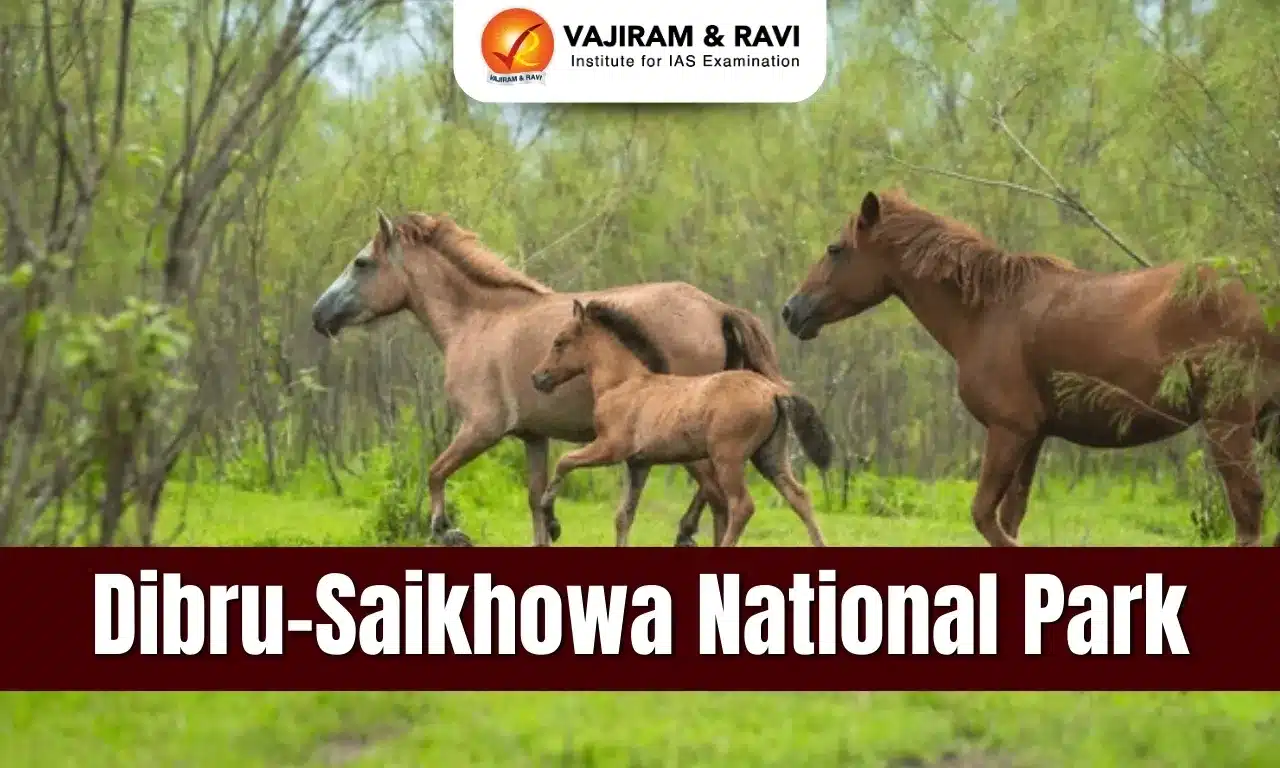
Dibru-Saikhowa National Park is located in the Dibrugarh and Tinsukia districts of Assam and is one of India’s most important riverine protected areas. Surrounded by the Brahmaputra, Lohit, and Dibru rivers, it is known for its wetlands, swamp forests, and rich biodiversity. The park supports diverse flora, including semi-evergreen forests, grasslands, and the largest Salix swamp forest in Northeast India. It is home to rare fauna such as the White-winged Wood Duck, Royal Bengal Tiger, Wild Water Buffalo, and over 350 bird species.
Dibru Saikhowa National Park
Dibru-Saikhowa National Park is a renowned protected area in Assam, famous for its riverine forests, wetlands, and exceptional wildlife diversity. Established as a National Park in 1999, it also forms the core of the Dibru-Saikhowa Biosphere Reserve. The park is an important habitat for endangered species, migratory birds, and the rare White-winged Wood Duck, making it a biodiversity hotspot in Northeast India.
Dibru Saikhowa National Park History
The history of Dibru-Saikhowa National Park reflects over a century of conservation efforts aimed at protecting Assam’s unique riverine forests, wetlands, and endangered wildlife. Over time, the area evolved from reserved forests into a Wildlife Sanctuary, Biosphere Reserve, and finally a National Park.
- 1890: The area was first declared as the Dibru Reserved Forest.
- 1920: Additional forest land was added to the Dibru Reserved Forest.
- 1929: The Saikhowa Reserved Forest was established.
- 1933: More forest area was incorporated into the Dibru Reserved Forest.
- 1986: Around 650 sq. km was proposed as a Wildlife Sanctuary.
- 1995: A 340 sq. km area was officially notified as the Dibru-Saikhowa Wildlife Sanctuary.
- 1997: It was designated as the Dibru-Saikhowa Biosphere Reserve, covering 765 sq. km with a 340 sq. km core area and a 425 sq. km buffer zone.
- 1999: The core sanctuary area was declared Dibru-Saikhowa National Park.
- The park was originally established to conserve the endangered White-winged Wood Duck and its fragile wetland habitat.


Dibru Saikhowa National Park Flora
The flora of Dibru-Saikhowa National Park is highly diverse due to its fertile floodplains, wetlands, and tropical monsoon climate. The park supports a mix of swamp forests, grasslands, riverine vegetation, and semi-evergreen forests, providing vital habitats for a wide range of wildlife.
- Salix (Willow) Forests: The park contains the largest Salix swamp forest in Northeast India.
- Moist Semi-evergreen Forests: Dominated by tree species adapted to high rainfall and humid conditions.
- Moist Deciduous Forests: Home to a variety of broad-leaved trees that shed leaves seasonally.
- Riverine Forests: Found along the banks of the Brahmaputra, Lohit, and Dibru rivers.
- Grasslands: Tall elephant grass and reed beds support herbivores and ground-nesting birds.
- Canebrakes: Dense cane thickets provide shelter for many mammals and birds.
- Bamboo Groves: Various bamboo species thrive in the park’s floodplain ecosystem.
- Important Tree Species: Hollong, Nahor, Simul, Sissoo, Khair, and Jamun are commonly found.
- Aquatic Vegetation: Water lilies, lotus, reeds, sedges, and floating aquatic plants flourish in wetlands and marshes.
Dibru Saikhowa National Park Fauna
The fauna of Dibru-Saikhowa National Park is highly diverse, with a rich variety of mammals, birds, reptiles, amphibians, and fish inhabiting its forests, wetlands, and riverine ecosystems. The park is an important refuge for several endangered species and migratory birds.
- Royal Bengal Tiger is one of the park’s top predators and an important flagship species.
- Asian Elephant, Wild Water Buffalo, Leopard, Clouded Leopard, Fishing Cat, Jungle Cat, Hog Deer, Sambar Deer, and Barking Deer are commonly found.
- Primates such as the Capped Langur, Slow Loris, and Assamese Macaque inhabit the forested areas.
- The park is famous for its population of Feral Horses, believed to be descendants of abandoned domestic horses.
- More than 350 bird species, including the White-winged Wood Duck, Black-breasted Parrotbill, Greater Adjutant, Spot-billed Pelican, Grey-headed Fish Eagle, and several migratory birds, have been recorded.
- Indian Python, King Cobra, Monitor Lizard, Freshwater Turtles, along with numerous freshwater fish species such as Rohu, Catla, Mrigal, and Mahseer, thrive in the park’s rivers and wetlands.
Dibru Saikhowa National Park Climate & Vegetation
The climate and vegetation of Dibru-Saikhowa National Park are shaped by the tropical monsoon climate, heavy rainfall, and the floodplains of the Brahmaputra, Lohit, and Dibru rivers. These conditions support diverse forests, wetlands, and grasslands that sustain the park’s rich biodiversity.
- The park experiences a tropical monsoon climate with hot, humid summers and cool, relatively dry winters.
- It receives an annual rainfall of about 2,300–3,800 mm, mainly during the southwest monsoon season.
- Seasonal flooding by the Brahmaputra and its tributaries replenishes nutrients and maintains the park’s wetland ecosystem.
- The vegetation includes moist mixed semi-evergreen forests, moist mixed deciduous forests, riverine forests, grasslands, canebrakes, and marshy wetlands.
- Dibru-Saikhowa is home to the largest Salix (willow) swamp forest in Northeast India, making it ecologically unique.
- Extensive elephant grass, bamboo groves, reeds, aquatic plants, and riparian vegetation provide ideal habitats for numerous mammals, birds, reptiles, and aquatic species.
Dibru Saikhowa National Park Conservation Efforts
Dibru-Saikhowa National Park is protected through various conservation initiatives aimed at preserving its unique riverine ecosystem, wetlands, and endangered wildlife. These efforts focus on habitat protection, biodiversity conservation, and sustainable management of natural resources.
- Protected Area Status: Declared a Wildlife Sanctuary (1995), Biosphere Reserve (1997), and National Park (1999) to ensure long-term conservation.
- Habitat Conservation: Wetlands, swamp forests, grasslands, and riverine habitats are protected to support diverse plant and animal species.
- Wildlife Protection: Regular anti-poaching patrols and wildlife monitoring help safeguard endangered species such as the White-winged Wood Duck, Royal Bengal Tiger, and Wild Water Buffalo.
- Biodiversity Monitoring: Periodic surveys are conducted to monitor populations of birds, mammals, reptiles, and aquatic species.
- Community Participation: Local communities are encouraged to participate in eco-tourism, conservation awareness, and sustainable livelihood initiatives.
- Legal Protection: In 2020, the Gauhati High Court stayed permission for hydrocarbon exploration inside the protected area, reinforcing the park’s ecological importance and legal safeguards.

 Last updated on Oct, 2026
→ UPSC 2027 Notification will be released on 13 January 2027 at upsconline.nic.in.
→ Check Nobel Prize 2026 Winners List here.
→ Download PIB PRiSM Monthly Magazine 2026 here.
→ Check UPSC Monthly Current Affairs Magazine The Recitals here.
→ Check out the latest UPSC Syllabus here.
→ Download UPSC Model Answers for Mains 2026
→ UPSC Mains Question Paper 2026 is out now for Essay & GS Paper 1, 2, 3 & 4.
→ UPSC Calendar 2027 has been released.
→ Enroll in Vajiram & Ravi’s UPSC Mains Test Series 2027 for structured answer writing practice, expert evaluation, and exam-oriented feedback.
→ Join Vajiram & Ravi’s UPSC Mentorship Program 2027 for personalized guidance, strategy planning, and one-to-one support from experienced mentors.
→ Go through the UPSC Mains Previous Year Papers to enhance your preparation.
→ UPSC has released UPSC Toppers List 2025 with the Civil Services final result on its official website.
→ Also check Best UPSC Coaching in India
Dibru Saikhowa National Park FAQs
Q1. Where is Dibru-Saikhowa National Park located?+
Q2. Why is Dibru-Saikhowa National Park famous?+
Q3. When was Dibru-Saikhowa declared a National Park?+
Q4. What is the area of Dibru-Saikhowa Biosphere Reserve?+
Q5. Which rivers surround Dibru-Saikhowa National Park?+
Q6. Which endangered species are found in Dibru-Saikhowa National Park?+
Tags: dibru saikhowa national park geography geography notes