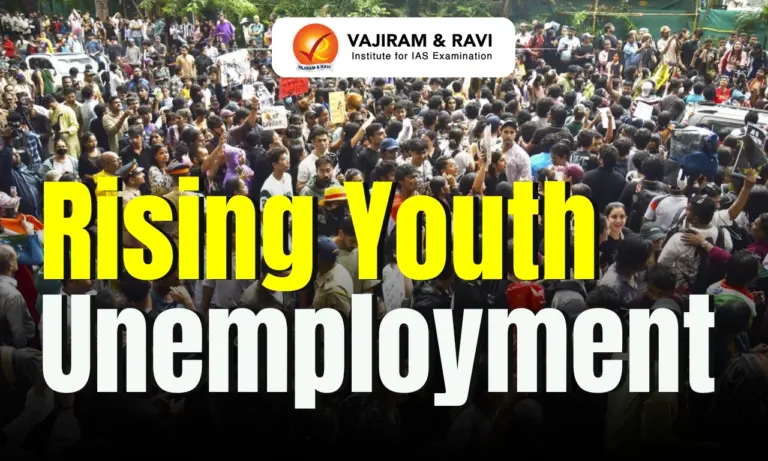
Rising Youth Unemployment Latest News
- The NEET paper leak triggered the Cockroach Janata Party (CJP)-led protests, and Union Education Minister Dharmendra Pradhan has resigned as a result.
- However, economists argue that the unrest exposes a far deeper structural problem — rising youth unemployment that threatens India’s demographic dividend.
The Numbers
- According to the Periodic Labour Force Survey (PLFS), unemployment among Indian youth (15–29 age bracket) rose to 16.2% in June 2026, up from 13.8% in April 2025 — the highest on record since monthly data collection began.
- Caveat: The Ministry of Statistics and Programme Implementation (MoSPI) has cautioned that monthly fluctuations don’t necessarily indicate secular trends, given seasonal, academic, and labour market variations.


Two Troubling Trends
- Broad-based rise: Unemployment increased across all six youth categories tracked over 15 months — males and females, at the all-India, urban, and rural levels.
- Falling participation, rising unemployment: Youth unemployment rose even as the Labour Force Participation Rate (LFPR) — the share of people looking for work — declined in nearly every category.
- Overall youth LFPR fell from 42.7% to 40.3%.
- Only urban male LFPR rose, reaching 60.1% (up 1 percentage point).
- Normally, a falling LFPR should reduce unemployment even without new job creation — but this hasn’t happened, signalling deeper labour market stress.
- For context: The overall unemployment rate (15+ age group) was a comparatively stable 5.5% in June (versus 5.6% in April 2025), with LFPR at 54.4%.
A Long-Term, Not Just Cyclical, Problem
- Annual data confirms the trend isn’t new:
- Of 36 states/UTs, youth unemployment in 2025 was higher than in 2022 in 13 of them — including Andhra Pradesh (16.2% from 15.1%), Delhi (14.4% from 5.9%), Telangana (18.1% from 12.6%), and West Bengal (10.6% from 8.4%).
- For young women, the situation is worse: 16 states/UTs saw rising unemployment over the same period.
Weakening Informal Sector
- The informal sector — traditionally a job-absorption cushion — is also faltering:
- Informal sector job creation fell to 74.5 lakh in 2025, down sharply from 1.1 crore in the year ending September 2024 (MoSPI’s Annual Survey of Unincorporated Sector Enterprises).
- Wage growth slowed to 3.9%, down from 13%.
The Education-Employment Mismatch
- Despite years of additional schooling, less than 7% of male Indian graduates find a permanent salaried job within a year of graduating (Azim Premji University’s State of Working India 2026 report).
- For white-collar jobs specifically, this figure drops to just 3.7%.
- An estimated 1.1 crore of 6.3 crore graduates aged 20–29 were unemployed in 2023.
- Graduate youth unemployment (under 25) rose to 39.33% in 2023, up from 35.02% in 1983 — showing this is a persistent structural issue, not a recent shock.
Why This Threatens India’s Demographic Dividend
- India’s median age (~29 years) is rising and expected to reach 38 by 2050.
- The current period is the critical window for India’s working-age population to earn and drive economic growth — not just build future safety nets.
- As per an Observer Research Foundation paper (March 2026): by the 2040s, the dependency ratio will rise and fiscal space will tighten, meaning demography will no longer automatically drive growth.
- Without productivity, innovation, and institutional gains, progress could stall once India’s population peaks.
Conclusion
- The CJP protests may have been sparked by a single exam paper leak, but the underlying grievance is structural: a growing mismatch between education and employment, a shrinking informal sector safety net, and a shrinking window to convert India’s youth bulge into economic growth.
- Without urgent, sustained job creation, India risks squandering its demographic dividend before it fully arrives.
Source: IE

 Last updated on Sep, 2026
→ UPSC 2027 Notification will be released on 13 January 2027 at upsconline.nic.in.
→ Asian Games 2026 are being held in Aichi-Nagoya, Japan, from 19 September to 4 October.
→ Check out the latest UPSC Syllabus here.
→ Download UPSC Model Answers for Mains 2026
→ UPSC Mains Question Paper 2026 is out now for Essay & GS Paper 1, 2, 3 & 4.
→ UPSC Calendar 2027 has been released.
→ Enroll in Vajiram & Ravi’s UPSC Mains Test Series 2027 for structured answer writing practice, expert evaluation, and exam-oriented feedback.
→ Join Vajiram & Ravi’s UPSC Mentorship Program 2027 for personalized guidance, strategy planning, and one-to-one support from experienced mentors.
→ Go through the UPSC Mains Previous Year Papers to enhance your preparation.
→ UPSC has released UPSC Toppers List 2025 with the Civil Services final result on its official website.
→ Also check Best UPSC Coaching in India
Rising Youth Unemployment FAQs
Q1. Why has Rising Youth Unemployment become a major policy concern in India?+
Q2. How does Rising Youth Unemployment threaten India's demographic dividend?+
Q3. What role does the informal sector play in Rising Youth Unemployment?+
Q4. Why is the education-employment mismatch central to Rising Youth Unemployment?+
Q5. What policy measures can address Rising Youth Unemployment?+
Tags: mains articles Rising Youth Unemployment upsc current affairs upsc mains current affairs