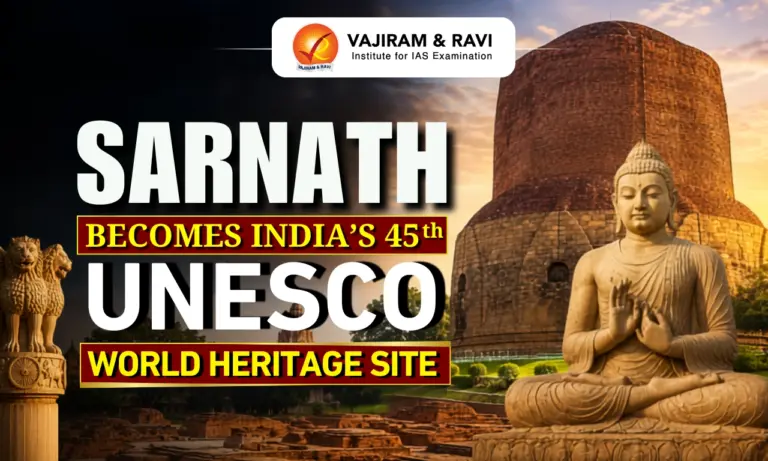
Sarnath has officially been inscribed as India’s 45th UNESCO World Heritage Site, marking a significant milestone in the country’s cultural heritage. Located near Varanasi in Uttar Pradesh, Sarnath is one of the holiest places in Buddhism, where Gautama Buddha delivered his first sermon after attaining enlightenment. The UNESCO recognition highlights Sarnath’s outstanding universal value, its rich archaeological remains, and its lasting contribution to world history, religion, and culture. India ranks 6th globally and 2nd in the Asia-Pacific region for the highest number of UNESCO World Heritage Sites.
India also has 69 sites in the Tentative List of the World Heritage, which is a mandatory threshold for any site to be considered as a World Heritage property in the future.
Sarnath History
Sarnath is one of the oldest and most sacred Buddhist sites in the world, with a history spanning over 2,500 years. It gained prominence after Gautama Buddha delivered his first sermon here following his enlightenment, making it the birthplace of the Buddhist Sangha.
- Ancient Name: Sarnath was originally known as Isipatana or Rishipattana, meaning the “place of sages.”
- First Sermon: Around the 6th century BCE, Gautama Buddha delivered the Dhammacakkappavattana Sutta (First Sermon) to his five disciples.
- Mauryan Patronage: Emperor Ashoka visited Sarnath in the 3rd century BCE and built stupas, monasteries, and the famous Ashokan Pillar.
- Gupta Period: Between the 4th and 6th centuries CE, Sarnath flourished as a major centre of Buddhist learning, art, and architecture.
- Medieval Decline: The site declined after invasions during the 12th century CE, leading to the destruction of many Buddhist structures.
- Rediscovery: Archaeological excavations in the 19th century uncovered stupas, monasteries, sculptures, and inscriptions, restoring Sarnath’s historical significance.
Also Read: UNESCO Adds D-Day Landing Beaches, Mount Olympus and Other Sites to World Heritage List
Teachings of Gautama Buddha at Sarnath
At Sarnath, Gautama Buddha delivered his first sermon, known as the Dhammacakkappavattana Sutta (Setting the Wheel of Dharma in Motion). This sermon laid the foundation of Buddhist philosophy and marked the beginning of the Buddhist Sangha (monastic community).
- Four Noble Truths: Explained the nature, cause, cessation of suffering, and the path to liberation.
- Noble Eightfold Path: Taught the path to enlightenment through Right View, Right Intention, Right Speech, Right Action, Right Livelihood, Right Effort, Right Mindfulness, and Right Concentration.
- Middle Path (Madhyama Marga): Advocated avoiding both extreme luxury and severe self-mortification.
- Compassion (Karuna): Encouraged kindness, empathy, and non-violence towards all living beings.
- Non-Attachment: Taught that freedom from desire and attachment leads to inner peace.
- Self-Discipline: Emphasised ethical conduct, meditation, and wisdom as the means to attain enlightenment.
- Formation of the Sangha: The first five disciples accepted Buddha’s teachings, leading to the establishment of the first Buddhist monastic community.
- Universal Message: The teachings promoted peace, equality, tolerance, and moral living, influencing societies across Asia and the world.


Major Archaeological Remains at Sarnath
Sarnath is home to several archaeological monuments that reflect its importance as an ancient centre of Buddhism, art, and learning. These structures, built over different historical periods, provide valuable insights into India’s cultural and religious heritage.
- Dhamek Stupa: Built to commemorate Gautama Buddha’s first sermon, this massive cylindrical stupa is the most prominent monument at Sarnath and features intricate Gupta-period carvings.
- Chaukhandi Stupa: Marks the place where Buddha met his first five disciples before delivering his first sermon. It was later modified with an octagonal tower during the Mughal period.
- Ashokan Pillar: Erected by Emperor Ashoka in the 3rd century BCE. Its Lion Capital, now preserved in the Sarnath Museum, is the National Emblem of India.
- Sarnath Archaeological Museum: India’s first site museum, housing the Lion Capital of Ashoka, Buddhist sculptures, inscriptions, relics, and Gupta-era masterpieces.
- Mulagandha Kuti: The remains of an ancient monastery believed to mark the place where Buddha spent his first rainy season after enlightenment.
- Ancient Monasteries (Viharas): Excavated brick monasteries reveal Sarnath’s role as a major centre of Buddhist education and monastic life.
- Dharmarajika Stupa: Originally constructed by Emperor Ashoka to enshrine Buddhist relics. Although largely destroyed in the 18th century, its remains remain archaeologically significant.
- Temple Ruins: Foundations of several temples and shrines demonstrate the continuous development of Buddhist architecture from the Mauryan to the medieval period.
- Stone Sculptures and Inscriptions: Numerous statues of Buddha, Bodhisattvas, and inscriptions discovered at Sarnath showcase the excellence of Gupta-period art and provide important historical records.
UNESCO World Heritage Convention
The UNESCO World Heritage Convention is an international treaty adopted in 1972 to identify, protect, conserve, and preserve cultural and natural heritage of outstanding universal value.
- Adopted by: UNESCO General Conference in 1972.
- Official Name: Convention Concerning the Protection of the World Cultural and Natural Heritage.
- Objective: To safeguard cultural and natural heritage for present and future generations.
- Administered by: UNESCO World Heritage Committee.
- Selection Basis: Sites are inscribed based on Outstanding Universal Value (OUV) and fulfil one or more of the 10 UNESCO selection criteria.
- Types of Heritage: Covers Cultural, Natural, and Mixed World Heritage Sites.
- International Cooperation: Encourages technical, financial, and scientific assistance among member countries for heritage conservation.
- State Parties: Countries that ratify theHeritage Convention are responsible for identifying, protecting, and managing World Sites within their territory.
- India’s Participation: India ratified the Convention in 1977 and has 45 UNESCO World Heritage Sites after the inscription of Sarnath.
- Significance: Promotes heritage conservation, sustainable tourism, cultural exchange, and global awareness of humanity’s shared heritage.
Sarnath’s Role in the Spread of Buddhism
Sarnath played a pivotal role in the growth of Buddhism as it was here that Gautama Buddha delivered his first sermon and established the first Buddhist Sangha.
- Birthplace of the Sangha: The first Buddhist monastic community (Sangha) was established at Sarnath with Buddha’s first five disciples.
- Centre of Learning: Sarnath developed into a renowned centre for Buddhist education, philosophy, and monastic training.
- Royal Patronage: Emperor Ashoka promoted Buddhism by constructing stupas, monasteries, and the Ashokan Pillar at Sarnath.
- Pilgrimage Centre: It became one of the four holiest Buddhist pilgrimage sites, attracting devotees from across the world.
- Spread Across Asia: Monks and scholars travelling from Sarnath helped disseminate Buddhist teachings to Sri Lanka, China, Tibet, Myanmar, Thailand, Japan, Korea, and other Asian regions.
- Accounts of Foreign Travellers: Chinese pilgrims Faxian and Xuanzang documented Sarnath’s prosperity and importance, providing valuable historical evidence.
- Promotion of Buddhist Art: Sarnath became famous for its distinctive Gupta-style Buddhist sculptures, which influenced Buddhist art across Asia.

 Last updated on Sep, 2026
→ UPSC 2027 Notification will be released on 13 January 2027 at upsconline.nic.in.
→ Asian Games 2026 are being held in Aichi-Nagoya, Japan, from 19 September to 4 October.
→ Check out the latest UPSC Syllabus here.
→ Download UPSC Model Answers for Mains 2026
→ UPSC Mains Question Paper 2026 is out now for Essay & GS Paper 1, 2, 3 & 4.
→ UPSC Calendar 2027 has been released.
→ Enroll in Vajiram & Ravi’s UPSC Mains Test Series 2027 for structured answer writing practice, expert evaluation, and exam-oriented feedback.
→ Join Vajiram & Ravi’s UPSC Mentorship Program 2027 for personalized guidance, strategy planning, and one-to-one support from experienced mentors.
→ Go through the UPSC Mains Previous Year Papers to enhance your preparation.
→ UPSC has released UPSC Toppers List 2025 with the Civil Services final result on its official website.
→ Also check Best UPSC Coaching in India
Sarnath Becomes India's 45th UNESCO World Heritage Site FAQs
Q1. Why has Sarnath been declared a UNESCO World Heritage Site?+
Q2. Where is Sarnath located?+
Q3. Why is Sarnath important in Buddhism?+
Q4. Which monument at Sarnath is India's National Emblem associated with?+
Q5. What are the major monuments at Sarnath?+
Tags: sarnath becomes india's 45th UNESCO world heritage site UNESCO world heritage site