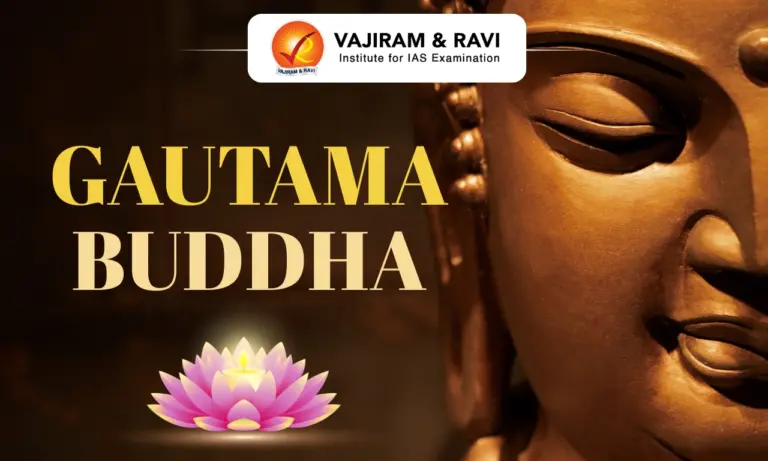
Gautam Buddha was one of the greatest spiritual teachers and the founder of Buddhism. Born as Siddhartha Gautama, he attained enlightenment after years of meditation and dedicated his life to teaching the path to end human suffering. His teachings on compassion, non-violence, ethical living, and the Middle Path transformed Indian society and spread across many parts of Asia. Even today, Gautam Buddha’s life, philosophy, and teachings continue to inspire people to lead peaceful, balanced, and meaningful lives.
Who Was Gautam Buddha?
Gautam Buddha was one of the greatest spiritual teachers and philosophers of ancient India. He was the founder of Buddhism, one of the world’s major religions. Born as Siddhartha Gautama in the 6th century BCE, he belonged to the Shakya clan of the Kshatriya community.
After witnessing the realities of human life, including old age, disease, and death, Siddhartha renounced his royal life in search of truth and a way to overcome human suffering. After years of meditation and spiritual practice, he attained enlightenment under the Bodhi Tree at Bodh Gaya and became known as Buddha, meaning “the Enlightened One.”
Life and Early Years of Gautam Buddha
Gautam Buddha, originally known as Siddhartha Gautama, was born in the 6th century BCE at Lumbini in present-day Nepal. Born into a royal family, he lived a luxurious life but later renounced worldly comforts to search for the truth about human suffering and the path to enlightenment.
- Siddhartha Gautama was born around 563 BCE to King Suddhodana, the ruler of the Shakya clan, and Queen Maya Devi.
- His mother passed away shortly after his birth, and he was raised by his maternal aunt Mahaprajapati Gautami.
- He belonged to the Kshatriya class and was brought up as a prince in the Shakya kingdom.
- According to Buddhist traditions, sages predicted that Siddhartha would either become a great ruler or a great spiritual teacher.
- His father wanted him to become a powerful king and protected him from witnessing the hardships of life.
- Siddhartha spent his early years surrounded by wealth, comfort, and royal privileges.
- He received education in subjects like warfare, administration, philosophy, and religious teachings suitable for a prince.
- He married Yashodhara and later had a son named Rahula.
- Despite having a comfortable life, Siddhartha felt deeply concerned about the problems of human existence.
- His perspective changed after seeing the Four Sights, an old person, a sick person, a dead body, and a monk.
- These experiences made him realise that wealth and material pleasures could not provide permanent happiness.
- At the age of 29, Siddhartha left his palace, family, and royal responsibilities in search of spiritual knowledge.
- This event is known as Mahabhinishkramana (The Great Renunciation) and marked the beginning of his journey towards enlightenment.


The Four Great Events in Gautam Buddha’s Life
The life of Gautam Buddha is marked by four major events that represent his journey from a royal prince to an enlightened spiritual teacher. These events, Birth, Enlightenment, First Sermon, and Mahaparinirvana are considered the most important milestones in Buddhist tradition.
Birth at Lumbini
- Gautam Buddha was born as Siddhartha Gautama around 563 BCE at Lumbini in present-day Nepal.
- He was born to King Suddhodana and Queen Maya Devi of the Shakya clan.
- His birth is celebrated as Buddha Purnima or Vesak by followers of Buddhism.
- Lumbini is recognised as one of the four major Buddhist pilgrimage sites.
Enlightenment at Bodh Gaya
- After leaving his royal life at the age of 29, Siddhartha Gautama spent years practising meditation and searching for the truth.
- He attained enlightenment at the age of 35 under the Bodhi Tree at Bodh Gaya in present-day Bihar.
- After attaining enlightenment, he became known as Buddha, meaning “The Enlightened One.”
- He gained knowledge about the causes of suffering and discovered the path to liberation.
First Sermon at Sarnath
- After enlightenment, Buddha delivered his first sermon at Deer Park, Sarnath, near Varanasi.
- This event is known as Dharmachakra Pravartana, meaning “Turning of the Wheel of Dharma.”
- In this sermon, he explained the Four Noble Truths and the Eightfold Path.
- This marked the beginning of the spread of Buddhist teachings and the formation of the Buddhist Sangha.
Mahaparinirvana at Kushinagar
- Gautam Buddha attained Mahaparinirvana at the age of 80 at Kushinagar in present-day Uttar Pradesh.
- It marked his final liberation from the cycle of birth, death, and rebirth.
- Before his death, Buddha advised his followers to follow his teachings and practice self-discipline.
- Kushinagar became an important Buddhist pilgrimage centre after this event.
Teachings of Gautam Buddha Four Noble Truths and Eightfold Path
The teachings of Gautam Buddha focus on understanding the causes of human suffering and finding a practical way to achieve peace and liberation. His philosophy is mainly based on the Four Noble Truths and the Eightfold Path, which form the foundation of Buddhism. These teachings guide individuals towards ethical living, self-control, wisdom, and the attainment of Nirvana.
Four Noble Truths
The Four Noble Truths are the core principles taught by Buddha after attaining enlightenment. They explain the nature of suffering and the path to overcome it.
- Truth of Suffering (Dukkha)
- Buddha explained that suffering is an unavoidable part of human life.
- Birth, ageing, illness, death, separation from loved ones, and unfulfilled desires are different forms of suffering.
- He believed that understanding the reality of suffering is the first step towards finding a solution.
- Truth of the Cause of Suffering (Samudaya)
- According to Buddha, the main cause of suffering is desire, attachment, and ignorance.
- Human beings suffer because they develop strong attachments to material possessions, relationships, and expectations.
- The endless cycle of desire and dissatisfaction keeps individuals away from true happiness.
- Truth of the End of Suffering (Nirodha)
- Buddha taught that suffering can be overcome by eliminating desires and attachments.
- The complete freedom from suffering is known as Nirvana.
- Nirvana represents a state of peace, wisdom, and liberation from the cycle of birth and rebirth.
- Truth of the Path Leading to the End of Suffering (Magga)
- Buddha explained that the way to overcome suffering is through the Eightfold Path.
- This path helps individuals develop moral conduct, mental discipline, and wisdom.
Eightfold Path of Buddhism
The Eightfold Path is the practical way taught by Gautam Buddha to overcome suffering and achieve Nirvana. It focuses on developing wisdom, ethical conduct, and mental discipline.
- Right View (Samyak Drishti): Understanding the true nature of life, including the Four Noble Truths, karma, and the causes of suffering.
- Right Intention (Samyak Sankalpa): Developing positive thoughts, compassion, kindness, and avoiding hatred, greed, and harmful desires.
- Right Speech (Samyak Vacha): Speaking truthfully and avoiding lies, abusive language, gossip, and words that create conflict.
- Right Action (Samyak Karmanta): Following moral behaviour by practising non-violence, honesty, and respecting all living beings.
- Right Livelihood (Samyak Ajiva): Choosing an ethical profession that does not cause harm to others.
- Right Effort (Samyak Vyayama): Making continuous efforts to remove negative qualities and develop positive thoughts and actions.
- Right Mindfulness (Samyak Smriti): Maintaining awareness of one’s thoughts, emotions, actions, and surroundings.
- Right Concentration (Samyak Samadhi): Practising meditation and developing mental focus to achieve inner peace and wisdom.
Core Philosophy and Principles of Buddhism
The philosophy of Buddhism is based on Gautam Buddha’s teachings about overcoming suffering through wisdom, ethical conduct, and self-discipline. It focuses on achieving peace, compassion, and liberation.
- Middle Path (Madhyam Marg): Buddha taught a balanced way of life by avoiding both luxury and extreme hardship.
- Four Noble Truths: It explains the nature of suffering, its causes, the end of suffering, and the path to liberation.
- Concept of Karma: Every action has consequences, and good deeds lead to positive outcomes.
- Nirvana: The ultimate goal of Buddhism is liberation from suffering and the cycle of birth and rebirth.
- Ahimsa (Non-Violence): Buddha promoted peace, kindness, and respect for all living beings.
- Compassion (Karuna): Buddhism encourages empathy, love, and concern for others.
- Anitya (Impermanence): It teaches that everything in life is temporary and constantly changing.
- Anatta (No Permanent Self): Buddhism rejects the idea of a fixed and permanent self.
- Meditation and Mindfulness: These practices help develop awareness, concentration, and inner peace.
- Equality and Social Harmony: Buddha emphasised equality and opposed discrimination based on birth.
- Ethical Living: Buddhism promotes truthfulness, moral conduct, and self-control.

 Last updated on Oct, 2026
→ UPSC 2027 Notification will be released on 13 January 2027 at upsconline.nic.in.
→ Asian Games 2026 are being held in Aichi-Nagoya, Japan, from 19 September to 4 October.
→ Check Nobel Prize 2026 Winners List here.
→ Download PIB PRiSM Monthly Magazine 2026 here.
→ Check UPSC Monthly Current Affairs Magazine The Recitals here.
→ Check out the latest UPSC Syllabus here.
→ Download UPSC Model Answers for Mains 2026
→ UPSC Mains Question Paper 2026 is out now for Essay & GS Paper 1, 2, 3 & 4.
→ UPSC Calendar 2027 has been released.
→ Enroll in Vajiram & Ravi’s UPSC Mains Test Series 2027 for structured answer writing practice, expert evaluation, and exam-oriented feedback.
→ Join Vajiram & Ravi’s UPSC Mentorship Program 2027 for personalized guidance, strategy planning, and one-to-one support from experienced mentors.
→ Go through the UPSC Mains Previous Year Papers to enhance your preparation.
→ UPSC has released UPSC Toppers List 2025 with the Civil Services final result on its official website.
→ Also check Best UPSC Coaching in India
Gautam Buddha FAQs
Q1. Who was Gautam Buddha?+
Q2. Where was Gautam Buddha born?+
Q3. What was the original name of Gautam Buddha?+
Q4. Why did Siddhartha Gautama leave his palace?+
Q5. Where did Gautam Buddha attain enlightenment?+
Tags: biography buddhism gautam buddha sects of buddhism