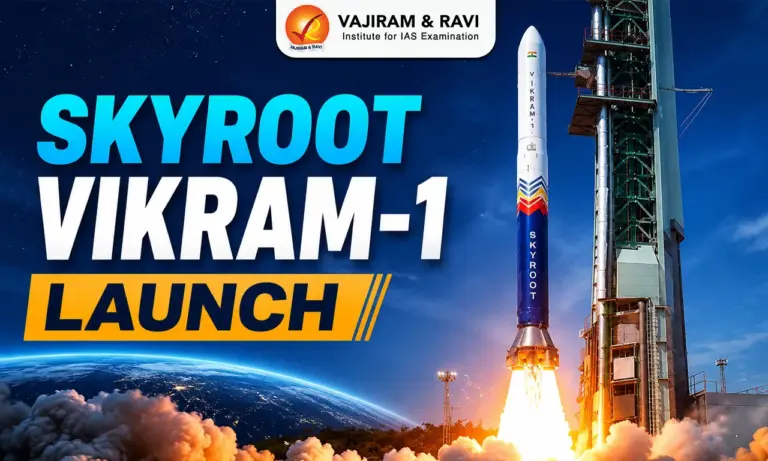
India created a new milestone in space exploration on 18 July 2026 with the successful Skyroot Vikram-1 Launch. It is the first privately developed orbital launch vehicle of India. The Vikram 1 has been launched from the Satish Dhawan Space Centre, Sriharikota. The mission successfully placed multiple technology demonstration payloads into Low Earth Orbit (LEO).
Mission Aagaman makes India as the third country in the world to achieve private orbital launch capability through a privately developed rocket and marked a significant step in expanding the country’s commercial space ecosystem.
Skyroot Vikram-1 Rocket Launch 2026
Skyroot Vikram-1 Launch 2026 marked India’s entry into the private orbital launch era with a successful maiden mission carrying multiple demonstration payloads. The launch came 46 years after SLV-3 placed the Rohini (RS-1) satellite into orbit from the same launch centre on 18 July 1980, linking two landmark moments in India’s space journey.
Skyroot Vikram-1 Rocket Launch Features
Skyroot Aerospace developed Vikram-1 entirely in India, showcasing the growing strength of the country’s private space industry.
- Company Profile: Skyroot Aerospace is a Hyderabad based private aerospace company that developed Vikram-1 as its first orbital launch vehicle after the successful Vikram-S suborbital mission in November 2022.
- Leadership: The company was co-founded by Pawan Kumar Chandana, who serves as Co-founder and Chief Executive Officer (CEO) and described the mission as the foundation for future regular launch services.
- Authorisation: The mission received launch approval from the Indian National Space Promotion and Authorisation Centre (IN-SPACe), which regulates and promotes private space activities in India.
- Future Vision: Skyroot plans to begin full commercial launches after one or two successful demonstration missions, aiming to provide dedicated launch services for small satellites.


Vikram-1 Rocket Features
Vikram-1 Rocket combines advanced indigenous technologies with lightweight design for efficient launches of small satellites into orbit.
- Rocket Design: Vikram-1 is a 22 metre high, 1.7 metre diameter, seven storey, multi stage orbital launch vehicle. It is built using an all carbon composite structure for reduced weight and improved performance.
- Payload Capacity: Vikram-1 is designed to carry up to 350 kg of payload into Low Earth Orbit, with its maiden mission targeting a 450 km orbit at a 60° inclination.
- Technological Firsts:
- Vikram-1 is India’s first all carbon composite orbital rocket,
- the first orbital vehicle with a 100% 3D printed engine,
- the longest monolithic carbon composite rocket stage and features an ultra-low-shock pneumatic separation system.
Mission Aagaman 2026
Mission Aagaman 2026 demonstrated new launch technologies while successfully deploying multiple technology payloads into orbit for future commercial missions.
- Mission Objective: The primary goal was to achieve safe lift off, tower clearance, successful orbital injection and collect maximum flight data to validate Vikram-1 under actual operating conditions.
- Mission Profile: The complete mission lasted about 15.46 minutes and covered 14 flight phases, generating valuable engineering data for future improvements and regular launch operations.
- Special Highlights: A handwritten postcard from Prime Minister of India Narendra Modi carrying the message “Vande Mataram“, along with postcards from engineers and well wishers, travelled into space, symbolising India’s growing private space capabilities.

 Last updated on Oct, 2026
→ UPSC 2027 Notification will be released on 13 January 2027 at upsconline.nic.in.
→ Check Nobel Prize 2026 Winners List here.
→ Download PIB PRiSM Monthly Magazine 2026 here.
→ Check UPSC Monthly Current Affairs Magazine The Recitals here.
→ Check out the latest UPSC Syllabus here.
→ Download UPSC Model Answers for Mains 2026
→ UPSC Mains Question Paper 2026 is out now for Essay & GS Paper 1, 2, 3 & 4.
→ UPSC Calendar 2027 has been released.
→ Enroll in Vajiram & Ravi’s UPSC Mains Test Series 2027 for structured answer writing practice, expert evaluation, and exam-oriented feedback.
→ Join Vajiram & Ravi’s UPSC Mentorship Program 2027 for personalized guidance, strategy planning, and one-to-one support from experienced mentors.
→ Go through the UPSC Mains Previous Year Papers to enhance your preparation.
→ UPSC has released UPSC Toppers List 2025 with the Civil Services final result on its official website.
→ Also check Best UPSC Coaching in India
Skyroot Vikram-1 Launch 2026 FAQs
Q1. What is Skyroot Vikram-1?+
Q2. Who developed the Vikram-1 Rocket?+
Q3. When was Skyroot Vikram-1 launched?+
Q4. What is Mission Aagaman 2026?+
Q5. What are the major achievements of Skyroot Vikram-1 Launch 2026?+
Tags: skyroot vikram-1 launch space mission