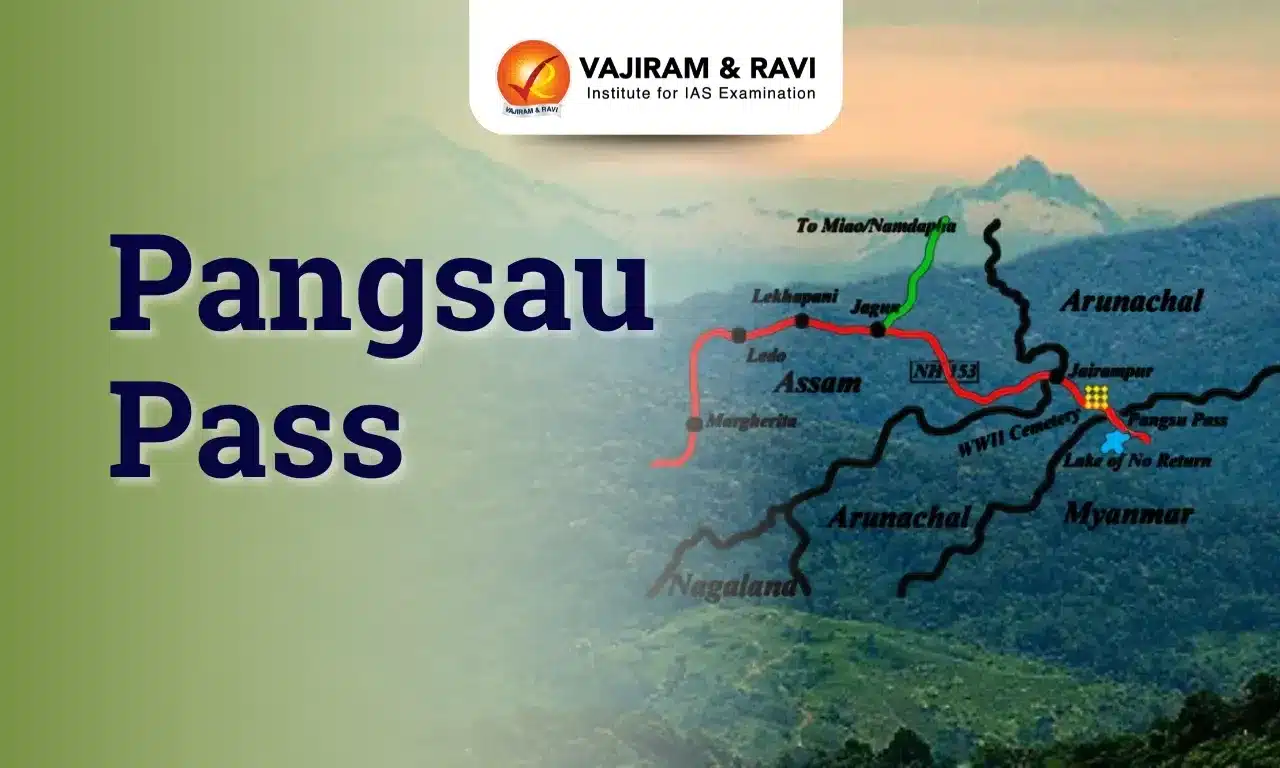
Pangsau Pass is also known as ‘Pan Saung Pass’, ‘Hell Pass’ and ‘Hell Gate’. It is a historic mountain pass located on the crest of the Patkai Hills along the India-Myanmar border in Changlang district of Arunachal Pradesh. It is situated at an altitude of 1,136 metres. It is one of the easiest natural routes connecting the Assam plains with Myanmar. It is an important geographical, historical, cultural and strategic landmark.
Pangsau Pass
Pangsau Pass lies on the ridge of the Patkai Hills at the India-Myanmar border in Arunachal Pradesh. It is named after Pangsau, the nearest Myanmar village located about 2 km east of the pass. The pass is closely associated with the Stilwell Road, the Second World War, the Shan tribe’s movement into Assam and the famous Lake of No Return. It provides one of the most accessible land routes between the Assam plains and Myanmar and has remained an important border gateway for centuries.
Pangsau Pass Features
Pangsau Pass is known for its geographical, historical and strategic importance. It also attracts visitors because of its natural beauty and wartime heritage.
- Height: Located at 3,727 feet (1,136 metres), the pass lies across densely forested Patkai Hills.
- Terrain: Its steep slopes, heavy rainfall and muddy tracks earned it the wartime nickname “Hell Pass” or “Hell Gate.”
- Mountain Range: Pangsau Pass lies on the Patkai Hills (Patkai Range), a mountain system forming part of the eastern extension of the Himalayan ranges. The pass stands on the ridge along the India-Myanmar border and serves as a natural corridor between the Assam plains and Myanmar.
- Historic route into Assam: The pass is recognised as the route used by the Ahoms, a Shan tribe, during their 13th century entry into Assam, making it an important historical corridor connecting Northeast India with Myanmar.
- Role in World War II: During the Second World War, the pass became the first major obstacle faced by General “Vinegar Joe” Stilwell while constructing the Stilwell (Ledo) Road to reconnect Allied forces with China after Burma fell to Japanese control.
- Connectivity: The historic road started from Ledo and passed through Lekhapani, Jagun, Jairampur and Nampong before climbing to Pangsau Pass, strengthening wartime logistics and regional connectivity.
- Lake of No Return: The famous Lake of No Return, located on the Myanmar side of the border, is visible from the pass. It is one of the best known natural landmarks associated with the region.


Pangsau Pass Festival 2026
The Pangsau Pass International Festival promotes cultural interaction, border tourism and economic cooperation between India and Myanmar.
- Venue: The festival is organised every year at Nampong in Changlang district, Arunachal Pradesh.
- Celebration: It returned after a four year gap, highlighting renewed cultural and tourism activities in the border region.
- Cross border cultural exchange: The event brings together tribes from Northeast India and Myanmar, providing a platform to present traditional music, folk dance, handicrafts, ethnic food, local products and indigenous customs.
- Trade and community participation: Besides cultural programmes, the festival encourages cross border trade, strengthens people to people relations and promotes cooperation between communities living on both sides of the India-Myanmar border.
Also Read: Festivals of Arunachal Pradesh 2026
Pangsau Pass Significance
Pangsau Pass remains important because of its geographical position, historical legacy, cultural connections and tourism opportunities.
- Strategic Border Location: Situated on the India-Myanmar frontier, the pass supports border connectivity, facilitates cross border interaction and holds long term importance for regional cooperation and frontier management.
- Historical Importance: The pass preserves the legacy of the Stilwell Road and the Allied campaign during the Second World War while also representing the historic movement of the Shan people into Assam.
- Tourism Significance: Surrounded by forests, hills, wartime sites and the nearby Lake of No Return, the region has strong potential for eco-tourism, heritage tourism and border tourism.
- Shared Indigenous Heritage of India and Myanmar: The pass reflects long standing cultural links between indigenous communities of Northeast India and Myanmar, where traditions, customs and festivals continue to strengthen cross border cultural identity.
- Economic Opportunities: Tourism, cultural festivals, handicrafts, local markets and improved infrastructure can generate employment, encourage regional development and support sustainable economic growth in the border region.

 Last updated on Sep, 2026
→ UPSC 2027 Notification will be released on 13 January 2027 at upsconline.nic.in.
→ Asian Games 2026 are being held in Aichi-Nagoya, Japan, from 19 September to 4 October.
→ Check out the latest UPSC Syllabus here.
→ Download UPSC Model Answers for Mains 2026
→ UPSC Mains Question Paper 2026 is out now for Essay & GS Paper 1, 2, 3 & 4.
→ UPSC Calendar 2027 has been released.
→ Enroll in Vajiram & Ravi’s UPSC Mains Test Series 2027 for structured answer writing practice, expert evaluation, and exam-oriented feedback.
→ Join Vajiram & Ravi’s UPSC Mentorship Program 2027 for personalized guidance, strategy planning, and one-to-one support from experienced mentors.
→ Go through the UPSC Mains Previous Year Papers to enhance your preparation.
→ UPSC has released UPSC Toppers List 2025 with the Civil Services final result on its official website.
→ Also check Best UPSC Coaching in India
Pangsau Pass FAQs
Q1. Where is Pangsau Pass located?+
Q2. What is the Lake of No Return?+
Q3. What is the Pangsau Pass International Festival?+
Q4. Why is Pangsau Pass strategically important?+
Q5. Why is Pangsau Pass called Hell Pass?+
Q6. Which famous road passes through Pangsau Pass?+
Q7. What is the height of Pangsau Pass?+
Tags: pangsau pass passes in india