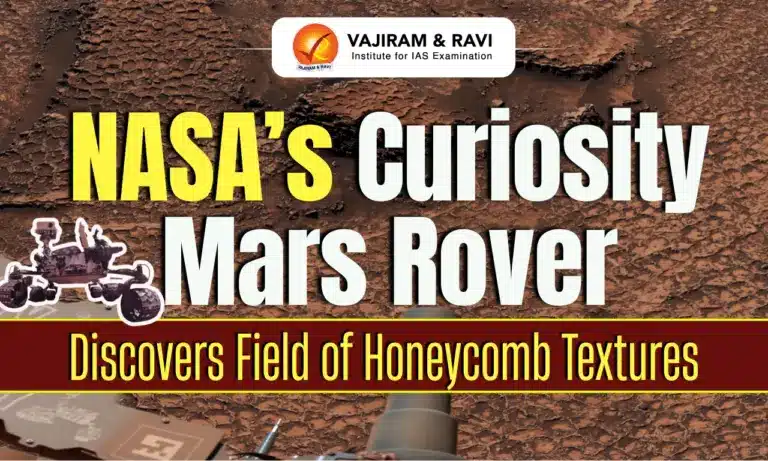
NASA’s Curiosity Mars Rover has discovered an extensive field of honeycomb-like polygonal fractures in a Martian valley called Valle Grande. While similar patterns had been observed earlier in small patches, this is the largest continuous field recorded by the rover since it landed on Mars in 2012. Scientists believe these formations could reveal important clues about ancient water activity, climate cycles, and the geological evolution of Mars, helping researchers better understand whether the Red Planet once had conditions suitable for life.
What are the Honeycomb Textures on Mars?
The newly discovered honeycomb textures are interconnected polygon-shaped rock patterns found in the Valle Grande region of Gale Crater. Scientists suggest these formations developed due to repeated environmental changes over millions of years.
Key Features
- Located in Valle Grande on the lower slopes of Mount Sharp.
- Largest continuous field of polygonal textures found by Curiosity.
- Individual polygons are approximately 4-8 cm wide.
- Formed within sulfate-rich sedimentary rocks.
- Indicate repeated wetting, drying, and mineral deposition processes.
- May have originated from ancient mud cracks or groundwater-related activity.
- Help scientists reconstruct the climatic history of ancient Mars.
About Mars
- Position in the Solar System: Mars is the fourth planet from the Sun.
- Nickname: Known as the Red Planet due to iron oxide (rust) covering its surface.
- Planet Type: A terrestrial (rocky) planet with a thin atmosphere.
- Diameter: Approximately 6,779 km, about half the size of Earth.
- Moons: Mars has two natural satellites, Phobos and Deimos.
- Atmosphere: Composed mainly of carbon dioxide (about 95%), with nitrogen and argon.
- Surface Features: Home to Olympus Mons, the largest volcano in the Solar System, and Valles Marineris, one of the largest canyon systems.
- Polar Ice Caps: Contains permanent polar caps made of water ice and frozen carbon dioxide (dry ice).
- Evidence of Water: Geological features indicate that ancient Mars once had rivers, lakes, and possibly oceans, making it a key target in the search for past life.
- Exploration: Mars has been explored by multiple orbiters, landers, and rovers, including NASA’s Curiosity and Perseverance, to study its geology, climate, and habitability.
- Day and Year: A Martian day (sol) lasts about 24 hours 39 minutes, while one Martian year is approximately 687 Earth days.
- Importance: Mars is considered the most promising planet for future human exploration due to its relatively accessible environment and evidence of past water.


About NASA
The National Aeronautics and Space Administration (NASA) is the United States’ civil space agency responsible for space exploration, scientific research, aeronautics, and Earth observation.
- Established: 29 July 1958 under the National Aeronautics and Space Act, 1958.
- Headquarters: Washington, D.C., United States.
- Nature: The U.S. government’s civilian space and aeronautics agency.
- Primary Objective: To conduct space exploration, scientific research, aeronautics, and Earth observation.
- Major Programmes: Artemis Programme (Moon exploration), Mars Exploration Programme, Earth Science Missions, Hubble Space Telescope, James Webb Space Telescope, and International Space Station (ISS) collaborations.
- Mars Missions: Operates robotic missions such as Curiosity, Perseverance, and Ingenuity (helicopter), along with several Mars orbiters.
- Scientific Contributions: Studies planets, the Sun, asteroids, galaxies, climate change, and the universe using satellites, telescopes, spacecraft, and robotic missions.
- International Collaboration: Partners with global space agencies, including ESA, JAXA, CSA, and other international organizations for scientific and space exploration missions.

 Last updated on Sep, 2026
→ UPSC 2027 Notification will be released on 13 January 2027 at upsconline.nic.in.
→ Asian Games 2026 are being held in Aichi-Nagoya, Japan, from 19 September to 4 October.
→ Check out the latest UPSC Syllabus here.
→ Download UPSC Model Answers for Mains 2026
→ UPSC Mains Question Paper 2026 is out now for Essay & GS Paper 1, 2, 3 & 4.
→ UPSC Calendar 2027 has been released.
→ Enroll in Vajiram & Ravi’s UPSC Mains Test Series 2027 for structured answer writing practice, expert evaluation, and exam-oriented feedback.
→ Join Vajiram & Ravi’s UPSC Mentorship Program 2027 for personalized guidance, strategy planning, and one-to-one support from experienced mentors.
→ Go through the UPSC Mains Previous Year Papers to enhance your preparation.
→ UPSC has released UPSC Toppers List 2025 with the Civil Services final result on its official website.
→ Also check Best UPSC Coaching in India
Honeycomb Textures on Mars FAQs
Q1. What are the honeycomb textures discovered on Mars?+
Q2. Where were the honeycomb textures found on Mars?+
Q3. Which mission discovered the honeycomb textures on Mars?+
Q4. Why are the honeycomb textures important?+
Q5. When did Curiosity land on Mars?+
Tags: nasa’s curiosity mars rover discovers field of honeycomb textures