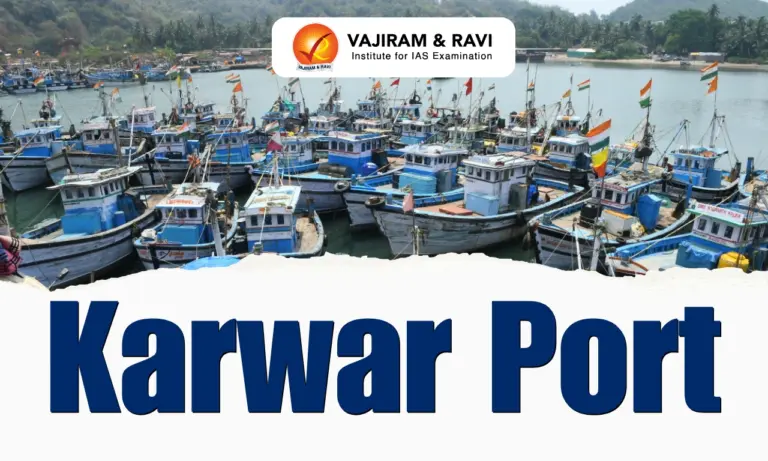
Karwar Port is an important natural port located in Karnataka, along the Arabian Sea. It is known for its deep-water harbour and strategic location, which makes it suitable for both commercial trade and naval activities. It is situated close to the banks of the Kali River. The port plays a key role in handling cargo like iron ore and also supports the Indian Navy, contributing to both economic development and maritime security.
Karwar Port
- Location: Karwar Port is located at the northern end of Karnataka on the Arabian Sea coast giving it a strategically important coastal position.
- Administrative Structure: It is one of the four divisions of the state port department, which includes Karwar, Sadashivgad, Belekeri, with the headquarters at Karwar itself.
- Type of Port: The port is an I.S.P.S compliant and all-weather port, meaning it operates throughout the year and follows international maritime safety standards.
- Natural Advantage: Karwar is regarded as one of the best natural all-weather ports on the West Coast due to its safe and deep harbour conditions, which reduce the need for heavy artificial infrastructure.
- Strategic Importance: It lies midway between Mumbai and Mangalore ports, and since Mormugao is the only major port in between, Karwar plays a key role in regional trade connectivity.
- Connectivity: The port enjoys strong connectivity via NH-66 (the Mumbai-Kochi corridor) and is situated close to the Konkan Railway, enabling efficient and seamless transportation of goods.
- Utilisation Status: Despite strong advantages, the port is currently underutilised, indicating huge untapped potential for future growth.
- Development Projects: To improve capacity, the Government of Karnataka is developing it under the Sagarmala Scheme.
- Trade Growth: Non-major ports in Karnataka, including Karwar, have shown consistent growth in EXIM (export-import) trade, especially over the last few years.
- Export Items: Major exports include sugar, alumina, food grains, maize, granite, horticulture and agricultural products, along with liquid cargo like molasses and phosphoric acid.
- Import Items: Imports handled include cement, fertilizers, industrial salts, rock phosphate, raw sugar, caustic soda, and liquid cargo such as HSD, furnace oil, kerosene, palm oil, and chemicals.
- Container Facility: Karwar has been declared a Container Freight Station (CFS), and container-handling infrastructure is currently being developed.
- Geographical Features: It is located in Uttara Kannada district, near the Kali River, and is uniquely positioned between the Arabian Sea and the Western Ghats.
- Tourism Identity: Karwar is also known as the “Kashmir of Karnataka” because of its rich biodiversity, scenic beauty, and diverse flora and fauna.
Sagarmala Scheme
- The Sagarmala Project was approved in 2015 by the Union Cabinet with the aim of promoting port-led development along India’s long coastline through modernisation, mechanisation and computerisation of ports.
- Objective: The main goal is to develop a holistic maritime infrastructure and increase cargo traffic up to three times, making ports more efficient and globally competitive.
- India’s Maritime Importance: India has a coastline of about 11,099 km and nearly 14,500 km of navigable waterways, making the maritime sector crucial for trade and economic growth.
- Trade Dependency: Around 95% of India’s trade by volume and about 70% by value is carried through maritime routes, highlighting the importance of ports.
- Port Structure: India has 12 major ports (under the Ministry of Ports, Shipping and Waterways) and 200+ non-major ports (under State Governments/Maritime Boards).
- Need for Sagarmala: Ports handle diverse cargo like crude oil, coal, fertilizers, containers, and agricultural goods, so improving port efficiency is essential for reducing logistics cost and boosting trade.
- Connectivity Focus: The project emphasises last-mile connectivity by linking ports with railways, roads, inland waterways and coastal shipping, ensuring smooth cargo movement.
- Multimodal Transport: It promotes integrated transport systems, combining rail, road, coastal and inland water transport for faster and cost-effective logistics.
- Key Components (5 Pillars)
- Port Modernization and New Port Development: This focuses on upgrading existing ports and building new ports by improving infrastructure, increasing capacity, and using modern technology and digital systems.
- Port Connectivity Enhancement: Aims to strengthen links between ports and hinterland regions through multimodal connectivity, reducing delays and transportation costs.
- Port-Led Industrialization: Encourages setting up industrial clusters near ports, which helps industries reduce logistics costs and improves access to global markets.
- Coastal Community Development: Focuses on improving the livelihood of coastal populations through skill development, fisheries support, tourism promotion, and sustainable development.
- Coastal Shipping and Inland Waterways: Promotes use of coastal shipping and inland waterways as cheaper and eco-friendly alternatives to road and rail transport.
- Sagarmala 2.0 (Next Phase)
- Vision Expansion: Sagarmala 2.0 builds on the original programme with a broader vision aligned with Maritime India Vision (MIV) 2030 and Maritime Amrit Kaal Vision (MAKV) 2047.
- Key Aim: To make India a global maritime hub by improving ports, connectivity, industrialization, and maritime services.
- Development Focus: Includes modern ports, better hinterland connectivity, inland waterways development, coastal community growth, and innovation.
- Economic Impact: Aims to promote inclusive growth, job creation, and reduction in logistics costs, supporting the vision of Viksit Bharat 2047.
- Investment Plan: The project proposes ₹85,482 crore budgetary support with a total investment of about ₹3.6 lakh crore across sectors like ports, waterways, coastal infrastructure, R&D, and institutional strengthening.


 Last updated on Oct, 2026
→ UPSC 2027 Notification will be released on 13 January 2027 at upsconline.nic.in.
→ Check Nobel Prize 2026 Winners List here.
→ Download PIB PRiSM Monthly Magazine 2026 here.
→ Check UPSC Monthly Current Affairs Magazine The Recitals here.
→ Check out the latest UPSC Syllabus here.
→ Download UPSC Model Answers for Mains 2026
→ UPSC Mains Question Paper 2026 is out now for Essay & GS Paper 1, 2, 3 & 4.
→ UPSC Calendar 2027 has been released.
→ Enroll in Vajiram & Ravi’s UPSC Mains Test Series 2027 for structured answer writing practice, expert evaluation, and exam-oriented feedback.
→ Join Vajiram & Ravi’s UPSC Mentorship Program 2027 for personalized guidance, strategy planning, and one-to-one support from experienced mentors.
→ Go through the UPSC Mains Previous Year Papers to enhance your preparation.
→ UPSC has released UPSC Toppers List 2025 with the Civil Services final result on its official website.
→ Also check Best UPSC Coaching in India
Karwar Port FAQs
Q1. What is Karwar Port and where is it located?+
Q2. Why is Karwar Port strategically important?+
Q3. What makes Karwar Port unique among Indian ports?+
Q4. What are the major exports and imports at Karwar Port?+
Q5. Why is Karwar Port underutilised?+
Q6. What is the Sagarmala Project?+
Q7. What are the main objectives of the Sagarmala Programme?+
Q8. What are the five pillars of Sagarmala?+
Tags: economy economy notes karwar port ports of india