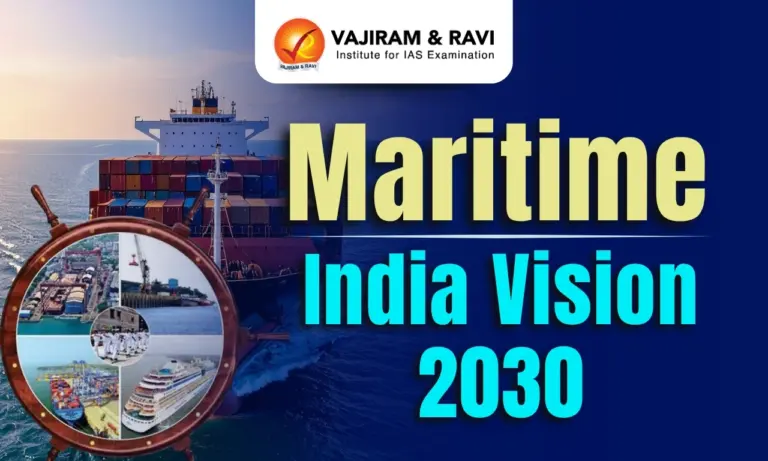
Maritime India Vision 2030 (MIV 2030) is a comprehensive roadmap prepared by the Ministry of Ports, Shipping and Waterways to accelerate the growth of India’s maritime sector. It covers ports, shipping, inland waterways, coastal transport, shipbuilding, logistics, cruise tourism, sustainability and maritime governance. The vision aims to place India among the leading maritime nations by implementing more than 150 initiatives across 10 major themes while attracting investments of about ₹3 lakh crore to ₹3.5 lakh crore over the decade.
Maritime Sector in India
India’s maritime sector forms the backbone of external trade and logistics connectivity. It supports economic growth through ports, shipping networks, coastal transportation, inland waterways, shipbuilding and maritime services.
- Strategic Maritime Network: India has a coastline of about 7,500 km, 13 major ports and more than 200 non major ports, creating one of the largest maritime networks in the world.
- Trade Importance: Nearly 95% of India’s trade by volume and around 70% by value moves through maritime routes, highlighting the sector’s critical role in economic development.
- Port Dominance: More than 54% of total cargo handled at Indian ports is managed by the country’s 12 major ports, making them central to trade operations.
- Port Capacity Growth: Capacity at major ports increased significantly from 871 MMT in 2015 to around 1,617 MMT in 2023, reflecting large scale infrastructure expansion.
- Inland Water Transport Expansion: India has over 5,000 km of navigable inland waterways under development and has increased cargo modal share from 0.5% to 2%.
- Global Ship Recycling Position: India ranks second globally in ship recycling and twenty first in shipbuilding, demonstrating its growing maritime industrial capability.
- Seafarer Strength: India is among the top five countries supplying trained maritime manpower, with the number of seafarers growing by around 17% in recent years.
Maritime India Vision 2030
Maritime India Vision 2030 serves as the national blueprint for coordinated and accelerated development of the maritime ecosystem through infrastructure, policy, technology and sustainability reforms.
- Comprehensive Roadmap: MIV 2030 identifies more than 150 initiatives across ports, shipping, inland waterways, logistics, cruise tourism, shipbuilding and maritime services to strengthen India’s maritime competitiveness.
- Investment Ambition: The vision proposes investments worth approximately ₹3 lakh crore to ₹3.5 lakh crore across ports, shipping and inland waterways, excluding projects already under implementation through Sagarmala.
- Global Maritime Leadership Goal: The primary objective is to place India at the forefront of the global maritime sector through improved infrastructure, efficiency, innovation and international connectivity.
- Extension of Sagarmala: MIV 2030 builds upon the Sagarmala programme by introducing new policy reforms, logistics improvements, infrastructure modernization and maritime industrial development.
- Guiding Principles: The vision is based on challenge analysis, innovation adoption, time bound implementation, global benchmarking, human resource development and the Waste to Wealth approach.
- Digital Governance Focus: Monitoring mechanisms such as the Sagarmanthan Portal provide real time tracking of projects, KPIs, traffic growth, port performance and capital expenditure progress.
- Institutional Monitoring: The Ministry established Viksit Bharat Sankalp (ViBhaS) and Neel Arth Vision Implementation Cells (NAVIC) to monitor implementation, innovation and long term maritime planning.


Maritime India Vision 2030 Objectives
The vision of Maritime India Vision 2030 outlines specific objectives to transform every major component of India’s maritime ecosystem through integrated development.
- World Class Port Infrastructure: Develop mega ports, expand brownfield capacities, modernize existing facilities and create globally competitive transshipment hubs.
- Logistics Cost Reduction: Improve end to end logistics efficiency through faster cargo evacuation, better multimodal connectivity, coastal shipping promotion and industrialization around ports.
- Technology Integration: Promote digital smart ports, process automation, National Logistics Portal (Marine) and technology driven performance monitoring systems.
- Governance Reforms: Strengthen maritime institutions, improve regulatory frameworks, encourage public private partnerships and create a more investor friendly ecosystem.
- Shipbuilding Growth: Increase India’s global share in shipbuilding, repair and recycling through domestic demand creation, industrial clusters and stronger ancillary industries.
- Waterway Development: Enhance passenger and cargo transportation through fairway development, terminal infrastructure, regulatory support and promotion of inland vessels.
- Cruise Tourism Promotion: Expand coastal, river and island cruise tourism through terminal development, tourism circuits, ferry connectivity and training institutions.
- Global Maritime Cooperation: Strengthen maritime partnerships with countries such as Bangladesh, Sri Lanka, Maldives, United Kingdom, United States and Netherlands.
- Green Maritime Development: Promote renewable energy adoption, emission reduction, water conservation, waste management and safety focused port operations.
- Human Resource Development: Create world class maritime education, training, research and innovation ecosystems to establish India as a leading seafaring nation.
Maritime India Vision 2030 Projects
Several infrastructure, connectivity, policy and technology projects have been planned under the Maritime India Vision 2030 to achieve long term maritime transformation.
- Mega Port Development: Construction of world class mega ports with capacities exceeding 300 million tonnes to handle rising trade volumes efficiently.
- Transshipment Hubs: Development of major transshipment facilities in southern India to reduce dependence on foreign ports for cargo transshipment.
- Waterways Connectivity Transport Grid: A regional connectivity network linking India with Bangladesh, Nepal, Bhutan and Myanmar through inland waterways.
- Riverine Development Fund: Creation of a dedicated fund to provide affordable financing for inland waterway vessels and associated infrastructure.
- National Logistics Portal (Marine): A single window digital platform integrating cargo operators, shipping lines, financial institutions, regulators and logistics stakeholders.
- Sagarmanthan Portal: A technology enabled monitoring platform tracking project implementation, maritime KPIs, capital expenditure, traffic growth and operational performance.
- Cruise Infrastructure Projects: Development of cruise terminals, river cruise facilities, coastal tourism circuits, island tourism infrastructure and ferry networks.
- Port Modernization Programme: Large scale modernization projects focused on mechanization, automation, cargo handling improvements and operational efficiency enhancement.
- Regulatory Reforms: Introduction of the Major Port Authorities Act, 2021, Marine Aids to Navigation Act, 2021 and Indian Vessels Act, 2021 to modernize governance.
- Green Port Initiatives: Implementation of Harit Sagar Green Port Guidelines, renewable energy projects, emission reduction programmes and environmental management systems.
Maritime India Vision 2030 Impacts
Implementation of Maritime India Vision 2030 has already generated measurable improvements across port performance, trade facilitation and logistics efficiency.
- Port Traffic Growth: Cargo traffic at ports increased from 720 MMT in FY 2022 to 820 MMT in FY 2024, indicating stronger maritime trade activity.
- Major Port Capacity Increase: Major port capacity expanded from 1,598 MMTPA in FY 2022 to 1,630 MMTPA in FY 2024, improving handling capability.
- Improved Vessel Efficiency: Average vessel turnaround time reduced from 53 hours in FY 2022 to 48 hours in FY 2024, resulting in faster cargo movement.
- Higher Berth Productivity: Ship berth day output improved from 16,000 MT in FY 2022 to 18,900 MT in FY 2024, reflecting greater operational efficiency.
- Growth in Coastal Cargo: Coastal cargo tonnage increased from 260 MMT in FY 2022 to 324 MMT in FY 2024 due to improved coastal shipping infrastructure.
- Expansion of Inland Waterways: Cargo movement on National Waterways rose from 108 MMT across 19 operational waterways to 133 MMT across 24 waterways by FY 2024.
- Employment Generation: Expansion of ports, waterways, shipping services, logistics networks and cruise tourism has created significant direct and indirect employment opportunities.
Maritime India Vision 2030 Significance
The Maritime India Vision 2030 is strategically important for economic growth, logistics competitiveness, environmental sustainability and India’s global maritime position.
- Trade Competitiveness: Efficient ports and logistics systems lower transportation costs, making Indian exports more competitive in international markets.
- Blue Economy Development: MIV 2030 strengthens maritime industries, fisheries, tourism, shipping and coastal economic activities under the Blue Economy framework.
- Regional Connectivity: Enhanced maritime links with neighboring countries support trade integration, economic cooperation and regional development.
- Ease of Doing Business: Digital platforms and regulatory reforms simplify cargo movement, documentation, approvals and logistics operations.
- Energy Efficiency: Increased use of waterways and coastal shipping reduces fuel consumption and logistics costs compared to road transportation.
- Environmental Sustainability: Green port initiatives support emission reduction, renewable energy adoption and sustainable maritime operations.
- National Maritime Leadership: The vision supports India’s ambition to emerge as a leading global maritime power through infrastructure and institutional excellence.
Maritime India Vision 2030 Achievements
Significant achievements have been recorded since the implementation of Maritime India Vision 2030, demonstrating progress toward long term maritime goals.
- Global Port Recognition: Two Indian ports, including Jawaharlal Nehru Port and Mundra Port, have featured among leading global container ports.
- Improved Logistics Ranking: India’s ranking in the World Bank International Shipments Logistics Performance Index improved from 44 in 2018 to 22 in 2023.
- Reduced Dwell Time: Cargo dwell time at Indian ports has reached about three days, significantly lower than approximately seven days in the United States and ten days in Germany.
- Global Turnaround Performance: India’s average turnaround time of around 0.9 days is among the best globally, compared with 1.4 days in Germany and 1.5 days in the United States.
- Infrastructure Investments: Capital expenditure by the Ministry of Ports, Shipping and Waterways increased by 37% from ₹5,527 crore in FY 2022 to ₹7,571 crore in FY 2024.
- Higher Budgetary Support: Gross Budget Support increased by 54%, rising from ₹1,099 crore in FY 2022 to ₹1,687 crore in FY 2024.
- Project Implementation Success: Around 75 port development projects were awarded across major ports to improve cargo handling capacity and operational efficiency.
- PPP Expansion: Public private partnership participation expanded substantially, contributing to modernization, investment mobilization and infrastructure creation.
Maritime Amrit Kaal Vision 2047
Maritime Amrit Kaal Vision 2047 builds upon Maritime India Vision 2030 and provides a long term roadmap for transforming India into a global maritime leader by the centenary year of independence.
- Long Term Maritime Roadmap: Launched during the Global Maritime India Summit, it serves as the next phase of maritime sector transformation beyond 2030.
- Massive Investment Target: The vision proposes investments of approximately ₹80 lakh crore to strengthen ports, shipping, logistics, waterways and maritime industries.
- Extensive Consultation Process: The roadmap was prepared through more than 150 stakeholder consultations and benchmarking against around 50 international standards.
- Action Oriented Framework: It contains over 300 actionable initiatives covering infrastructure, logistics, shipping, technology, sustainability and governance reforms.
- Port Capacity Expansion: The vision aims to raise India’s port capacity to 10,000 MTPA, significantly enhancing cargo handling capability.
- Shipbuilding Ambition: India seeks to become one of the world’s top five shipbuilding nations through industrial expansion and technological advancement.
- Employment Creation: The roadmap targets creation of more than 1.5 crore employment opportunities across maritime industries and associated sectors.
- Four Strategic Pillars: The framework is based on port led development, shipping and shipbuilding growth, seamless logistics integration and maritime skill development.
- Blue Economy Support: The vision promotes sustainable utilization of marine resources while strengthening economic growth, environmental protection and coastal development.
- Global Maritime Leadership Goal: Maritime Amrit Kaal Vision 2047 seeks to establish India as a world leading maritime nation with globally competitive infrastructure, logistics systems and maritime services.

 Last updated on Oct, 2026
→ UPSC 2027 Notification will be released on 13 January 2027 at upsconline.nic.in.
→ Check Nobel Prize 2026 Winners List here.
→ Download PIB PRiSM Monthly Magazine 2026 here.
→ Check UPSC Monthly Current Affairs Magazine The Recitals here.
→ Check out the latest UPSC Syllabus here.
→ Download UPSC Model Answers for Mains 2026
→ UPSC Mains Question Paper 2026 is out now for Essay & GS Paper 1, 2, 3 & 4.
→ UPSC Calendar 2027 has been released.
→ Enroll in Vajiram & Ravi’s UPSC Mains Test Series 2027 for structured answer writing practice, expert evaluation, and exam-oriented feedback.
→ Join Vajiram & Ravi’s UPSC Mentorship Program 2027 for personalized guidance, strategy planning, and one-to-one support from experienced mentors.
→ Go through the UPSC Mains Previous Year Papers to enhance your preparation.
→ UPSC has released UPSC Toppers List 2025 with the Civil Services final result on its official website.
→ Also check Best UPSC Coaching in India
Maritime India Vision 2030 FAQs
Q1. What is Maritime India Vision 2030?+
Q2. What is the investment target under Maritime India Vision 2030?+
Q3. What are the main objectives of Maritime India Vision 2030?+
Q4. How has Maritime India Vision 2030 improved India's maritime sector?+
Q5. What is the relationship between Maritime India Vision 2030 and Maritime Amrit Kaal Vision 2047?+
Tags: economy maritime india vision 2030 public policy