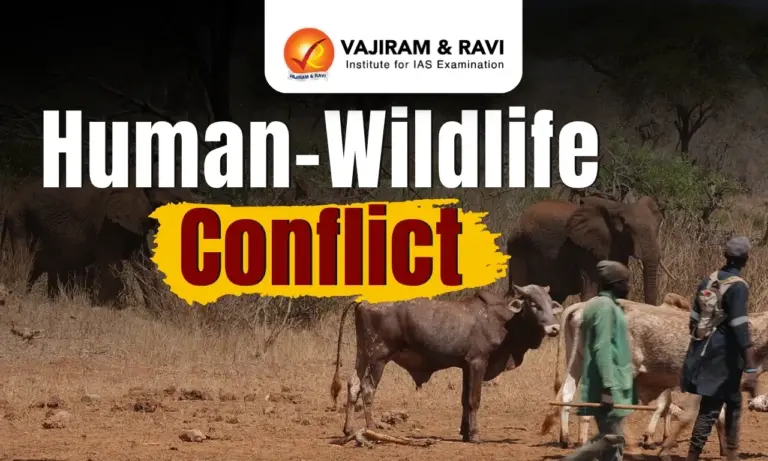
Human-Wildlife Conflict (HWC) refers to negative interactions between people and wild animals that cause harm to human lives, livelihoods, property, wildlife populations, or ecosystems. The problem has intensified due to habitat loss, infrastructure expansion, climate change and growing human presence near forests. India is witnessing increasing conflicts involving elephants, tigers, leopards, bears and other species. Between 2019 and 2024, elephant attacks caused over 2,700 human deaths, while tiger attacks claimed 349 lives, highlighting the growing scale of this challenge.
Human-Wildlife Conflict Causes
Growing pressure on natural habitats has increased encounters between humans and wildlife across many regions of India.
- Habitat Loss and Fragmentation: Expansion of agriculture, settlements, roads, railways, dams and industrial projects reduces forest cover and breaks wildlife habitats into smaller patches, forcing animals to move through villages, farms and human dominated landscapes.
- Disruption of Wildlife Corridors: Highways, railway tracks, canals, tea plantations and urban development block traditional migratory routes. The recent death of eight elephants in a train collision in Assam highlights risks created by fragmented movement pathways.
- Climate Change and Water Stress: Droughts, erratic monsoons, changing rainfall patterns and drying forest water sources push animals toward agricultural fields, village ponds and irrigation facilities in search of food and water.
- Agricultural Expansion Near Forests: Cultivation along forest edges attracts elephants, wild boars, monkeys and nilgai. In Karnataka’s Kodagu region, expanding coffee and ginger plantations have increased crop raiding incidents by elephants.
- Adaptation to Human Landscapes: Species such as elephants, monkeys, leopards and bears increasingly associate human settlements with easy food sources. Leopards in Maharashtra’s sugarcane fields have become highly adapted to living close to people.
- Population Recovery of Wildlife: Conservation programmes have increased populations of elephants, tigers and leopards. In some areas, wildlife numbers have grown faster than available habitat capacity, resulting in greater interactions near reserve boundaries.
- Decline in Habitat Quality: Invasive species, monoculture plantations and reduced availability of natural fodder lower the quality of forest ecosystems, encouraging animals to seek resources outside protected habitats.
Human-Wildlife Conflict Zones in India
Several regions experience frequent conflicts because of dense wildlife populations, fragmented habitats and expanding human activities.
- Assam Landscape: The Kaziranga-Karbi Anglong region, tea estates, railway lines and fragmented elephant corridors witness recurring crop damage, human casualties and elephant deaths caused by train collisions and habitat disruption.
- Odisha and West Bengal: These states record some of the highest levels of human-elephant conflict in India, contributing significantly to the nearly 500 annual human deaths linked to elephant encounters.
- Karnataka and Western Ghats: Expansion of plantations, infrastructure projects and shrinking habitat connectivity have increased elephant movement into agricultural lands, causing major crop and property losses.
- Maharashtra Conflict Areas: Leopards living within sugarcane fields frequently prey on livestock and enter villages, leading to regular human-animal encounters and rescue operations.
- Kerala Forest Fringe Regions: Human-Wildlife Conflict has become a major concern due to increasing incidents involving elephants, wild boars, tigers and leopards. Between 2021 and 2025, 344 people lost their lives in wildlife related incidents.
- Jammu and Kashmir Highlands: Changing climatic conditions have altered food availability, resulting in Himalayan brown bears moving to lower elevations and increasing interactions with local communities.
- Madhya Pradesh Tiger Landscape: Expanding tiger populations and habitat pressures have increased conflict risks. The state also recorded significant tiger mortality, with 28 tiger deaths reported during the first five months of 2026.


Human-Wildlife Conflict Impacts
Human-Wildlife Conflict produces severe ecological, economic, social and conservation related consequences affecting both people and animals.
- Human Fatalities and Injuries: Elephant encounters alone cause around 500 human deaths annually in India. Between 2019 and 2024, elephants killed more than 2,700 people, while tigers were responsible for 349 human deaths.
- Crop Damage and Livelihood Losses: Farmers lose approximately 10-15% of annual agricultural production to crop raiding species such as elephants, monkeys, nilgai and wild boars, creating serious economic hardship.
- Livestock Predation: Leopards, tigers, wolves and other carnivores frequently attack domestic animals, reducing household income and increasing resentment among communities living near forests.
- Wildlife Mortality: India loses nearly 100 elephants every year to non natural causes such as electrocution, train accidents, poisoning, quarrying activities and illegal human interventions.
- Infrastructure and Property Damage: Elephants and other large mammals damage houses, fences, roads, electric infrastructure, irrigation facilities and agricultural storage structures during movement and foraging activities.
- Economic Burden on Governments: Compensation payments, habitat management, fencing projects and conflict mitigation measures require substantial expenditure. Kerala alone spent ₹79.3 crore over six years on compensation and protection initiatives.
- Psychological and Social Stress: Constant fear of wildlife attacks affects daily life in forest fringe villages, reducing social security and creating anxiety among farming and tribal communities.
- Threat to Conservation Goals: Retaliatory killings, poisoning, trapping and hostility toward wildlife undermine conservation efforts and threaten populations of ecologically important species.
- Ecological Imbalance: Loss of keystone species such as elephants disrupts seed dispersal, vegetation dynamics and ecosystem functioning, negatively affecting biodiversity and forest health.
Human-Wildlife Conflict Government Initiatives
India has adopted legal, institutional, technological and conservation based measures to reduce Human-Wildlife Conflict.
- Constitutional Protection: Article 51A(g) places a Fundamental Duty on citizens to protect and improve the natural environment, including forests and wildlife.
- Wildlife Protection Act, 1972: The Act provides the principal legal framework for wildlife conservation through protected areas, species protection and corridor conservation measures.
- National Wildlife Action Plan 2017-31: The plan promotes habitat conservation, species recovery, scientific research, education and coexistence strategies to reduce conflict situations.
- Project Elephant and Project Tiger: These flagship programmes support habitat protection, corridor management, conflict mitigation and conservation of two major conflict prone species.
- Human-Wildlife Conflict Mitigation Strategy: The Ministry of Environment, Forest and Climate Change has issued a national strategy emphasizing prevention, early warning systems, rapid response and community participation.
- Technological Solutions: The Gajraj System uses AI enabled fibre optic sensors to detect elephants on railway tracks, while TrailGuard AI cameras help identify wildlife movement in protected areas.
- Early Warning Mechanisms: Mobile applications, SMS alerts, GPS tracking, thermal sensors and elephant monitoring systems help communities receive advance information regarding animal movements.
- Eco-Sensitive Zones and Habitat Schemes: Buffer areas around protected regions and habitat improvement programmes reduce pressure on wildlife and discourage movement into human settlements.
Human-Wildlife Conflict Challenges
Despite multiple interventions, several obstacles continue to hinder effective management of conflict situations.
- Corridor Encroachment: Many wildlife corridors remain unprotected or fragmented by roads, railways, mining projects and settlements, increasing risks of collisions and accidental deaths.
- Delayed Compensation Systems: Lengthy procedures and documentation requirements often delay financial assistance, reducing community confidence in government support mechanisms.
- Inadequate Data and Monitoring: Underreporting of incidents and gaps in wildlife movement mapping limit evidence based planning and reduce the effectiveness of mitigation strategies.
- Technological Constraints: GPS tracking, AI monitoring systems and early warning networks require substantial funding, maintenance and communication infrastructure for large scale deployment.
- Habitat Degradation: Invasive species, declining forest quality and shrinking food resources continue to push animals toward agricultural landscapes and human settlements.
- Unscientific Deterrence Methods: Studies in Assam indicate that Anti Depredation Squads may unintentionally increase accidental elephant deaths by 200-300%, showing the risks of poorly designed interventions.
- Weak Inter Agency Coordination: Effective conflict management requires cooperation among forest, revenue, agriculture, disaster management, police and local administration departments, which often remains insufficient.
Human-Wildlife Conflict Mitigation Measures
Long term coexistence requires integrated and science based approaches that address both human welfare and wildlife conservation.
- Securing Wildlife Corridors: Legal protection, restoration and scientific mapping of corridors can maintain habitat connectivity and reduce dangerous interactions between wildlife and human infrastructure.
- Landscape Level Planning: Development projects should integrate wildlife considerations through zoning regulations, habitat connectivity assessments and ecological impact evaluations.
- Smart Infrastructure Development: Construction of underpasses, overpasses, eco bridges, wildlife crossings and sensor based railway warning systems can reduce animal mortality.
- Improved Compensation Mechanisms: Transparent, digital and time bound compensation systems with direct bank transfers can reduce economic losses and improve community tolerance.
- Community Participation: Village committees, awareness programmes and local monitoring groups can strengthen coexistence and encourage non confrontational responses during wildlife encounters.
- Promotion of Conflict Resistant Livelihoods: Beekeeping, ecotourism, agroforestry and cultivation of crops such as chilli, lemongrass and other unpalatable species can reduce vulnerability to wildlife damage.
- Habitat Restoration Programmes: Removal of invasive species, improvement of water availability, reforestation and restoration of degraded ecosystems can reduce wildlife dependence on human resources.
- Strengthened Institutional Framework: Dedicated district and state level task forces involving multiple departments can improve coordination, rapid response, monitoring and long term conflict management planning.

 Last updated on Oct, 2026
→ UPSC 2027 Notification will be released on 13 January 2027 at upsconline.nic.in.
→ Check Nobel Prize 2026 Winners List here.
→ Download PIB PRiSM Monthly Magazine 2026 here.
→ Check UPSC Monthly Current Affairs Magazine The Recitals here.
→ Check out the latest UPSC Syllabus here.
→ Download UPSC Model Answers for Mains 2026
→ UPSC Mains Question Paper 2026 is out now for Essay & GS Paper 1, 2, 3 & 4.
→ UPSC Calendar 2027 has been released.
→ Enroll in Vajiram & Ravi’s UPSC Mains Test Series 2027 for structured answer writing practice, expert evaluation, and exam-oriented feedback.
→ Join Vajiram & Ravi’s UPSC Mentorship Program 2027 for personalized guidance, strategy planning, and one-to-one support from experienced mentors.
→ Go through the UPSC Mains Previous Year Papers to enhance your preparation.
→ UPSC has released UPSC Toppers List 2025 with the Civil Services final result on its official website.
→ Also check Best UPSC Coaching in India
Human-Wildlife Conflict FAQs
Q1. What is Human-Wildlife Conflict (HWC)?+
Q2. What measures can reduce Human-Wildlife Conflict in India?+
Q3. What is the impact of Human-Wildlife Conflict on farmers?+
Q4. What are the main causes of Human-Wildlife Conflict?+
Q5. Which animals are most commonly involved in Human-Wildlife Conflict in India?+
Tags: biology environmental science human-wildlife conflict