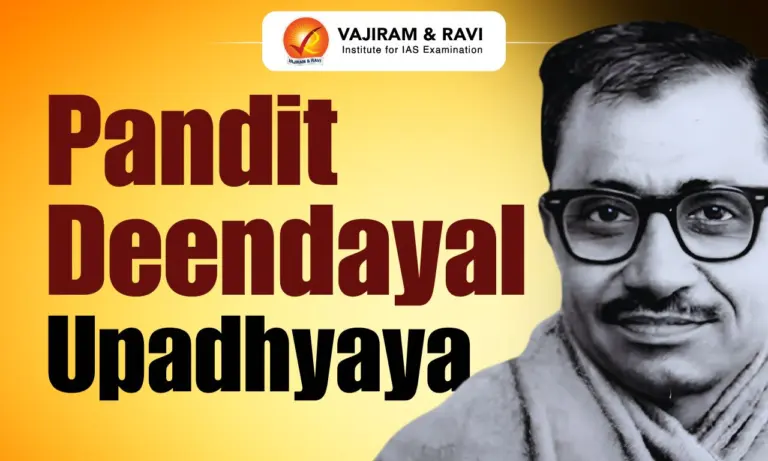
Pandit Deendayal Upadhyaya was a prominent Indian thinker, political leader, and social philosopher known for his vision of value-based politics and nation-first approach. He emphasized development rooted in Indian culture and traditions, rather than blindly following Western models. His most important contribution, the philosophy of Integral Humanism, focuses on the holistic development of individuals and society, balancing economic growth with moral and social well-being. Through his ideas like Antyodaya (upliftment of the last person), he highlighted inclusive growth and social justice. Even today, his thoughts continue to influence discussions on governance, self-reliance, and sustainable development in India.
Early Life and Education of Pandit Deendayal Upadhyaya
- Pandit Deendayal Upadhyaya was born on September 25, 1916, in Nagla Chandrabhan (Mathura, Uttar Pradesh) in a lower middle-class Hindu family.
- His father, Bhagwati Prasad, was an Assistant Station Master, and his mother, Rampyari, was deeply religious.
- He lost both parents at a very young age (father early; mother due to tuberculosis), which deeply influenced his life.
- He was brought up by his maternal grandfather (Chunnilal Shukla) and later by his maternal uncle and aunt.
- His childhood was marked by poverty, hardships, and personal losses, which shaped his resilience and strong character.
- An important childhood incident shows his fearlessness, when he calmly faced dacoits, impressing them with his presence of mind..
- His early experiences of suffering, simplicity, and social realities played a crucial role in shaping his philosophy of “Integral Humanism”, emphasizing a balanced approach to human development and societal welfare.
Political Career of Pandit Deendayal Upadhyaya
- His political journey began with his association with the Rashtriya Swayamsevak Sangh (RSS) in 1937, where he started as a dedicated worker and later became a full-time pracharak, dedicating his life to social and national service.
- He worked extensively at the grassroots level, especially in Uttar Pradesh, where he developed strong organizational skills and built close connections with people.
- In 1951, he entered formal politics and played a crucial role in the creation of a new political platform, where he emerged as a key organizer and strategist.
- He served as the General Secretary for nearly 17 years (1951-1967), during which he built the party structure from the ground level and ensured its steady growth across different regions of India.
- His leadership qualities were widely recognized when he was elected as the President in 1967, although his tenure remained short due to his untimely death.
- Throughout his political career, he remained known for his simplicity, discipline, integrity, and commitment to nation-building, rather than personal power or position.


Philosophy of Integral Humanism
- Integral Humanism is the central philosophy developed by Pandit Deendayal Upadhyaya, which focuses on the overall development of a human being, including physical, intellectual, emotional, and spiritual aspects.
- He rejected both Western capitalism, which he felt was too materialistic, and communism, which ignored individual freedom, and instead proposed a balanced, Indian-centered approach.
- The philosophy emphasizes that development should not be limited to economic growth but should also include moral values, cultural identity, and social harmony.
- A key concept within this philosophy is Antyodaya, which means the upliftment of the last and weakest person in society, ensuring that development benefits everyone equally.
- He supported decentralization of power and economy, promoting local self-reliance, small-scale industries, and the idea of Swadeshi (indigenous development).
- Integral Humanism sees society as an interconnected whole, where cooperation, balance, and harmony are more important than competition or conflict.
Role of Pandit Deendayal Upadhyaya in Bharatiya Jana Sangh
- Pandit Deendayal Upadhyaya played a foundational role in the establishment of the Bharatiya Jana Sangh in 1951, helping to build its structure from the very beginning.
- He organized the party’s state unit in Uttar Pradesh and contributed significantly to expanding its presence across the country.
- As General Secretary, he was the main driving force behind the party’s growth, focusing on building a strong, disciplined, and committed cadre base.
- His organizational abilities were considered exceptional, and he was often described as the “backbone” or “moving spirit” of the party.
- When he became the President in 1967, he aimed to take the party’s message to all regions of India, especially expanding its reach beyond the north.
- He emphasized creating a value-based political organization, rooted in ideology, discipline, and long-term vision rather than short-term gains.
Key Contributions of Pandit Deendayal Upadhyaya to Indian Politics
- One of his biggest contributions was the development of Integral Humanism, which provided a distinct Indian alternative to dominant global political and economic ideologies.
- He strongly promoted the idea of Antyodaya, ensuring that governance and policies focus on the most marginalized sections of society.
- He played a crucial role in strengthening grassroots politics, demonstrating how strong organization at the local level can shape national politics.
- He emphasized economic democracy, stating that just as political democracy requires voting rights, economic democracy requires opportunities for work and livelihood for all.
- His focus on ethical and value-based politics encouraged leaders to prioritize public service over personal ambition.
- He also supported self-reliant development models, reducing dependence on foreign systems and promoting indigenous solutions.
Pandit Deendayal Upadhyaya’s Ideology and Vision for India
- His vision for India was deeply rooted in Indian culture, traditions, and values, which he believed should guide modern development.
- He supported the concept of Dharmarajya, which does not mean a religious state but a system based on justice, morality, and ethical governance.
- He believed in Sarvodaya (welfare of all) along with Antyodaya (upliftment of the last person), ensuring inclusive and balanced development.
- His idea of Samanvaya (harmony and coordination) emphasized cooperation among different sections of society instead of conflict.
- He advocated for decentralization of power and resources, ensuring that economic and political systems do not become concentrated in a few hands.
- Overall, he envisioned an India that is self-reliant, socially just, culturally rooted, and economically balanced.
Books and Writings of Pandit Deendayal Upadhyaya
- Pandit Deendayal Upadhyaya was not only a political leader but also a prolific writer and journalist, who used writing as a tool to spread his ideas.
- He established publications like Rashtra Dharma, Panchjanya, and Swadesh, which became important platforms for promoting cultural and national thought.
- He regularly wrote columns, including the well-known “Political Diary”, where he shared his views on contemporary political issues.
- His major works include Integral Humanism, Ekatma Manavvad, Political Diary, Samrat Chandragupt, and Jagatguru Shankaracharya.
- His writings mainly focus on Indian philosophy, politics, culture, and economic thinking, reflecting his deep intellectual understanding.
Death and Legacy of Pandit Deendayal Upadhyaya
- Pandit Deendayal Upadhyaya passed away on 11 February 1968 under mysterious circumstances, when his body was found near a railway station, and the case remains unresolved.
- His death at the age of 52 was a major shock, especially because it came just after he assumed a major leadership role.
- Despite his short life, he left behind a powerful ideological and organizational legacy that continues to influence Indian politics.
- He is remembered as a selfless leader, disciplined worker, and visionary thinker, who dedicated his life to national service.
- His ideas, especially Integral Humanism and Antyodaya, continue to guide policy thinking and governance approaches in India.
- Today, he is seen as a leader who combined simplicity, deep thought, and commitment to the welfare of society.
Major National Schemes Inspired by Pandit Deendayal Upadhyaya
- Deendayal Upadhyaya Gram Jyoti Yojana (DDUGJY): Aims to improve rural electricity supply and strengthen power infrastructure for better village development.
- Deendayal Upadhyaya Antyodaya Yojana (DAY): Focuses on reducing poverty by promoting livelihoods, self-employment, and skill development among the poor.
- Deendayal Upadhyaya Grameen Kaushalya Yojana (DDU-GKY): Provides job-oriented skill training to rural youth to improve employment opportunities.
- Pandit Deendayal Upadhyaya Shramev Jayate Karyakram: Works towards improving labor conditions, skill development, and workplace safety.
- Deendayal Disabled Rehabilitation Scheme (DDRS): Supports programs for the rehabilitation and empowerment of persons with disabilities.
- Pandit Deendayal Upadhyay National Welfare Fund for Sportspersons: Offers financial assistance to athletes facing hardship, injury, or financial difficulties.

 Last updated on Sep, 2026
→ UPSC 2027 Notification will be released on 13 January 2027 at upsconline.nic.in.
→ Asian Games 2026 are being held in Aichi-Nagoya, Japan, from 19 September to 4 October.
→ Check out the latest UPSC Syllabus here.
→ Download UPSC Model Answers for Mains 2026
→ UPSC Mains Question Paper 2026 is out now for Essay & GS Paper 1, 2, 3 & 4.
→ UPSC Calendar 2027 has been released.
→ Enroll in Vajiram & Ravi’s UPSC Mains Test Series 2027 for structured answer writing practice, expert evaluation, and exam-oriented feedback.
→ Join Vajiram & Ravi’s UPSC Mentorship Program 2027 for personalized guidance, strategy planning, and one-to-one support from experienced mentors.
→ Go through the UPSC Mains Previous Year Papers to enhance your preparation.
→ UPSC has released UPSC Toppers List 2025 with the Civil Services final result on its official website.
→ Also check Best UPSC Coaching in India
Pandit Deendayal Upadhyaya FAQs
Q1. Who was Pandit Deendayal Upadhyaya?+
Q2. When and where was Pandit Deendayal Upadhyaya born?+
Q3. What are his major contributions to Indian politics?+
Q4. What books were written by Deendayal Upadhyaya?+
Q5. What is Integral Humanism?+
Q6. What is the meaning of Antyodaya?+
Q7. What was his role in Bharatiya Jana Sangh?+
Q8. When did Pandit Deendayal Upadhyaya die?+
Tags: indian polity indian polity notes pandit deendayal upadhyaya