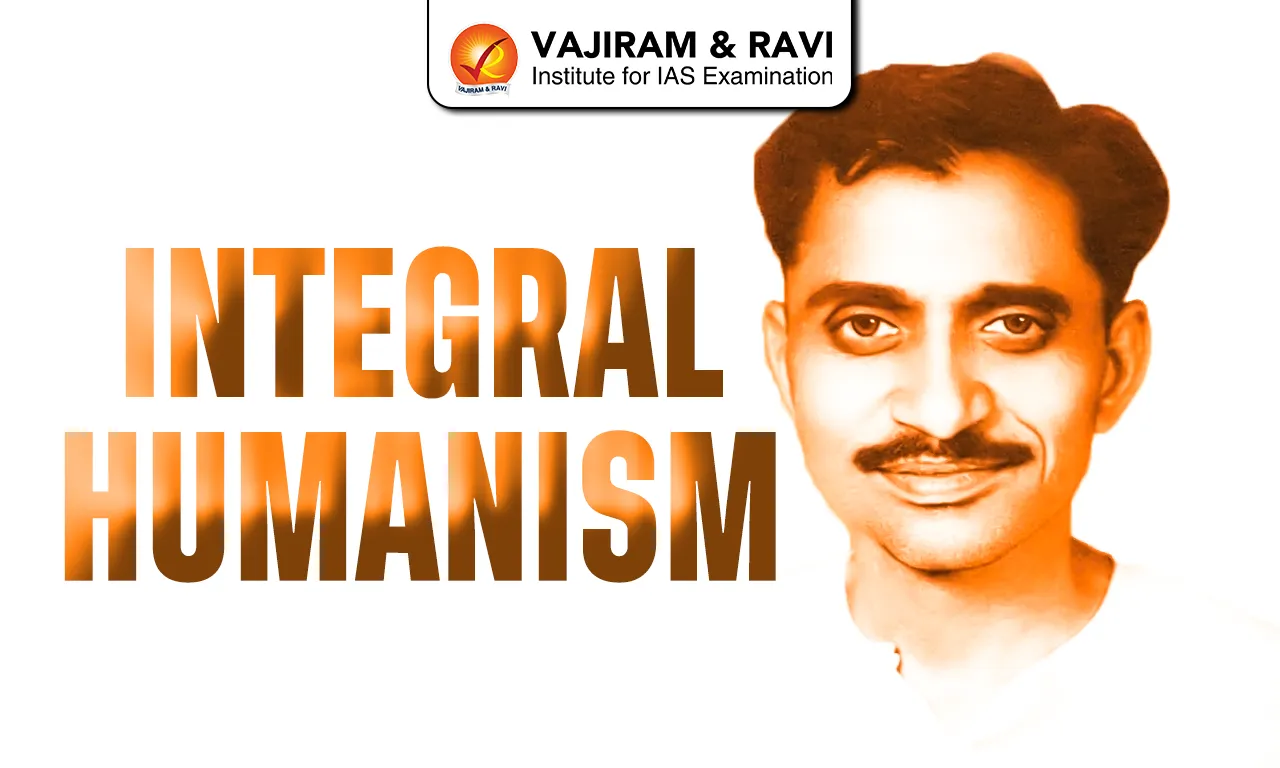
Integral Humanism is also known as ‘Ekatm Manavvad’. It is a socio-political philosophy proposed by Pandit Deen Dayal Upadhyay in the mid 1960s to guide India’s development through indigenous ideas. It emphasizes balanced growth of body, mind, intellect and soul while ensuring harmony between individual and society. The philosophy integrates material progress with ethical and spiritual values, aiming to create an equitable, culturally rooted and self reliant social order.
Integral Humanism Background
Integral Humanism emerged as an indigenous ideological response to post independence challenges, rooted in Indian philosophical traditions and cultural identity.
- Origin: Upadhyay presented Integral Humanism in a series of lectures in Bombay in April 1965, outlining a uniquely Indian development model rejecting blind imitation of Western systems.
- Influence of Daishik Shastra: The philosophy draws from Daishik Shastra by Badrishah Thulgharia (1923), which emphasized cultural unity and national identity, praised by leaders like Mahatma Gandhi and Bal Gangadhar Tilak.
- Reaction to Western Ideologies: Upadhyay rejected capitalism for excessive individualism and socialism for suppressing individual freedom, arguing both ignored India’s socio-cultural realities and spiritual dimensions.
- Gandhian Inspiration: It incorporates ideas similar to Gandhian Sarvodaya, Swadeshi and Gram Swaraj, focusing on welfare of all, self reliance and decentralized governance with a cultural foundation.
- Philosophical Roots in Advaita: Inspired by Advaita Vedanta of Adi Shankaracharya, the philosophy views existence as interconnected, emphasizing unity of individual, society, nature and the divine.
Integral Humanism Philosophy
Integral Humanism is based on a holistic vision of life, combining ethical governance, cultural identity and balanced development guided by core philosophical principles.
- Primacy of Whole: This principle states that society and life should be seen as an integrated whole rather than fragmented parts, ensuring harmony between individual, society, nature and universal order.
- Supremacy of Dharma: Dharma acts as the guiding moral principle governing social, economic and political actions, ensuring justice, ethical conduct and balance between material and spiritual pursuits.
- Autonomy of Society: Society is viewed as a natural organism with its own identity and values, not merely a contract among individuals and should function independently with cultural and moral coherence.
- Purusharthas Framework: The philosophy is based on four goals of life- Dharma, Artha, Kama and Moksha, ensuring that economic and personal desires are guided by moral duties and spiritual growth.
- Integrated Human Personality: It recognizes human beings as composed of body, mind, intellect and soul, requiring policies that address not just economic needs but also emotional, intellectual and spiritual well being.


Integral Humanism Features
Integral Humanism presents a comprehensive framework for governance and development, focusing on social harmony, cultural values and inclusive economic growth.
- Cultural Nationalism: It promotes Bharatiyata by integrating traditional knowledge, customs and values with modern development, ensuring policies align with India’s cultural ethos and civilizational identity.
- Antyodaya Concept: The philosophy emphasizes upliftment of the last person in society, ensuring that development benefits reach the poorest and most marginalized sections first.
- Decentralized Economy: It advocates a village based, self reliant economic model where local communities manage resources, promoting balanced regional development and reducing dependency on centralized systems.
- Ethical Governance: The concept of Dharma Rajya focuses on transparent, accountable governance based on moral values rather than mere legal authority or religious dominance.
- Swadeshi Approach: It encourages economic self reliance by prioritizing domestic production, indigenous resources and local skills while selectively adopting modern technology suited to Indian needs.
Integral Humanism Significance
Integral Humanism remains highly relevant as it offers a balanced framework addressing modern socio-economic challenges through ethical, cultural and sustainable approaches.
- Holistic Development Model: It provides a comprehensive development framework combining economic growth with social justice and spiritual well being, avoiding extremes of materialism or state control.
- Social Harmony and Equality: By opposing caste discrimination and promoting unity, it supports creation of an inclusive society based on equality, justice and mutual respect.
- Environmental Sustainability: The philosophy emphasizes harmony between humans and nature, aligning with sustainable development and ecological balance through responsible resource use.
- Good Governance Framework: Its stress on ethical conduct, accountability and moral principles helps strengthen transparent governance and reduce corruption in public systems.
- Global Relevance: Integral Humanism offers an alternative global model balancing national interest with universal welfare, promoting cooperation, peace and the idea of Vasudhaiva Kutumbakam.
Pandit Deen Dayal Upadhyaya
Pandit Deen Dayal Upadhyaya (1916-1968) was an Indian philosopher, economist, sociologist, historian and political leader who articulated Integral Humanism as an alternative to Western ideologies. He was born in Mathura district of Uttar Pradesh. He became the President of Bharatiya Jana Sangh in 1967 and edited publications like Panchajanya and Swadesh. His works include Samrat Chandragupt, Jagatguru Shankaracharya and Political Diary, reflecting his deep engagement with Indian civilizational thought.

 Last updated on Oct, 2026
→ UPSC 2027 Notification will be released on 13 January 2027 at upsconline.nic.in.
→ Check Nobel Prize 2026 Winners List here.
→ Download PIB PRiSM Monthly Magazine 2026 here.
→ Check UPSC Monthly Current Affairs Magazine The Recitals here.
→ Check out the latest UPSC Syllabus here.
→ Download UPSC Model Answers for Mains 2026
→ UPSC Mains Question Paper 2026 is out now for Essay & GS Paper 1, 2, 3 & 4.
→ UPSC Calendar 2027 has been released.
→ Enroll in Vajiram & Ravi’s UPSC Mains Test Series 2027 for structured answer writing practice, expert evaluation, and exam-oriented feedback.
→ Join Vajiram & Ravi’s UPSC Mentorship Program 2027 for personalized guidance, strategy planning, and one-to-one support from experienced mentors.
→ Go through the UPSC Mains Previous Year Papers to enhance your preparation.
→ UPSC has released UPSC Toppers List 2025 with the Civil Services final result on its official website.
→ Also check Best UPSC Coaching in India
Integral Humanism FAQs
Q1. What is Integral Humanism?+
Q2. When was Integral Humanism introduced?+
Q3. What are the main principles of Integral Humanism?+
Q4. What is the concept of Purusharthas in Integral Humanism?+
Q5. Why is Integral Humanism important today?+
Tags: indian political thinkers integral humanism political science