Lake Mead Latest News
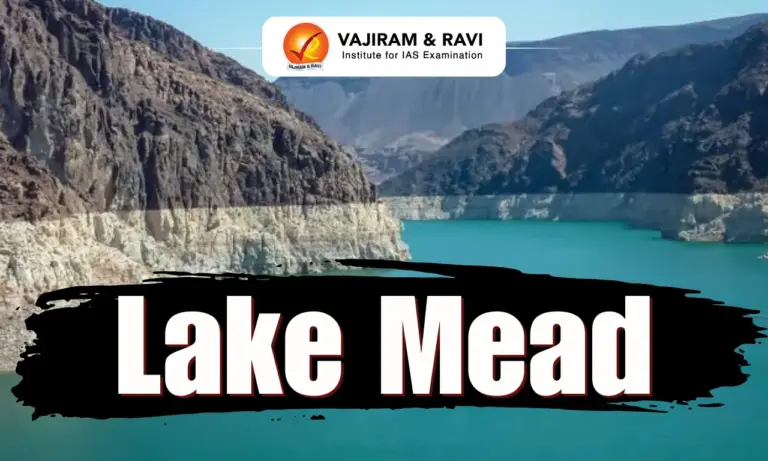
Lake Mead, the largest reservoir in the United States, has plummeted to its lowest water level since it was filled some 90 years ago, another sign of the crisis plaguing the Colorado River system.
About Lake Mead
- It is one of the largest man-made lakes in the world, located on the border between Southern Nevada and northwestern Arizona in the United States.
- It was formed in the mid-1930s by the damming of the Colorado River through the construction of the Hoover Dam.
- It is the largest reservoir in the U.S. when it’s full of water.
- When Lake Mead is completely full, it stretches 180 km long. It can be 162 m deep at its deepest point.
- The water surface is 375 m above sea level, covering an area of 640 sq.km.
- Most of the water is drawn from Rocky Mountain snowmelt and runoff.
- It supplies drinking water for about 25 million people.
- It is home to many species of mammals, including desert bighorn sheep, mountain lions, beavers, coyotes, and bats.
- Since 1999, periods of extended drought paired with increased water demands driven by population growth have caused a drastic drop in lake levels.


Key Facts about Colorado River
- It is a major river of North America.
- Course:
- It rises in the Rocky Mountains of Colorado, United States.
- It flows generally west and south for 2,330 km into the Gulf of California in northwestern Mexico.
- It flows through seven U.S. states and two Mexican states.
- The river drains a vast arid and semiarid sector of the North American continent.
- It is often referred to as the “Lifeline of the Southwest.”
- Lakes: It forms several major reservoirs, including Lake Mead and Lake Powell.
- International boundary: Colorado forms an international boundary between Arizona (US) and Mexico.
- Tributaries: The Colorado River has several tributaries, including Green, Gunnison, San Juan, Dolores, Little Colorado, Gila, and Virgin Rivers.
- One of the Colorado River’s most famous features is the Grand Canyon, which it carved over millions of years.
- Grand Canyon landscape is a UNESCO World Heritage Site and a major tourist attraction.
- The river also flows through Canyonlands National Park and Horseshoe Bend in Arizona.
News: APN

 Last updated on Oct, 2026
→ UPSC 2027 Notification will be released on 13 January 2027 at upsconline.nic.in.
→ Check Nobel Prize 2026 Winners List here.
→ Download PIB PRiSM Monthly Magazine 2026 here.
→ Check UPSC Monthly Current Affairs Magazine The Recitals here.
→ Check out the latest UPSC Syllabus here.
→ Download UPSC Model Answers for Mains 2026
→ UPSC Mains Question Paper 2026 is out now for Essay & GS Paper 1, 2, 3 & 4.
→ UPSC Calendar 2027 has been released.
→ Enroll in Vajiram & Ravi’s UPSC Mains Test Series 2027 for structured answer writing practice, expert evaluation, and exam-oriented feedback.
→ Join Vajiram & Ravi’s UPSC Mentorship Program 2027 for personalized guidance, strategy planning, and one-to-one support from experienced mentors.
→ Go through the UPSC Mains Previous Year Papers to enhance your preparation.
→ UPSC has released UPSC Toppers List 2025 with the Civil Services final result on its official website.
→ Also check Best UPSC Coaching in India
Lake Mead FAQs
Q1. Where is Lake Mead located?+
Q2. How was Lake Mead formed?+
Q3. What is the status of Lake Mead among reservoirs in the United States?+
Q4. What is the primary source of water for Lake Mead?+
Q5. What has caused a drastic decline in Lake Mead’s water levels since 1999?+
Tags: lake mead prelims pointers upsc current affairs upsc prelims current affairs