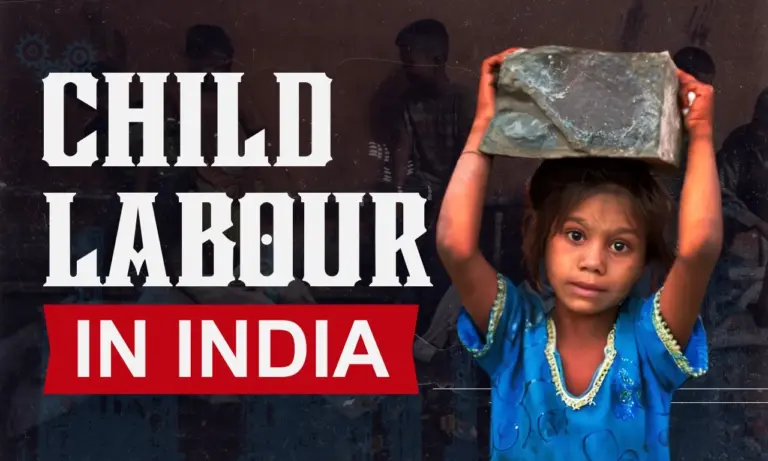
Child labour remains a serious social and economic issue in India, affecting children’s education, health, safety and overall development. Poverty, lack of access to education, family indebtedness and social inequalities are among the major factors that push children into work. India has adopted constitutional provisions, laws and government programmes to prevent child labour and ensure children have the opportunity to grow and study in a safe environment.
What is Child Labour?
Child labour refers to the engagement of children in work that deprives them of their childhood, education, dignity and opportunities for healthy development. It includes work that is mentally, physically, socially or morally harmful to children.
Under India’s legal framework, the Child and Adolescent Labour (Prohibition and Regulation) Act, 1986, as amended in 2016, prohibits the employment of children below 14 years in all occupations and processes, subject to limited exceptions provided under the law. It also prohibits adolescents aged 14-18 years from working in hazardous occupations and processes.
Current Status of Child Labour in India
India has made progress in reducing child labour, but it remains a concern, particularly in the informal and unorganised sectors. Census 2011 recorded about 10.1 million working children aged 5-14, with the ILO noting a decline from 2001 levels.
- 10.1 million children aged 5-14 were recorded as working in Census 2011.
- Child labour declined by about 2.6 million between 2001 and 2011.
- Rural areas witnessed a more significant decline, while urban child labour remained a concern.
- Children continue to be vulnerable in agriculture, domestic work, small industries, construction and informal businesses.
- Poverty, school dropout, migration and demand for cheap labour continue to contribute to the problem.
- Effective law enforcement, education, rehabilitation and social protection remain essential for eliminating child labour.


Major Causes of Child Labour in India
Child labour in India is driven by interconnected economic, social and educational factors, with poverty, lack of quality education, migration and limited social protection among the major contributors.
- Poverty and Financial Hardship: Poor families may depend on children’s earnings or assistance to meet basic household needs. Economic insecurity is one of the strongest drivers of child labour.
- Lack of Access to Quality Education: Children who face barriers such as school costs, poor infrastructure, distance, safety concerns or low-quality education are more likely to drop out and enter work.
- School Dropout: Children who leave school early have fewer opportunities for skill development and are more vulnerable to entering low-paid or informal employment.
- Family Indebtedness: Heavy debts and financial obligations can push vulnerable families to involve children in work to supplement household income.
- Unemployment and Low Adult Wages: When adults cannot find stable employment or earn sufficient wages, families may rely on children’s contribution to household income.
- Migration: Migrant families often face unstable employment, limited access to education and social services, increasing children’s vulnerability to labour.
- Demand for Cheap Labour: Informal businesses may employ children because they are perceived as cheaper and easier to control, particularly where labour monitoring is weak.
- Social and Cultural Practices: Traditional expectations, family occupations and social norms can sometimes encourage children to participate in work instead of continuing their education.
- Weak Social Protection: Families without adequate access to social security, childcare, healthcare and livelihood support may be more vulnerable to sending children to work.
- Informal and Unorganised Employment: Agriculture, household enterprises and small businesses can make child labour difficult to identify and regulate because such workplaces often operate outside formal monitoring systems.
Types of Child Labour in India
Child labour in India occurs across agriculture, domestic work, manufacturing, construction, street-based activities and other informal sectors, with hazardous work posing serious risks to children’s health, safety and development.
- Agricultural Labour: Children may work in farming, harvesting, livestock rearing, fishing and forestry, particularly in rural areas. Long working hours, machinery and exposure to pesticides can make such work hazardous.
- Domestic Labour: Some children work as domestic helpers, performing activities such as cleaning, cooking, washing and childcare in private households. Such work can remain hidden and difficult to monitor.
- Manufacturing and Factory Work: Children may be employed in small workshops, handicrafts, textiles, garment production and other informal manufacturing activities, often under poor working conditions.
- Construction Labour: Children may be involved in carrying materials, cleaning construction sites and assisting workers. Construction environments can expose them to falls, heavy materials, dust and machinery.
- Street-Based Labour: Children may work as street vendors, shop assistants, newspaper sellers, vehicle cleaners or helpers in markets and other public places.
- Hotel and Restaurant Work: Some children work in roadside eateries, restaurants, tea stalls and dhabas, performing tasks such as washing utensils, cleaning and serving customers.
- Mining and Quarrying: Work associated with mining, stone cutting and quarrying can expose children to dust, heavy equipment, injuries and other serious occupational hazards.
- Hazardous Labour: This includes work that can seriously harm a child’s health, safety or development. Indian law prohibits adolescents aged 14-18 from employment in notified hazardous occupations and processes.
Effects of Child Labour on Children
Child labour can seriously affect a child’s physical health, education, mental well-being and future opportunities, particularly when work is hazardous or interferes with schooling.
- Impact on Education: Long working hours can cause irregular school attendance, poor academic performance and school dropout, limiting future career opportunities.
- Physical Health Problems: Children involved in strenuous or hazardous work may suffer from injuries, exhaustion, malnutrition and occupational illnesses.
- Mental and Psychological Stress: Exploitative working environments can expose children to fear, abuse, anxiety, emotional distress and psychological harm.
- Loss of Childhood: Child labour deprives children of adequate time for play, recreation, family life and healthy social development.
- Exposure to Hazardous Conditions: Work involving dangerous machinery, chemicals, construction activities, mining or other unsafe environments can cause serious injuries, illness or permanent disability.
- Reduced Skill Development: Children who leave school early often miss opportunities to develop the knowledge, skills and qualifications needed for decent employment later in life.
- Social Isolation: Working children may have limited interaction with peers and reduced participation in normal school and community activities.
- Cycle of Poverty: Poor education and limited skills can lead to low-paid employment in adulthood, potentially perpetuating poverty across generations.
Constitutional Provisions on Child Labour in India
The Indian Constitution provides a strong framework for protecting children from exploitation, ensuring their right to education, health, dignity and protection from hazardous employment.
- Article 21A – Right to Education: Guarantees free and compulsory education to children aged 6-14 years.
- Article 24 – Prohibition of Child Labour: Prohibits employment of children below 14 years in factories, mines and other hazardous employment.
- Article 39(e): Directs the State to ensure that the health and strength of children are not abused and that they are not forced into work unsuitable for their age.
- Article 39(f): Requires the State to provide children with opportunities to develop in a healthy manner, with freedom and dignity, and protect them against exploitation.
- Article 45: Directs the State to provide early childhood care and education for children below six years.
- Article 51A(k): Makes it a fundamental duty of parents or guardians to provide opportunities for education to children between 6 and 14 years.
Laws and Acts to Prevent Child Labour in India
India has enacted several laws to prohibit child labour, prevent exploitation, ensure education and protect children from hazardous working conditions. The key legal framework includes the following:
- Child and Adolescent Labour (Prohibition and Regulation) Act, 1986: This is the principal law on child labour in India. Following the 2016 amendment, it prohibits the employment of children below 14 years in all occupations and processes, subject to specified exceptions, and prohibits adolescents aged 14-18 years from hazardous occupations and processes.
- Right of Children to Free and Compulsory Education Act, 2009: The RTE Act guarantees free and compulsory education to children aged 6-14 years, helping prevent school dropout and reducing children’s vulnerability to labour.
- Juvenile Justice (Care and Protection of Children) Act, 2015: Provides mechanisms for the care, protection, rehabilitation and social reintegration of children in need of care and protection, including children rescued from exploitative situations.
- Bonded Labour System (Abolition) Act, 1976: Abolishes the bonded labour system and protects vulnerable workers, including children, from labour arrangements involving forced or bonded work.
- Factories Act, 1948: Contains provisions regulating the employment of young persons in factories and restricting children from working in certain industrial environments.
Government Schemes and Initiatives to Eliminate Child Labour
The government uses a combination of education, rehabilitation, social protection and law enforcement to prevent child labour and ensure children remain in school.
- Samagra Shiksha: Promotes access, retention and quality education, including mainstreaming of children rescued from labour.
- PM SHRI Schools: Develops modern and inclusive schools with better infrastructure and learning environments to encourage school participation.
- NEP 2020: Focuses on universal education, foundational learning, reducing dropouts and vocational education, addressing key factors linked to child labour.
- PENCIL Portal: Enables citizens to report suspected cases of child labour for investigation and necessary action.
- National Child Labour Project (NCLP): Earlier provided education, vocational training, healthcare and rehabilitation to rescued children; it has been subsumed under Samagra Shiksha.
- Child Helpline and Rehabilitation: Provides protection, counselling, healthcare and rehabilitation to children rescued from exploitative situations.
- Law Enforcement and Awareness: Government agencies conduct inspections, rescue operations, legal action and awareness campaigns to prevent child labour.
Challenges and Measures to Eradicate Child Labour in India
Eliminating child labour requires addressing its economic, social and educational causes while strengthening enforcement and rehabilitation mechanisms.
Major Challenges
- Poverty and unemployment: Financial hardship can force families to depend on children’s earnings.
- Informal employment: Child labour is difficult to monitor in farms, homes, small businesses and unorganised industries.
- School dropouts: Children who leave school are more vulnerable to entering the workforce.
- Migration: Migrant families may face difficulties maintaining children’s access to education and welfare services.
- Weak enforcement: Limited monitoring and awareness can allow violations to continue.
- Social acceptance: In some communities, children’s participation in family work may be considered normal.
Measures to Eradicate Child Labour
- Strengthen law enforcement through regular inspections and strict action against violators.
- Improve quality education and prevent school dropouts through inclusive and accessible schooling.
- Provide livelihood support and social security to economically vulnerable families.
- Rehabilitate rescued children through education, healthcare, counselling and skill development.
- Improve monitoring of informal sectors and supply chains where child labour may remain hidden.
- Create awareness among parents, employers and communities about child rights and legal provisions.
- Ensure inter-agency coordination among labour, education, police and child protection authorities.

 Last updated on August, 2026
→ UPSC Mains Question Paper 2026 is out now for Essay & GS Paper 1, 2, 3 & 4.
→ UPSC Mains GS Paper 1 2026 is out now.
→ UPSC Mains GS Paper 2 2026 is out now.
→ UPSC Mains GS Paper 3 2026 is out now.
→ UPSC Mains GS Paper 4 2026 is out now.
→ UPSC Mains Indian Language Paper & English Compulsory Paper are out now.
→ Check out the latest UPSC Syllabus 2026 here.
→ UPSC Mains Admit Card 2026 is now out.
→ Enroll in Vajiram & Ravi’s UPSC Mains Test Series 2027 for structured answer writing practice, expert evaluation, and exam-oriented feedback.
→ Join Vajiram & Ravi’s UPSC Mentorship Program 2027 for personalized guidance, strategy planning, and one-to-one support from experienced mentors.
→ Go through the UPSC Mains Previous Year Papers to enhance your preparation.
→ Download UPSC Mains Essay Paper 2025, UPSC Mains GS Paper-I 2025, UPSC Mains GS Paper-II 2025, UPSC Mains GS Paper-III 2025, UPSC Mains GS Paper-IV 2025, UPSC Mains English (Compulsory) Paper 2025, UPSC Mains Hindi (Qualifying) Paper 2025 here.
→ UPSC has released UPSC Toppers List 2025 with the Civil Services final result on its official website.
→ UPSC Calendar 2027 has been released.
→ Also check Best UPSC Coaching in India
Child Labour in India FAQs
Q1. What is child labour in India?+
Q2. What is the legal age for child labour in India?+
Q3. Which Article of the Constitution prohibits child labour?+
Q4. What are the major causes of child labour in India?+
Q5. Which law prohibits child labour in India?+
Q6. How can child labour be eliminated in India?+
Tags: child labour child labour in india