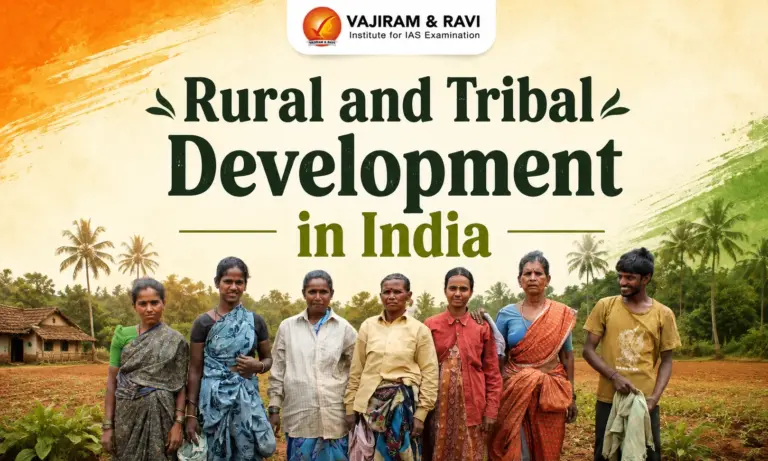
Rural and Tribal Development in India is increasingly moving from basic welfare delivery towards decentralised development, livelihood creation, digital connectivity, social security and community-led empowerment. Government interventions now focus not only on providing basic services but also on strengthening infrastructure, skills, financial inclusion, women-led enterprises and targeted support for tribal and vulnerable communities.
Rural Development in India
Rural Development in India focuses on improving the quality of life and economic opportunities of rural households through basic amenities, infrastructure, education, healthcare, livelihoods, financial inclusion and decentralised governance.
Decentralised Rural Development
- Under the 15th Finance Commission, direct fiscal transfers to Gram Panchayats were ₹2.36 lakh crore for 2021-26, increasing to ₹4.35 lakh crore under the 16th Finance Commission for 2026-31, strengthening local-level development.
- Under the Union Budget, allocation for rural development increased from ₹87,765 crore in 2016-17 to ₹2.73 lakh crore in 2026-27.
- Under BharatNet, 2.19 lakh Gram Panchayats were connected by May 2026, improving digital connectivity in rural areas.
- Under eGramSwaraj, more than ₹3 lakh crore in payments had been processed by June 2026, strengthening digital financial management of Panchayats.
Access to Basic Services
Access to water, sanitation, clean cooking fuel, electricity, healthcare and food security forms the foundation of dignified rural living.
- Under Jal Jeevan Mission, which aims to provide safe and adequate drinking water through functional household tap connections in rural households, tap-water coverage increased from 3.23 crore in August 2019 to more than 15.91 crore by August 12, 2026.
- Under the Har Ghar Jal campaign, 2.89 lakh villages had reported 100% household tap-water coverage by August 12, 2026.
- Under Swachh Bharat Mission-Grameen, which aims to eliminate open defecation and improve rural sanitation and waste management, more than 12.19 crore individual household toilets had been constructed by August 12, 2026.
- Under the Swachh Bharat Mission, India was declared Open Defecation Free in 2019.
- Under GOBARdhan, which promotes the conversion of cattle dung and organic waste into biogas, bio-slurry and other useful products, operational biogas plants increased from 14 in FY 2018-19 to more than 1,288 by August 11, 2026.
- Under PM Ujjwala Yojana, which provides LPG connections to women from poor households, more than 10.57 crore free LPG connections had been provided by August 12, 2026.
- The total number of LPG connections increased from 14.52 crore in 2014 to 33.39 crore in 2026.
- Under Saubhagya, which aimed to provide electricity connections to willing households, 100% willing household electrification was achieved at the pan-India level by March 2019.
- Under Deendayal Upadhyaya Gram Jyoti Yojana, which focused on strengthening rural electricity infrastructure, 100% village electrification was achieved by 2025.
- Under Ayushman Bharat, which provides health protection and strengthens primary healthcare, more than 45.51 crore Ayushman Cards had been issued by August 12, 2026.
- More than 1.86 lakh Ayushman Arogya Mandirs were functional by August 12, 2026, strengthening access to primary healthcare.
- Under PM Garib Kalyan Anna Yojana, which provides free foodgrains to eligible beneficiaries, more than 81.35 crore people were covered.
- Under the Public Distribution System, 99.8% of Fair Price Shops were automated by July 29, 2026.
- Under the One Nation One Ration Card, more than 221 crore portability transactions had been recorded by July 29, 2026, enabling beneficiaries to access ration from any participating location.
Education and Human Capital
Education and skill development are essential for breaking the cycle of rural poverty and inter-generational disadvantage.
- Under Samagra Shiksha, which supports school education through infrastructure, digital learning and skill education, 4,073 schools were upgraded and 1.49 lakh ICT and digital initiatives were implemented between 2018-19 and 2025-26.
- Under the same initiative, 25,000 schools were covered under skill education.
- Female dropout at the primary level declined from 4.6% in 2013-14 to 0.1% in 2025-26, while the secondary-level rate declined from 14.5% to 8% during the same period.
- Under Beti Bachao Beti Padhao, which promotes the survival, education and empowerment of girls, girls’ GER at the secondary level increased from 75.5% in 2014-15 to 83.4% in 2025-26.
- Under Kasturba Gandhi Balika Vidyalayas (KGBVs), which provide residential schooling mainly to girls from disadvantaged communities, sanctioned schools increased from 3,609 in 2014-15 to 5,639 in 2024-25, while 5,133 were operational, with enrolment rising from 3.52 lakh to 7.11 lakh during the same period.
Rural Infrastructure and Connectivity
Rural infrastructure connects households with markets, schools, healthcare, financial services and employment opportunities.
- Under Pradhan Mantri Awaas Yojana–Grameen (PMAY-G), which provides assistance for pucca rural houses with basic amenities, more than 3.91 crore houses had been sanctioned and 3.13 crore houses completed by August 12, 2026.
- Under Pradhan Mantri Gram Sadak Yojana (PMGSY), which provides all-weather road connectivity to eligible rural habitations, 99.6% of eligible habitations had been connected by June 2026, while completed road length increased from 3.86 lakh km during May 2000–May 2014 to 4.13 lakh km during May 2014–August 12, 2026, and completed bridges increased from 484 to 10,404 over the same periods.
Rural Livelihoods, Employment and Skills
The focus of rural development is increasingly shifting from short-term income support towards sustainable livelihoods, skills, entrepreneurship and women’s economic empowerment.
- Under Deendayal Antyodaya Yojana-National Rural Livelihoods Mission (DAY-NRLM), which organises rural women into Self-Help Groups (SHGs) and supports livelihoods through credit and skills, 10.19 crore households had been mobilised into 94.46 lakh SHGs by August 12, 2026, with over 9 lakh Community Resource Persons (CRPs) supporting areas such as agriculture, banking, insurance and nutrition, including 50,548 Bank Sakhis, 1.91 lakh Krishi Sakhis, 2,012 Matsya Sakhis and 1.70 lakh Pashu Sakhis.
- Under the Lakhpati Didi initiative, which aims to help rural women earn at least ₹1 lakh annually, 3.46 crore women had achieved the target by July 29, 2026.
- Under Self-Help Entrepreneur Mart (SHE-Mart), announced in Union Budget 2026-27, community-owned retail spaces are proposed under the SHG ecosystem, with an aim to benefit 1 crore women.
- Under Deen Dayal Upadhyaya Grameen Kaushalya Yojana (DDU-GKY), which provides placement-linked skill training to rural youth, training increased from 43,038 candidates in 2014-15 to 18.45 lakh till August 11, 2026, while placements increased from 21,446 to 12.35 lakh over the same period.
- Under Pradhan Mantri Kaushal Vikas Yojana (PMKVY), which provides industry-oriented skill training to youth, more than 1.64 crore youth had received training since inception till June 2026.
- Under Viksit Bharat-Guarantee for Rozgar and Ajeevika Mission (Gramin), which provides wage employment and supports rural livelihoods, persondays increased from 1,660 crore during FY 2006-07 to FY 2013-14 to 3,029 crore during FY 2014-15 to FY 2024-25, while women’s participation increased from 48% in FY 2013-14 to 58.19% in FY 2024-25.
Financial Inclusion and Social Security
Financial inclusion enables rural households to access formal credit, insurance, pensions, savings and entrepreneurship opportunities.
- Under PM Jan Dhan Yojana, which provides access to basic banking services, beneficiaries increased from 17.9 crore in August 2015 to 58.90 crore by August 12, 2026.
- Under PM MUDRA Yojana, which provides institutional credit to micro and small entrepreneurs, loans sanctioned increased from 3.49 crore in 2016 to more than 59.14 crore by July 2026.
- Under PM SVANidhi, which provides collateral-free working-capital loans to street vendors, beneficiaries increased from 26.37 lakh in November 2021 to 78.17 lakh by August 12, 2026, with ₹18,971.18 crore in loans disbursed.
- Under PM Vishwakarma, which supports traditional artisans through training, toolkits and credit, more than 30 lakh artisans had registered by August 12, 2026; 24.32 lakh had received skill training and 17.70 lakh toolkits.
- Under e-Shram, which creates a national database of unorganised workers for better delivery of social-security benefits, registrations increased from 14.40 crore in December 2021 to 31.87 crore by August 12, 2026.
- Under Atal Pension Yojana, beneficiaries increased from 48.80 lakh in 2016-17 to 9.29 crore by June 2026.
Tribal Development in India
Tribal Development in India focuses on improving the socio-economic conditions of Scheduled Tribes (STs), Particularly Vulnerable Tribal Groups (PVTGs) and tribal-majority communities through targeted interventions in livelihoods, basic services, education and social development. The approach is increasingly based on convergence, community participation and mission-mode implementation.
Increase in Budget for Tribal Development
The Union Budget for Tribal Affairs increased from ₹4,826 crore in 2016-17 to ₹15,421.97 crore in 2026-27, reflecting greater fiscal support for targeted tribal development.
Tribal Livelihoods and Economic Empowerment
- Under PM-JANMAN, which specifically targets Particularly Vulnerable Tribal Groups (PVTGs) through basic services and livelihood support, 540 Van Dhan Vikas Kendras had been sanctioned by August 5, 2026, benefiting 46,042 PVTG persons.
- Under the Pradhan Mantri Janjatiya Vikas Mission (PM-JVM), which promotes tribal livelihoods through value addition and marketing of minor forest produce, 4,172 Van Dhan Vikas Kendras had been sanctioned by August 2026, benefiting 12.48 lakh tribal people.
- Under Pradhan Mantri Janjatiya Unnat Gram Abhiyan (PM-JUGA), which brings together 17 ministries to address development gaps in tribal-majority villages and PVTG habitations, 7.60 lakh tribal houses have been completed, 28,303 tribal villages have gained drinking-water access, 59,812 tribal households and public institutions have been electrified, 657 Anganwadi Centres operationalised and 692 hostels sanctioned over the last 12 years.
Education and Scholarships for Tribal and Vulnerable Communities
- Under Eklavya Model Residential Schools (EMRS), which provide quality residential education to tribal students, operational schools increased from 129 in 2014-15 to 511 by August 12, 2026, with 1.68 lakh students enrolled.
- Under the Pre-Matric Scholarship Scheme for ST students, more than 28.99 lakh tribal students benefited between April 2024 and August 12, 2026.
- Under the National Fellowship for ST Students, 2,961 research scholars were supported in 2025-26, with women accounting for 56% of beneficiaries.
- Under PM-YASASVI, which provides educational support to students from economically disadvantaged OBC, EBC and DNT communities, 20.61 lakh students received pre-matric scholarships and 24.53 lakh students received post-matric scholarships in FY 2024–25.
- Under SHREYAS, which promotes higher education among disadvantaged communities, the Top-Class Education for SC Students component enabled 8,571 students to study in institutions such as IITs, IIMs, NITs and AIIMSin 2025–26.
Development of Vulnerable and Marginalised Communities
- Under PM-AJAY, which supports the socio-economic development of Scheduled Caste communities, more than 4.16 lakh SC houses had been built, over 3.57 lakh SC households had individual toilets and 17,578 villages had been declared Adarsh Grams by August 12, 2026.
- Under the Scheme for Economic Empowerment of De-Notified, Nomadic and Semi-Nomadic Tribes (SEED), which supports the education, livelihood and health needs of these communities, ₹26.75 crore was disbursed during 2025–26 for the educational empowerment of 4,485 DNT students, while 73,569 Ayushman Bharat cards were issued to DNT families under its health component.
Challenges of Rural and Tribal Development in India
Despite significant expansion in scheme coverage, Rural and Tribal Development in India continues to face structural challenges.
- Last-mile delivery: Infrastructure and scheme coverage do not always translate into quality, regular and accessible services.
- Regional disparities: Development outcomes remain uneven across States, districts and tribal regions.
- Livelihood insecurity: Rural households remain vulnerable to agricultural risks, informal employment and low productivity.
- Digital divide: Digital delivery can exclude households facing poor connectivity, limited digital literacy or authentication problems.
- Weak market linkages: Small farmers, artisans and tribal producers often receive low returns because of inadequate processing, storage, branding and market access.
- Climate vulnerability: Droughts, floods, heatwaves and changing rainfall patterns disproportionately affect rural livelihoods.
- Tribal rights: Development projects, displacement and resource extraction can affect tribal land, forests, livelihoods and traditional rights.
- Human capital gaps: Quality of education, healthcare and skill development remains uneven despite improved access.
Way Forward
The next phase should focus on moving from coverage to outcomes and from welfare to sustainable economic empowerment.
- Strengthen local institutions: Give Panchayats and Gram Sabhas greater planning capacity, resources and technical support.
- Focus on outcomes: Measure not only the number of houses, toilets or connections created but also their quality, functionality and actual use.
- Promote local value chains: Support processing, storage, branding, FPOs, SHGs and tribal enterprises to improve producer incomes.
- Strengthen tribal convergence: Integrate housing, water, healthcare, education, infrastructure and livelihoods in tribal areas.
- Protect tribal rights: Ensure effective implementation of the Forest Rights Act, 2006 and PESA, 1996, with meaningful Gram Sabha participation.
- Bridge the digital divide: Combine digital governance with accessible offline mechanisms for vulnerable households.
- Build climate resilience: Promote water conservation, climate-resilient agriculture, renewable energy and disaster preparedness.
- Strengthen women’s economic agency: Expand SHGs, financial inclusion, entrepreneurship and women’s ownership of productive assets.


 Last updated on Sep, 2026
→ UPSC 2027 Notification will be released on 13 January 2027 at upsconline.nic.in.
→ Asian Games 2026 are being held in Aichi-Nagoya, Japan, from 19 September to 4 October.
→ Check out the latest UPSC Syllabus here.
→ Download UPSC Model Answers for Mains 2026
→ UPSC Mains Question Paper 2026 is out now for Essay & GS Paper 1, 2, 3 & 4.
→ UPSC Calendar 2027 has been released.
→ Enroll in Vajiram & Ravi’s UPSC Mains Test Series 2027 for structured answer writing practice, expert evaluation, and exam-oriented feedback.
→ Join Vajiram & Ravi’s UPSC Mentorship Program 2027 for personalized guidance, strategy planning, and one-to-one support from experienced mentors.
→ Go through the UPSC Mains Previous Year Papers to enhance your preparation.
→ UPSC has released UPSC Toppers List 2025 with the Civil Services final result on its official website.
→ Also check Best UPSC Coaching in India
Rural and Tribal Development in India FAQs
Q1. What is the approach to Rural and Tribal Development in India?+
Q2. What are the major pillars of Rural Development in India?+
Q3. What are the major initiatives for Rural Development in India?+
Q4. What is the approach to Tribal Development in India?+
Q5. What are the major initiatives for Tribal Development in India?+
Q6. What are the key challenges to Rural and Tribal Development in India?+
Tags: rural and tribal development in india