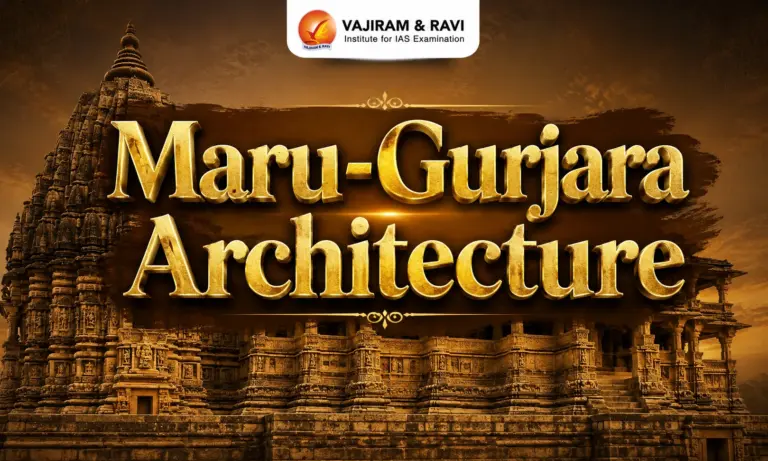
The Maru-Gurjara style of architecture is a distinctive temple-building tradition that developed mainly in Gujarat and Rajasthan between the 8th and 13th centuries CE. It is also known as the Solanki or Chaulukya style and is considered a regional form of Nagara architecture. The style is known for its highly detailed stone carvings, ornate temples and rich sculptural decoration.
Maru-Gurjara Architecture Origin and Development
The name Maru-Gurjara combines Maru, referring to the desert region of Rajasthan, and Gurjara, referring to Gujarat.
- The style developed mainly under the Chaulukya or Solanki rulers of Gujarat and was also supported by Rajput rulers of Rajasthan.
- It flourished particularly under rulers such as Bhima I and Kumarapala.
- Jain merchant communities also played an important role in its development, especially through patronage of Jain temples.
- Over time, it developed as a distinct regional form of the Nagara style, shaped by local artistic traditions and skilled craftsmanship.
Maru-Gurjara Architecture Features
The Maru-Gurjara architecture is known for its complex temple plans, fine marble work, richly carved pillars and ceilings, ornate gateways and detailed sculptures. Its architectural features are also described in texts such as the Aparajitaprccha and Samarangana Sutradhara, which discuss temple construction, ceilings, toranas and other elements of architecture.
- White marble and sandstone were the main materials, with marble from the Mount Abu region used prominently.
- Temples often had a stellate or multi-faceted plan, giving the outer walls several projections and recesses.
- The shikhara was curvilinear, following the Nagara tradition, and was often surrounded by smaller spires called urushringas.
- Mandapas were elaborate pillared halls with richly carved ceilings and decorative elements.
- The ranga-mandapa was an open pillared hall with 12 pillars along its outer edge and an inner octagonal arrangement supporting the ceiling.
- A detached pillared hall was called a sabha-mandapa, while a large or multi-storeyed hall was known as a meghanada-mandapa.
- Vitana referred to the elaborately carved, concentric and corbelled ceiling, often decorated with pendant lotus motifs.
- The characteristic pillar design, known as the West Indian Order, had a square or octagonal base, a sixteen-sided middle section and a richly decorated circular capital.
- Bracket figures, including female celestial figures or surasundaris, were carved at the junction of pillars and capitals.
- Gajathara was a plinth band decorated with a continuous row of elephants, while Narathara above it showed human figures, dancers, musicians and scenes of everyday life.
- Toranas were ornamental gateways at temple entrances, while kirti-toranas were free-standing ceremonial gateways placed before the mandapa.
- Kirtistambhas, or pillars of fame, were another distinctive decorative feature.
- A kunda was a stepped temple tank, often placed on the same axis as the temple.
- The style is especially known for its fine, lace-like and filigree-style carving, particularly in marble.
- Stone beams, rafters and roof ribs were sometimes carved to imitate wooden architectural forms.
- The style was used for both Hindu and Jain temples, as both traditions patronised craftsmen from the same artisan communities.


Maru-Gurjara Architecture Important Examples
The Maru-Gurjara architecture can be seen in several important temples, stepwells and gateways across Gujarat and Rajasthan.
Dilwara Jain Temples
The Dilwara Jain Temples at Mount Abu, Rajasthan, are among the finest examples of Maru-Gurjara marble craftsmanship.
- Vimal Vasahi was built by Vimal Shah in 1031 CE.
- Luna Vasahi was built later by Tejahpala in 1230 CE.
- The temples are especially famous for their highly detailed marble ceilings and carvings.
Modhera Sun Temple
The Sun Temple at Modhera in Gujarat was built under Bhima I of the Solanki dynasty around 1026 CE.
- The complex consists of the Surya Kund, Sabha-mandapa and Garbhagriha.
- These structures are arranged along a single east-west axis.
- The Surya Kund contains 108 miniature shrines.
- The design allows the rising sun’s rays to pass through the complex towards the sanctum around the equinoxes.
Rani ki Vav
Rani ki Vav at Patan, Gujarat, shows the application of the Maru-Gurjara artistic tradition to a stepwell.
- It was built by Rani Udayamati of the Solanki dynasty in the 11th century.
- It was inscribed as a UNESCO World Heritage Site in 2014.
- It is also depicted on the ₹100 currency note.
Taranga Jain Temple
The Ajitnatha Temple at Taranga, Gujarat, was built by Kumarapala of the Solanki dynasty in the 12th century.
- Its construction was associated with the guidance of Acharya Hemachandra.
- The complex contains 14 Svetambara and 5 Digambara shrines.
Rudra Mahalaya
The Rudra Mahalaya at Siddhpur, Gujarat, was a grand Shiva temple.
- It was begun by Mularaja and completed by Jayasimha Siddharaja around 1140 CE.
- Much of the temple was later destroyed, but toranas and pillars survive.
Kirti Toran at Vadnagar
The Kirti Toran at Vadnagar, Gujarat, consists of two free-standing ceremonial gateways. It dates to the 12th century. It is an important surviving example of the kirti-torana tradition.
Somnath Temple
The Somnath Temple in Prabhas Patan, Gujarat, is one of the most important Shaivite temples associated with the Maru-Gurjara architectural tradition.
- It is dedicated to Lord Shiva and is revered as the first of the twelve Jyotirlingas.
- The temple has been destroyed and rebuilt several times during its long history.
- The present temple was rebuilt in the Chaulukya/Maru-Gurjara style after Indian independence.
- Its architecture features a curvilinear shikhara, ornate carvings, mandapas and richly decorated stonework, reflecting the western Indian temple tradition.
Ranakpur Jain Temple
The Ranakpur Jain Temple in Rajasthan is a major Jain temple complex built in the 15th century, which continued the Maru-Gurjara architectural and sculptural tradition.
- The main temple is the Adinatha Temple, dedicated to Tirthankara Rishabhanatha (Adinatha).
- It was built during the reign of Rana Kumbha of Mewar, with the patronage of the Jain merchant Dharna Shah.
Maru-Gurjara Architecture Patronage and Craft Tradition
The growth of Maru-Gurjara architecture was closely linked with royal, religious and merchant patronage.
- Solanki rulers supported large temple-building projects as expressions of power and prosperity.
- Rajput rulers of Rajasthan also patronised the tradition.
- Jain merchant communities played an important role in financing Jain temples.
- Hindu and Jain patrons often employed the same groups of craftsmen, leading to similarities in architectural form.
- The Sompura/Salat communities were important artisan groups involved in temple construction in Gujarat and Rajasthan.
Maru-Gurjara and Nagara Architecture
Maru-Gurjara is a regional form of Nagara architecture, but it developed a distinct identity through its western Indian traditions.
| Feature | Nagara Architecture | Maru-Gurjara Architecture |
|
Region |
North and Central India broadly |
Mainly Gujarat and Rajasthan |
|
Shikhara |
Curvilinear |
Curvilinear, often with urushringas |
|
Decoration |
Rich |
Extremely intricate and detailed |
|
Material |
Varies by region |
Prominent use of white marble and sandstone |
|
Patronage |
Various dynasties |
Solanki rulers, Rajput rulers and Jain merchants |
|
Religious use |
Mainly Hindu |
Hindu and Jain |
Significance of Maru-Gurjara Architecture
The Maru-Gurjara style provides insights into the artistic, social, economic and religious life of medieval western India.
- It shows the regional development of the Nagara style in Gujarat and Rajasthan.
- Sculptures depicting dancers, musicians and everyday activities provide glimpses of contemporary social life.
- Grand temples reflect the wealth and economic resources available for large construction projects.
- Jain merchant patronage highlights the growing role of merchant communities in cultural activities.
- Similar forms in Hindu and Jain temples show shared artistic traditions and craftsmanship.
- Highly detailed carvings reflect the advanced skills of specialised craftsmen.
- Large temples also served as symbols of royal power and prosperity.
- Monuments such as Dilwara, Modhera, Rani ki Vav and Taranga preserve the cultural heritage of medieval western India.

 Last updated on Oct, 2026
→ UPSC 2027 Notification will be released on 13 January 2027 at upsconline.nic.in.
→ Check Nobel Prize 2026 Winners List here.
→ Download PIB PRiSM Monthly Magazine 2026 here.
→ Check UPSC Monthly Current Affairs Magazine The Recitals here.
→ Check out the latest UPSC Syllabus here.
→ Download UPSC Model Answers for Mains 2026
→ UPSC Mains Question Paper 2026 is out now for Essay & GS Paper 1, 2, 3 & 4.
→ UPSC Calendar 2027 has been released.
→ Enroll in Vajiram & Ravi’s UPSC Mains Test Series 2027 for structured answer writing practice, expert evaluation, and exam-oriented feedback.
→ Join Vajiram & Ravi’s UPSC Mentorship Program 2027 for personalized guidance, strategy planning, and one-to-one support from experienced mentors.
→ Go through the UPSC Mains Previous Year Papers to enhance your preparation.
→ UPSC has released UPSC Toppers List 2025 with the Civil Services final result on its official website.
→ Also check Best UPSC Coaching in India
Maru-Gurjara Architecture FAQs
Q1. What is Maru-Gurjara Architecture?+
Q2. What are the main features of Maru-Gurjara Architecture?+
Q3. What are the important examples of Maru-Gurjara Architecture?+
Q4. Who patronised Maru-Gurjara Architecture?+
Q5. How is Maru-Gurjara Architecture related to Nagara Architecture?+
Tags: maru gurjara architecture