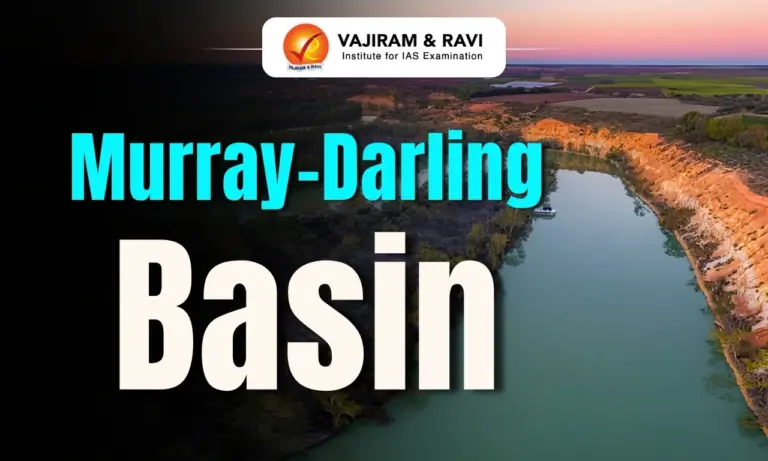
The Murray-Darling Basin is Australia’s largest River System. The Basin has 77,000 km of rivers and supports more than 2.4 million people. It contains the Murray River and Darling River, 16 internationally significant wetlands, diverse ecosystems and major agricultural areas.
Murray-Darling Basin
The Murray-Darling Basin combines major rivers, wetlands, floodplains, lakes and diverse habitats across Australia’s inland southeast, making it vital for water, agriculture and biodiversity.
- Location: The Murray-Darling Basin is located in southeastern Australia. It spans parts of New South Wales, Queensland, Victoria and South Australia, along with the Australian Capital Territory.
- Size: The Murray-Darling Basin covers more than 1 million km², or about one-seventh of Australia’s landmass. Its rivers have a combined length of about 77,000 km.
- Major Rivers: The Murray River is Australia’s Longest River at 2,508 km. The Darling River is Australia’s third longest river and joins the Murray near the New South Wales-Victoria border.
- River System: The Basin contains 23 rivers, including the Murray, Darling, Murrumbidgee, Lachlan and Goulburn. Its total river length is about 77,000 km.
- Wetlands: The Basin contains more than 30,000 wetlands. Eleven are protected under the Ramsar Convention, while 16 wetlands are internationally significant.
- Agriculture: Around 40% of Australia’s agricultural produce comes from the Basin.
- Biodiversity: The Murray-Darling Basin supports diverse wildlife, including Murray cod, golden perch, platypus, koalas, red kangaroos, eastern grey kangaroos, Azure kingfishers and River Murray short necked turtles.
- Vegetation: River red gum forests, floodplain woodlands, shrublands, grasslands, sedgelands and herblands occur across the Basin. Native plants reduce erosion, filter water and provide wildlife habitats.
- Environmental Challenges: Reduced river flows, drought, water extraction, salinity, algal blooms and introduced species have affected Basin ecosystems. Carp can reduce water quality and compete with native fish.
- Cultural Importance: More than 50 First Nations communities have longstanding cultural connections with the Basin. Its waterways support cultural practices, ceremonies, fishing, hunting and responsibilities for caring for Country.
- Water Management: The Murray-Darling Basin Plan was developed after prolonged drought and excessive extraction raised concerns about river health. The Murray-Darling Basin Authority monitors and reports on the Plan.


 Last updated on Oct, 2026
→ UPSC 2027 Notification will be released on 13 January 2027 at upsconline.nic.in.
→ Check Nobel Prize 2026 Winners List here.
→ Download PIB PRiSM Monthly Magazine 2026 here.
→ Check UPSC Monthly Current Affairs Magazine The Recitals here.
→ Check out the latest UPSC Syllabus here.
→ Download UPSC Model Answers for Mains 2026
→ UPSC Mains Question Paper 2026 is out now for Essay & GS Paper 1, 2, 3 & 4.
→ UPSC Calendar 2027 has been released.
→ Enroll in Vajiram & Ravi’s UPSC Mains Test Series 2027 for structured answer writing practice, expert evaluation, and exam-oriented feedback.
→ Join Vajiram & Ravi’s UPSC Mentorship Program 2027 for personalized guidance, strategy planning, and one-to-one support from experienced mentors.
→ Go through the UPSC Mains Previous Year Papers to enhance your preparation.
→ UPSC has released UPSC Toppers List 2025 with the Civil Services final result on its official website.
→ Also check Best UPSC Coaching in India
Murray-Darling Basin FAQs
Q1. What is the Murray-Darling Basin?+
Q2. Which are the two main rivers of the Murray-Darling Basin?+
Q3. Where is the Murray-Darling Basin located?+
Q4. Why is the Murray-Darling Basin important?+
Q5. What is the Murray-Darling Basin Plan?+
Tags: murray-darling murray-darling basin