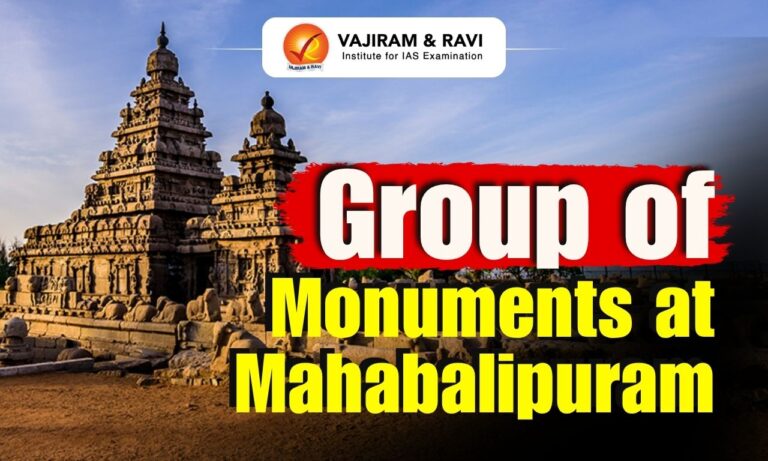
The Group of Monuments at Mahabalipuram, also known as Mamallapuram, is an important collection of ancient monuments located along the Coromandel Coast of Tamil Nadu. Created mainly under the Pallava rulers during the 7th and 8th centuries CE, the site is known for its rock-cut caves, monolithic temples, large stone reliefs and structural temples. Its monuments represent an important stage in the development of South Indian and early Dravidian architecture.
History of Group of Monuments at Mahabalipuram
- Mahabalipuram, or Mamallapuram, developed as an important Pallava port city on the Coromandel Coast. Its name is associated with Narasimhavarman I, who was also known by the title Mamalla.
- The town played an important role in the Pallavas’ maritime and cultural connections with regions of Southeast Asia.
- The earliest architectural activity at the site is associated with the Pallava period, particularly the reigns of Mahendravarman I and Narasimhavarman I.
- Under these rulers, artists experimented with rock-cut architecture, caves, monolithic temples and large sculptural panels.
- During the reign of Narasimhavarman I Mamalla, several important monuments were created, including the Pancha Rathas, Varaha Mandapa, Mahishasuramardini Mandapa and large open-air reliefs such as Arjuna’s Penance.
- Later, Narasimhavarman II, also known as Rajasimha, expanded structural temple architecture at Mahabalipuram. This period reached its architectural high point with the construction of the famous Shore Temple.
- Architectural activity continued in later periods, including the Chola and Vijayanagara periods, although on a smaller scale.
- Excavations around the Shore Temple have also revealed buried structures and sculptures that provide further evidence of the site’s long architectural history.
Architecture and Major Monuments of Mahabalipuram
- The monuments of Mahabalipuram represent different forms of rock-cut, monolithic and structural architecture. The major groups include mandapas, rathas, open-air rock reliefs, structural temples and excavated remains, showing the experimentation and craftsmanship of Pallava architects.
- The mandapas, or rock-cut cave temples, contain beautifully carved sculptures of Hindu deities and mythological scenes. Important examples include the Varaha Mandapa, Mahishasuramardini Mandapa and Adivaraha Cave, with sculptures displaying considerable attention to movement and natural forms.
- The Pancha Rathas are among the best-known monuments of Mahabalipuram. These five monolithic temples were carved from individual blocks of rock and are traditionally associated with the five Pandavas and Draupadi.
- They display different plans, elevations and roof forms, demonstrating the experimental character of Pallava architecture.
- The Shore Temple is one of the most prominent structural temples at the site. Built during the reign of Narasimhavarman II (Rajasimha), the temple complex contains shrines associated with Shiva and Vishnu and stands prominently along the seashore.
- Arjuna’s Penance, also known as the Descent of the Ganges, is a large open-air rock relief containing numerous human, animal and divine figures. Its interpretation is associated either with Arjuna’s penance or the descent of the Ganges to Earth, making it one of the most significant sculptural works at Mahabalipuram.
- Excavations around the Shore Temple have uncovered additional rock-cut figures, temple remains, a reclining image of Vishnu, a Bhuvaraha image and other structures, adding to the understanding of the Pallava settlement and its architectural traditions.


UNESCO World Heritage Status of Mahabalipuram
- The Group of Monuments at Mahabalipuram was inscribed on the UNESCO World Heritage Sites List in 1984 because of its outstanding cultural and architectural importance.
- The site represents an important phase in the development of Indian temple architecture, particularly the early evolution of forms that later became prominent in South Indian Dravidian architecture.
- UNESCO recognition covers a remarkable collection of rock-cut caves, monolithic rathas, structural temples and monumental open-air sculptures, reflecting the high level of artistic skill achieved by Pallava craftsmen.
- The monuments also demonstrate how the Pallava architects made effective use of the natural rocky landscape.
- Instead of treating the rock merely as a building material, they transformed natural rock formations and boulders into temples, sculptures and architectural forms.
- The heritage site is therefore significant not only for its individual monuments but also for the way it demonstrates the evolution of architecture and sculpture during the Pallava period.
Group of Monuments at Mahabalipuram Religious and Cultural Significance
- The monuments of Mahabalipuram have strong connections with Hindu religious traditions, particularly through sculptures and temples dedicated to or depicting deities such as Shiva, Vishnu and Durga.
- The large reliefs and cave sculptures depict themes drawn from Hindu mythology and Indian religious traditions. Scenes associated with Arjuna, the Ganges, Krishna and various Hindu deities provide an important link between architecture, sculpture and religious storytelling.
- The Pancha Rathas, despite their popular association with the Pandavas, are primarily important as examples of monolithic temple architecture and architectural experimentation during the Pallava period.
- Mahabalipuram also reflects the close relationship between religion, art, architecture and royal patronage in early medieval South India. Pallava rulers used monumental architecture to express both religious devotion and their cultural achievements.
- The site’s location on the coast further adds to its cultural importance. As an ancient port, Mahabalipuram was connected with maritime trade and contacts with Southeast Asia, contributing to the wider spread of Indian cultural and architectural influences.
Pallava Dynasty and Mahabalipuram
- The Pallava dynasty played the central role in the development of Mahabalipuram as an important centre of architecture and sculpture. The Pallavas ruled parts of southern India for several centuries, with their major political centre at Kanchipuram.
- Mahendravarman I is associated with the early development of rock-cut cave architecture at the site. His period marked an important stage in the Pallava experimentation with creating temples directly from natural rock.
- Narasimhavarman I Mamalla greatly expanded the artistic activity at Mahabalipuram. Many of the site’s celebrated rathas, mandapas and rock reliefs are associated with his reign, making him one of the most important rulers in the architectural history of the town.
- Narasimhavarman II Rajasimha took Pallava temple architecture further by promoting structural temples. The construction of the Shore Temple represents the mature stage of this architectural development.
- The monuments created under different Pallava rulers together show the gradual transition from rock-cut and monolithic forms to fully structural temples, making Mahabalipuram particularly important for understanding the evolution of South Indian architecture.
Also Read : Pallava Art and Architecture
Group of Monuments at Mahabalipuram Preservation
- The Group of Monuments at Mahabalipuram is an important heritage and tourism destination in Tamil Nadu because of its distinctive combination of history, architecture, sculpture and coastal landscape.
- Its UNESCO World Heritage status has increased international recognition of the site and highlights the need for the long-term conservation of its monuments and sculptures.
- The monuments face challenges associated with their coastal location, including exposure to wind, salt and moisture. Regular conservation and scientific maintenance are therefore important for protecting the stone structures and sculptures.
- Archaeological excavations around the monument complex continue to provide information about buried structures and earlier phases of settlement and temple construction, adding to the historical understanding of Mahabalipuram.
- Today, Mahabalipuram remains an important destination for students, researchers and tourists interested in Pallava history, Indian temple architecture, UNESCO heritage and South Indian cultural traditions.
Group of Monuments at Mahabalipuram Significance
- Evidence of ancient maritime trade: Mahabalipuram was an important seaport on the Coromandel Coast and had maritime connections with different parts of Asia and the Mediterranean world. The discovery of Chinese, Persian and Roman coins supports its role as an important centre of ancient trade.
- Link with the Pallava dynasty: The monuments reflect the artistic and architectural achievements of the Pallava rulers and show how they developed new forms of rock-cut, monolithic and structural temple architecture. Mahabalipuram therefore holds an important place in the history of South Indian architecture.
- Historical India-China connections: Mahabalipuram also represents the long history of India-China maritime, cultural and diplomatic contacts. During the early 8th century, the Pallava ruler Narasimhavarman II (Rajasimha) maintained diplomatic links with the Tang court, reflecting the wider interaction between the two regions.
- Modern diplomatic importance: Mahabalipuram gained renewed international attention when it hosted the Second India-China Informal Summit in October 2019. The choice of the historic coastal town highlighted the ancient cultural and maritime links between India and China.
- Cultural and heritage value: With its Shore Temple, Pancha Rathas, rock-cut caves and monumental reliefs, Mahabalipuram represents the richness of India’s cultural heritage. Its UNESCO World Heritage status since 1984 further underlines its global historical and architectural importance.

 Last updated on Oct, 2026
→ UPSC 2027 Notification will be released on 13 January 2027 at upsconline.nic.in.
→ Check Nobel Prize 2026 Winners List here.
→ Download PIB PRiSM Monthly Magazine 2026 here.
→ Check UPSC Monthly Current Affairs Magazine The Recitals here.
→ Check out the latest UPSC Syllabus here.
→ Download UPSC Model Answers for Mains 2026
→ UPSC Mains Question Paper 2026 is out now for Essay & GS Paper 1, 2, 3 & 4.
→ UPSC Calendar 2027 has been released.
→ Enroll in Vajiram & Ravi’s UPSC Mains Test Series 2027 for structured answer writing practice, expert evaluation, and exam-oriented feedback.
→ Join Vajiram & Ravi’s UPSC Mentorship Program 2027 for personalized guidance, strategy planning, and one-to-one support from experienced mentors.
→ Go through the UPSC Mains Previous Year Papers to enhance your preparation.
→ UPSC has released UPSC Toppers List 2025 with the Civil Services final result on its official website.
→ Also check Best UPSC Coaching in India
Group of Monuments at Mahabalipuram FAQs
Q1. What is the Group of Monuments at Mahabalipuram?+
Q2. Where is the Group of Monuments at Mahabalipuram located?+
Q3. Who built the monuments at Mahabalipuram?+
Q4. When was the Group of Monuments at Mahabalipuram declared a UNESCO World Heritage Site?+
Q5. What are the major monuments at Mahabalipuram?+
Q6. What are the Pancha Rathas of Mahabalipuram?+
Q7. Why is the Shore Temple important?+
Q8. Why is Mahabalipuram historically significant?+
Q9. What is the significance of Arjuna's Penance at Mahabalipuram?+
Tags: art and culture art and culture notes group of monuments at mahabalipuram history history notes