The Java Trench, also known as the Sunda Trench, is a major submarine trench in the eastern Indian Ocean, located south of the Indonesian islands of Sumatra and Java. It lies along an active tectonic zone associated with the Sunda Volcanic Arc, frequent earthquakes and tsunami risk, making it important for understanding ocean-floor relief, plate tectonics and natural hazards.
About Java Trench
The Java Trench is a deep-sea trench formed along an active subduction zone, where the Australian Plate moves beneath the Sunda Plate.
- Location: It lies south of the Indonesian islands of Sumatra, Java and the Lesser Sunda Islands, along the southern margin of the Indonesian island arc.
- Formation: The Java Trench lies at a convergent plate boundary, where the relatively dense Australian Plate moves northward and subducts beneath the Sunda Plate. As the oceanic lithosphere bends downward and sinks into the mantle, it creates the long, narrow depression of the Java Trench.
- Depth: It reaches a depth of roughly 7.2 km. A depth of around 7,290 metres is commonly cited in conventional geographical sources, while modern surveys have recorded approximately 7,187 metres.
- Volcanic Activity: Fluids released from the subducting plate trigger partial melting in the overlying mantle, generating magma that rises towards the surface and contributes to the Sunda Volcanic Arc, which includes volcanoes such as Mount Merapi.
- Earthquake-Prone Zone: Friction can cause parts of the subduction interface to become locked, allowing tectonic stress to accumulate and eventually release through powerful megathrust earthquakes.
- Tsunami Risk: The Java Trench is prone to tsunamis because large earthquakes along the subduction zone can suddenly move the seafloor and displace seawater. The 2006 Java earthquake (magnitude 7.7) triggered a destructive tsunami along the southern coast of Java.
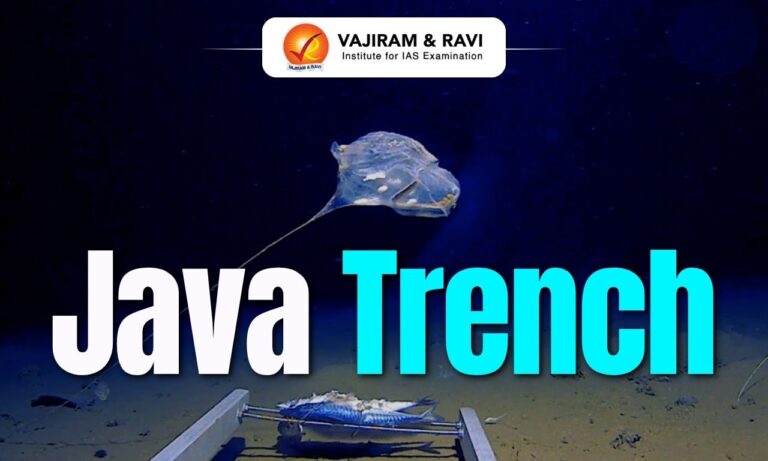
- Hadal Environment: Parts of the trench extend below 6,000 metres, placing them within the hadal zone, characterised by extremely high pressure, darkness, low temperatures and specialised deep-sea organisms.


 Last updated on August, 2026
→ UPSC Mains Question Paper 2026 is out now for Essay & GS Paper 1, 2, 3 & 4.
→ UPSC Mains GS Paper 1 2026 is out now.
→ UPSC Mains GS Paper 2 2026 is out now.
→ UPSC Mains GS Paper 3 2026 is out now.
→ UPSC Mains GS Paper 4 2026 is out now.
→ UPSC Mains Indian Language Paper & English Compulsory Paper are out now.
→ Check out the latest UPSC Syllabus 2026 here.
→ UPSC Mains Admit Card 2026 is now out.
→ Enroll in Vajiram & Ravi’s UPSC Mains Test Series 2027 for structured answer writing practice, expert evaluation, and exam-oriented feedback.
→ Join Vajiram & Ravi’s UPSC Mentorship Program 2027 for personalized guidance, strategy planning, and one-to-one support from experienced mentors.
→ Go through the UPSC Mains Previous Year Papers to enhance your preparation.
→ Download UPSC Mains Essay Paper 2025, UPSC Mains GS Paper-I 2025, UPSC Mains GS Paper-II 2025, UPSC Mains GS Paper-III 2025, UPSC Mains GS Paper-IV 2025, UPSC Mains English (Compulsory) Paper 2025, UPSC Mains Hindi (Qualifying) Paper 2025 here.
→ UPSC has released UPSC Toppers List 2025 with the Civil Services final result on its official website.
→ UPSC Calendar 2027 has been released.
→ Also check Best UPSC Coaching in India
Java Trench FAQs
Q1. Where is the Java Trench located?+
Q2. What is the Java Trench also known as?+
Q3. Which plates are involved in the formation of the Java Trench?+
Q4. What is the depth of the Java Trench?+
Q5. What are the major hazards associated with the Java Trench?+
Tags: java trench