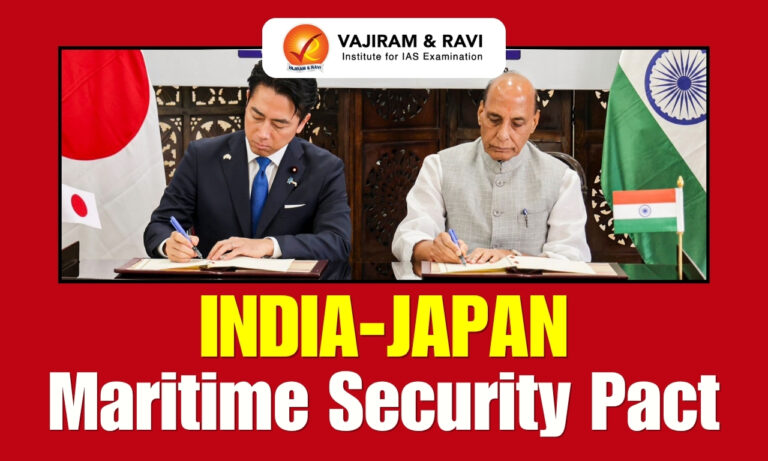
Why in the News?: Recently, the India-Japan Maritime Security Pact was signed as a Memorandum of Arrangement (MoA) to strengthen maritime security and defence cooperation between the two countries. The pact comes amid heightened regional security concerns and supports their shared vision of a free and open Indo-Pacific.
About India-Japan Maritime Security Pact
The India-Japan Maritime Security Pact is a Memorandum of Arrangement (MoA) signed by India and Japan to provide a structured framework for closer cooperation in maritime security and defence.
- The MoA was signed by Defence Minister Rajnath Singh and Japanese Defence Minister Shinjiro Koizumi during the Japan-India Defence Ministers’ Meeting in New Delhi.
- The arrangement forms part of the broader Japan-India Special Strategic and Global Partnership, under which the two countries are strengthening their defence relationship.
- The pact reflects the growing strategic and maritime convergence between India and Japan amid heightened regional and international security concerns.
India-Japan Maritime Security Pact Key Features
The India-Japan Maritime Security Pact include maritime cooperation with naval operations, logistics, shipbuilding, defence technology and wider Indo-Pacific cooperation. Both countries reaffirmed that their defence cooperation should contribute to a free and open Indo-Pacific, with greater coordination on regional and international security developments.
Maritime Security and Maritime Operations
- Maritime Domain Awareness: India and Japan will strengthen information sharing on Maritime Domain Awareness (MDA) to improve their understanding of developments in the maritime domain.
- Search and Rescue: Both sides will enhance cooperation in Search and Rescue (SAR) operations.
- Humanitarian assistance and disaster relief: The two countries will strengthen cooperation in Humanitarian Assistance and Disaster Relief (HADR) operations.
- Protection of sea routes: India and Japan will strengthen coordination for protecting Sea Lines of Communication (SLOCs) through naval, logistical and operational cooperation.
- Mine countermeasures: Both sides will work to enhance mine-countermeasure capabilities according to their strategic and operational requirements.
Naval and Operational Cooperation
- Naval visits and exercises: Cooperation will include mutual visits by naval ships and units and joint exercises to strengthen operational coordination.
- Personnel and expert exchanges: India and Japan will promote exchanges of military personnel and Subject Matter Experts (SMEs).
- Greater operational integration: Bilateral exercises will become more complex and integrated, including greater use of unmanned systems.
- Short-notice exercises: Both sides will explore the possibility of conducting joint exercises at short notice whenever opportunities arise.
- Special Operations Forces: India and Japan will promote exchanges between their respective Special Operations Forces.
- Integrated theatre commands: Japan will explore cooperation with India’s integrated theatre commands following their establishment.
Logistics, Ports and Ship Repair
- Port access: The two countries will strengthen logistical cooperation, including the use of ports.
- Maintenance and repair: Cooperation will extend to maintenance and repair facilities, supporting greater practical naval cooperation.
- Reciprocal ship repair: India and Japan will work towards reciprocal provision of ship-repair facilities and conclude a ship-repair arrangement in the near future.
Shipbuilding and Make in India
- Joint naval shipbuilding: The two countries will explore joint development in naval shipbuilding and design. The cooperation will leverage Japan’s technological expertise and India’s production capabilities.
- Defence shipbuilding: Both sides will seek to leverage each other’s strengths in defence shipbuilding and related areas.
- Make in India: Japan’s possible use of Indian production capabilities will be explored under the Make in India framework.
Defence Equipment and Technology
- Technology transfer: India and Japan will deepen cooperation in defence equipment and technology, following Japan’s recent review of its framework for defence equipment and technology transfers.
- UNICORN system: The shipborne UNICORN integrated communications antenna system has been identified as an important symbol of growing India–Japan defence technology cooperation.
- UNICORN is the first defence equipment transfer project between India and Japan, and both sides will work towards its early realisation.
- Future defence projects: India and Japan will discuss additional defence equipment and technology projects based on the operational requirements of their respective armed forces.
- DRDO-ATLA cooperation: India’s Defence Research and Development Organisation (DRDO) and Japan’s Acquisition, Technology & Logistics Agency (ATLA) will deepen cooperation in state-of-the-art defence technologies.
- Defence Industry Forum: The two countries will convene a Defence Industry Forum to promote greater cooperation between their defence industries.
Indo-Pacific and Regional Cooperation
- Third-country cooperation: India and Japan will deepen cooperation with third countries through high-level exchanges, exercises and other initiatives.
- Both sides welcomed the first trilateral naval PASSEX involving India, Japan and Indonesia, conducted in February.
- Indo-Pacific Logistics Network: India and Japan will further promote cooperation through the Indo-Pacific Logistics Network (IPLN) to support partner countries during natural disasters by transporting personnel and supplies.
- The second Indo-Pacific Logistics Network (IPLN) tabletop exercise is scheduled to be held at the Japan Ministry of Defense in September.
Institutional Mechanism for Implementation
- Working Group: India and Japan will establish a Working Group headed at the Director-General/Joint Secretary level to coordinate implementation of the decisions taken by the two Defence Ministers.
- The Working Group will cover operational, intelligence, equipment, technology and defence-industrial cooperation.]
- It will maximise synergies and accelerate implementation of agreed initiatives while respecting the respective policies and sovereign choices of both countries.
Defence Dialogue and Strategic Coordination
- 2+2 dialogue: India and Japan will accelerate discussions towards convening the Fourth Japan-India Foreign and Defence Ministerial Meeting (2+2) in Tokyo this year.
- Security consultations: Both countries agreed to hold consultations when necessary to contribute to the security of both countries and peace and stability in the region.


India-Japan Maritime Security Pact Significance
The pact deepens India-Japan defence ties by moving cooperation towards greater operational, technological, industrial and regional coordination.
For India
- Strengthens maritime security: Cooperation in Maritime Domain Awareness (MDA), naval operations, Search and Rescue (SAR) and Humanitarian Assistance and Disaster Relief (HADR) improves maritime coordination.
- Protects Sea Lines of Communication: Greater naval and logistical cooperation supports the protection of Sea Lines of Communication (SLOCs).
- Boosts defence capabilities: Joint exercises, unmanned systems and Special Operations Forces exchanges enhance operational preparedness.
- Supports Make in India: Joint shipbuilding and greater use of Indian production capabilities strengthen domestic defence manufacturing.
- Improves defence technology: The shipborne UNICORN integrated communications antenna system and cooperation between the Defence Research and Development Organisation (DRDO) and Japan’s Acquisition, Technology & Logistics Agency (ATLA) deepen India’s defence technology partnership with Japan.
For Japan
- Deepens strategic partnership: It gives greater practical depth to the Japan-India Special Strategic and Global Partnership.
- Strengthens maritime cooperation: Closer engagement with the Indian Navy enhances Japan’s maritime security cooperation.
- Expands defence industry cooperation: Shipbuilding, technology transfer and the Defence Industry Forum create opportunities for greater industrial collaboration.
- Supports regional stability: Cooperation with India and other Indo-Pacific partners strengthens Japan’s contribution to regional peace and stability.
For the Indo-Pacific
- Supports a free and open Indo-Pacific: The pact strengthens cooperation between two countries committed to this objective.
- Promotes freedom of navigation: Both countries oppose actions threatening the freedom and safety of navigation and overflight.
- Builds regional partnerships: The India-Japan-Indonesia trilateral naval Passage Exercise (PASSEX) and cooperation with third countries expand maritime cooperation.
- Strengthens disaster response: The Indo-Pacific Logistics Network (IPLN) supports regional humanitarian assistance and disaster-relief cooperation.

 Last updated on Oct, 2026
→ UPSC 2027 Notification will be released on 13 January 2027 at upsconline.nic.in.
→ Check Nobel Prize 2026 Winners List here.
→ Download PIB PRiSM Monthly Magazine 2026 here.
→ Check UPSC Monthly Current Affairs Magazine The Recitals here.
→ Check out the latest UPSC Syllabus here.
→ Download UPSC Model Answers for Mains 2026
→ UPSC Mains Question Paper 2026 is out now for Essay & GS Paper 1, 2, 3 & 4.
→ UPSC Calendar 2027 has been released.
→ Enroll in Vajiram & Ravi’s UPSC Mains Test Series 2027 for structured answer writing practice, expert evaluation, and exam-oriented feedback.
→ Join Vajiram & Ravi’s UPSC Mentorship Program 2027 for personalized guidance, strategy planning, and one-to-one support from experienced mentors.
→ Go through the UPSC Mains Previous Year Papers to enhance your preparation.
→ UPSC has released UPSC Toppers List 2025 with the Civil Services final result on its official website.
→ Also check Best UPSC Coaching in India
India-Japan Maritime Security Pact FAQs
Q1. What is the India-Japan Maritime Security Pact?+
Q2. Who signed the India-Japan Maritime Security Pact?+
Q3. What are the key areas covered under the India-Japan Maritime Security Pact?+
Q4. How does the India-Japan Maritime Security Pact strengthen defence cooperation?+
Q5. What is the significance of the India-Japan Maritime Security Pact for the Indo-Pacific?+
Tags: india japan maritime security pact