India Taliban Engagement Latest News
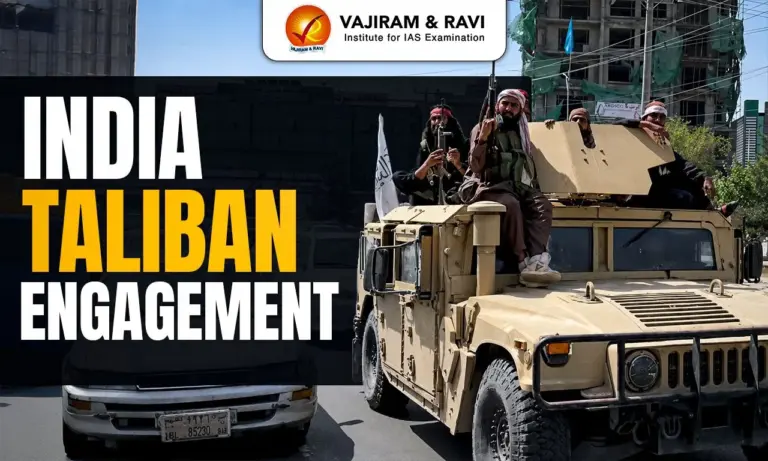
- On August 15, the Taliban-controlled Afghanistan embassy in New Delhi celebrated “victory day,” marking five years since the Taliban’s takeover of Kabul.
- The event, attended by Indian and around two dozen foreign diplomats, signalled how far India-Taliban ties have shifted — from New Delhi’s hurried evacuation of its Kabul embassy on August 17, 2021, to today’s open, if still unofficial, engagement.
- Indian officials describe this as “cautious engagement,” while critics call it “opportunistic.”
Why India Is Deepening Engagement
- India invested heavily in Afghanistan after the Taliban’s fall in 2001.
- When the Ashraf Ghani government collapsed in 2021 following the U.S. troop withdrawal announced by President Biden, New Delhi faced the prospect of losing its $2-3 billion developmental investment.
- This pushed India to upgrade engagement with the Taliban — without extending formal diplomatic recognition — both to protect this investment for the Afghan people and to build leverage and influence in the country.
- Three strategic factors accelerated this shift:
- Pakistan-Taliban rift: Pakistan, once the Taliban’s principal benefactor, has turned into an adversary, with repeated border clashes between the two. This fracture created a window of opportunity for India.
- China’s growing footprint: Beijing has been building infrastructure and pursuing natural resources in Afghanistan, filling the vacuum left by Western withdrawal.
- Russia’s parallel engagement: Russia, the only country to have formally established diplomatic ties with the Taliban, has been coordinating with India to monitor Chinese influence in the region.


Timeline of India’s Outreach
- India’s engagement evolved incrementally:
- August 31, 2021: First official contact — India’s ambassador to Qatar met the Taliban’s political office chief in Doha.
- September 2021: India acknowledged the Taliban as those “in positions of power and authority” in Afghanistan.
- December 2021: India sent its first medicine consignment, distinguishing the Taliban regime from the Afghan people.
- June 2022: First official Indian visit to Kabul post-takeover to oversee humanitarian aid delivery.
- January 2025: Foreign Secretary Vikram Misri held a substantive meeting with Taliban Foreign Minister Muttaqi in Dubai.
- May 2025: EAM S. Jaishankar spoke to Muttaqi by phone after India-Pakistan agreed to halt strikes during Operation Sindoor; the Taliban had condemned the Pahalgam terror attack.
- October 2025: Muttaqi visited India; both sides upgraded missions to embassy level and appointed chargé d’affaires.
Security Concerns
- India’s guiding principle remains that Afghan territory must not be used for anti-India activities or terrorism.
- A UN Security Council 1267 sanctions committee report noted that the terrorist threat from Afghanistan remains largely unchanged, with groups like ISIL-K and Al-Qaeda still active despite Taliban efforts to contain them.
- Notably, the report made no mention of anti-India groups like Lashkar-e-Taiba or Jaish-e-Mohammad — a relief for New Delhi, though it remains watchful.
- Taliban officials have sought to project Afghanistan as a hub for regional economic connectivity rather than terrorism, framing this as a message to both India and Pakistan.
The Human Rights Question
- India has delivered substantial humanitarian aid since 2021, including 50,000 metric tons of wheat and over 445 tons of medicines and disaster relief material.
- However, human rights, women’s rights, and minority rights — once part of India’s stated concerns — are no longer publicly emphasised.
- The Taliban has systematically curtailed rights for Afghanistan’s 22 million women: barring girls over 12 from school, restricting unaccompanied travel, and enabling child marriage.
- India had earlier voiced concern — including in December 2022 over university bans on women — and had backed a UN Security Council resolution (adopted August 30, 2021, under India’s presidency) calling for inclusive governance and equal rights for women and girls.
- India has since dropped insistence on these red lines, instead moving forward with development cooperation and visas for Afghans for medical treatment, business, and education.
Current Status
- Afghan missions in Delhi, Mumbai, and Hyderabad are now staffed by Taliban-appointed diplomats, though formal diplomatic recognition remains withheld.
- This is symbolised by the Delhi embassy’s flagpole still flying the former Afghan Republic’s tricolour rather than the Taliban’s flag.
Conclusion
- India’s Taliban engagement reflects pragmatic recalibration driven by strategic competition with Pakistan and China, rather than ideological alignment.
- While New Delhi has protected its economic stakes and security interests, its retreat from earlier human rights and women’s rights positions marks a significant, if quiet, shift — raising questions about the balance between strategic necessity and India’s traditional foreign policy values.
Source: IE

 Last updated on Oct, 2026
→ UPSC 2027 Notification will be released on 13 January 2027 at upsconline.nic.in.
→ Check Nobel Prize 2026 Winners List here.
→ Download PIB PRiSM Monthly Magazine 2026 here.
→ Check UPSC Monthly Current Affairs Magazine The Recitals here.
→ Check out the latest UPSC Syllabus here.
→ Download UPSC Model Answers for Mains 2026
→ UPSC Mains Question Paper 2026 is out now for Essay & GS Paper 1, 2, 3 & 4.
→ UPSC Calendar 2027 has been released.
→ Enroll in Vajiram & Ravi’s UPSC Mains Test Series 2027 for structured answer writing practice, expert evaluation, and exam-oriented feedback.
→ Join Vajiram & Ravi’s UPSC Mentorship Program 2027 for personalized guidance, strategy planning, and one-to-one support from experienced mentors.
→ Go through the UPSC Mains Previous Year Papers to enhance your preparation.
→ UPSC has released UPSC Toppers List 2025 with the Civil Services final result on its official website.
→ Also check Best UPSC Coaching in India
India Taliban Engagement FAQs
Q1. What is India Taliban Engagement?+
Q2. Why is India Taliban Engagement increasing?+
Q3. Does India Taliban Engagement mean India recognises the Taliban government?+
Q4. What are the security concerns surrounding India Taliban Engagement?+
Q5. How has India Taliban Engagement affected human rights concerns?+
Tags: India Taliban engagement mains articles upsc current affairs upsc mains current affairs