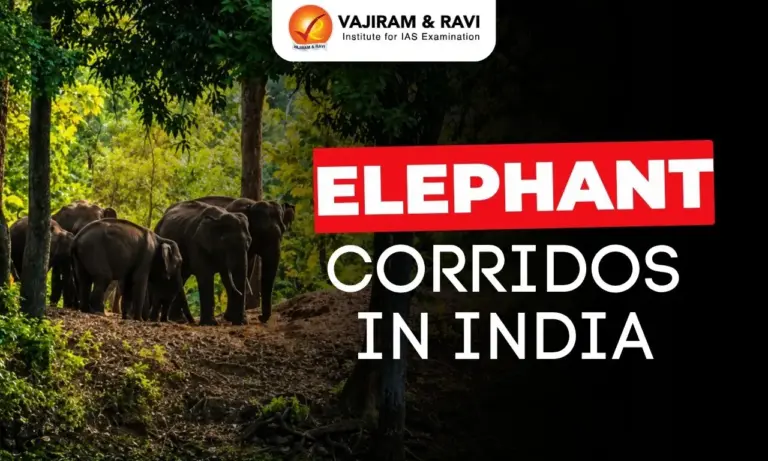
Elephant Corridors in India Latest News
- Recently, a Supreme Court bench headed by Chief Justice of India directed the Union government to conduct a fresh survey of elephant corridors, ruling that these corridors cannot be blocked over fears of crop damage since elephant herds naturally travel long distances.
- The bench was hearing an ongoing writ petition on managing human-elephant conflict, which had earlier also sought a ban on using fireballs, spikes, and similar methods to drive elephants away.
- The Court asked the Centre to report on steps taken to prohibit such “coercive measures” that divert elephants’ natural movement.
Why Do Elephants Move Long Distances?
- Asian elephants are highly mobile, social mammals. A male elephant’s home range — the area used for food, water, and shelter — typically spans 50 to 300 square kilometres, expanding further depending on resource availability.
- Elephants move through their range either in herds or individually, with home ranges varying by habitat type, food and water availability, population density, and human disturbance.
- According to studies by the National Centre for Biological Sciences and the Wildlife Institute of India, elephant movement is strongly shaped by seasonal food and water distribution.
- For instance, elephants migrate into Kerala during dry months, drawn to the relatively moist forests of the Western Ghats.
- Historically, climate change and drought have also driven such migrations. Corridors are essential to this movement, enabling elephants to find food, disperse naturally, and move seasonally.
- But these routes are increasingly disrupted by infrastructure, mining, and farmland expansion.


India’s Elephant Landscapes and Population
- India has four principal elephant landscapes:
- Western Ghats — 11,934 elephants (53.2%), across Karnataka (6,013), Tamil Nadu (3,136), and Kerala (2,785)
- North-Eastern Hills and Brahmaputra floodplains — 6,559 elephants (29.2%)
- Shivalik Hills and Gangetic plains — 2,062 elephants (9.2%)
- Central India and Eastern Ghats — 1,891 elephants (8.4%)
- India’s total elephant population stands at 22,446 (SAIEE 2021-25).
Fragmentation of Corridors: Region-Wise Challenges
- Western Ghats: Once a contiguous elephant habitat, this landscape is rapidly fragmenting due to changing land use, coffee and tea plantations, invasive plant species, and farmland fencing — a concern flagged in the latest all-India elephant population estimation report.
- Shivalik and Brahmaputra plains: Similar fragmentation has been recorded here, chiefly driven by railway lines, roads, power infrastructure, and other land-use changes.
- Central India and Eastern Ghats: This landscape presents the biggest conservation challenge, with elephant numbers rising steadily since the mid-to-late 1980s.
- Movement here began with El Niño-linked drought in erstwhile southern Bihar and later intensified due to iron ore mining in Jharkhand and Odisha.
- Over the past two decades, elephants have moved into Chhattisgarh from Jharkhand and Odisha owing to habitat loss and mining pressure, further expanding into Umaria and Shahdol (Madhya Pradesh) and Gadchiroli (Maharashtra).
Why Corridors Matter
- Corridors provide more than physical connectivity — they enable genetic exchange between fragmented elephant populations, maintaining genetic diversity.
- They also give elephants access to food and water during seasonal changes, reducing the likelihood of crop raiding and human-elephant conflict.
Corridor Mapping and Key Findings
- The government’s last major corridor-mapping exercise in 2023 documented 150 elephant corridors across 15 States within the four major landscapes.
- A subsequent report on human-elephant conflict in South India identified bottlenecks across 32 corridors in the region, citing highways, railway projects (such as the Bengaluru-Chennai line), hydel projects, high-tension power lines, electric fences, quarries, corridor narrowing, tea and coffee estates, resorts, and ashrams as key obstructions.
- West Bengal recorded the highest number of corridors — 26 across its northern and southern regions.
- Corridor sizes vary widely; the Charmar-Jingol corridor, largely in Chhattisgarh, is a notable example at 20 km long and 2.5 km wide, facilitating movement of an estimated 80-100 elephants from Odisha into Chhattisgarh’s interior.
Conclusion
- Elephant corridors are vital lifelines connecting fragmented habitats, enabling seasonal movement, genetic exchange, and reduced human-elephant conflict.
- With infrastructure, mining, and land-use change increasingly obstructing these pathways, the Supreme Court’s intervention signals growing judicial recognition that safeguarding corridors is essential — not just for elephant conservation, but for long-term conflict mitigation between humans and India’s largest terrestrial mammal.

 Last updated on Oct, 2026
→ UPSC 2027 Notification will be released on 13 January 2027 at upsconline.nic.in.
→ Check Nobel Prize 2026 Winners List here.
→ Download PIB PRiSM Monthly Magazine 2026 here.
→ Check UPSC Monthly Current Affairs Magazine The Recitals here.
→ Check out the latest UPSC Syllabus here.
→ Download UPSC Model Answers for Mains 2026
→ UPSC Mains Question Paper 2026 is out now for Essay & GS Paper 1, 2, 3 & 4.
→ UPSC Calendar 2027 has been released.
→ Enroll in Vajiram & Ravi’s UPSC Mains Test Series 2027 for structured answer writing practice, expert evaluation, and exam-oriented feedback.
→ Join Vajiram & Ravi’s UPSC Mentorship Program 2027 for personalized guidance, strategy planning, and one-to-one support from experienced mentors.
→ Go through the UPSC Mains Previous Year Papers to enhance your preparation.
→ UPSC has released UPSC Toppers List 2025 with the Civil Services final result on its official website.
→ Also check Best UPSC Coaching in India
Elephant Corridors in India FAQs
Q1. What are Elephant Corridors in India? +
Q2. Why are Elephant Corridors in India important?+
Q3. What threatens Elephant Corridors in India?+
Q4. Why has the Supreme Court intervened in Elephant Corridors in India?+
Q5. How many Elephant Corridors in India have been documented?+
Tags: Elephant Corridors in India mains articles upsc current affairs upsc mains current affairs