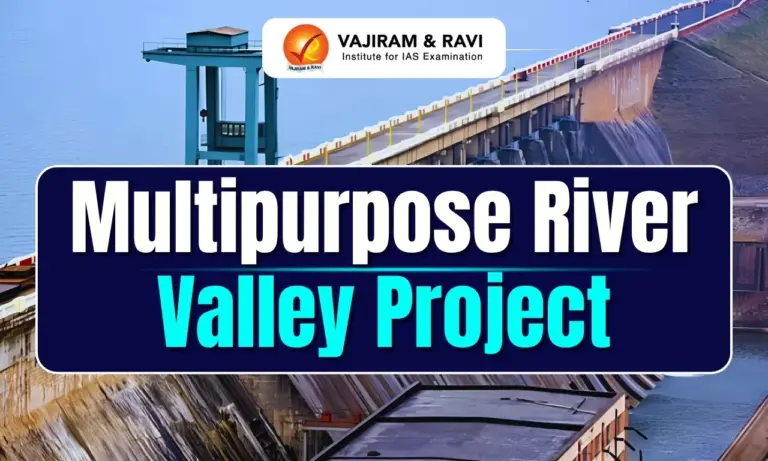
A Multipurpose River Valley Project is a large-scale water resource development project built around a river system to meet several needs at the same time. It generally includes dams, reservoirs, canals and powerhouses and is used for irrigation, electricity generation, flood control, water supply and other activities. These projects play an important role in the planned utilisation of India’s river water resources.
Multipurpose River Valley Project Objectives
- Irrigation: Multipurpose projects provide a more reliable supply of water to agricultural fields, especially during dry periods. Canals and reservoirs help extend irrigation facilities to areas that receive irregular or insufficient rainfall.
- Hydroelectric Power Generation: Water stored in reservoirs is used to generate hydroelectricity. Hydropower is a renewable source of energy and supports agricultural activities, industries, households and other economic activities.
- Flood Control: Dams and reservoirs can store excess water during periods of heavy rainfall and regulate its release. This helps reduce the intensity of floods in downstream areas, although the effectiveness of flood control depends on proper reservoir management.
- Water Supply: Reservoirs created by these projects provide water for drinking, domestic use and industrial activities. They are particularly useful for supplying water to towns, cities and industrial regions.
- Navigation: Regulated river flows and canals can support inland water transport in suitable areas. Navigation can provide a relatively economical way of transporting people and bulk goods.
- Fisheries: Reservoirs and associated water bodies can create suitable conditions for fish breeding and fisheries development, providing livelihood opportunities for local communities.
- Tourism and Recreation: Large reservoirs and surrounding landscapes can become centres for boating, fishing, tourism and other recreational activities, contributing to local economic development.
- Soil Conservation and Afforestation: Vegetation around catchment areas and reservoirs can help reduce soil erosion and support ecological conservation. Watershed management and afforestation are therefore important parts of sustainable river valley development.
Major Multipurpose River Valley Projects in India
India has developed several important Multipurpose River Valley Projects across different river basins. Some of the major projects are given below:
|
Multipurpose River Valley Project |
River |
Major States/Region |
Major Uses |
|
Bhakra-Nangal Project |
Himachal Pradesh, Punjab, Haryana, Rajasthan |
Irrigation, hydropower, flood control, water supply |
|
|
Damodar Valley Project |
Jharkhand, West Bengal |
Flood control, irrigation, power generation, industrial development |
|
|
Hirakud Project |
Odisha |
Irrigation, hydropower, flood control, water supply |
|
|
Sardar Sarovar Project |
Gujarat, Madhya Pradesh, Maharashtra, Rajasthan |
Irrigation, drinking water, hydropower |
|
|
Nagarjuna Sagar Project |
Telangana, Andhra Pradesh |
Irrigation, hydropower, water supply |
|
|
Chambal Valley Project |
Chambal |
Madhya Pradesh, Rajasthan |
Irrigation, hydropower, flood moderation |
|
Kosi Project |
Kosi |
Bihar, Nepal |
Flood control, irrigation, power and water management |
|
Gandak Project |
Gandak |
Bihar, Uttar Pradesh |
Irrigation and water management |
|
Tehri Project |
Bhagirathi |
Uttarakhand |
Hydropower, irrigation, water supply |
|
Rihand Project |
Rihand |
Uttar Pradesh |
Irrigation, power generation, industrial water supply |
|
Tungabhadra Project |
Tungabhadra |
Karnataka, Andhra Pradesh |
Irrigation, hydropower, water supply |
|
Koyna Project |
Koyna |
Maharashtra |
Hydropower, water management |
|
Mahi Project |
Mahi |
Gujarat, Rajasthan |
Irrigation and hydropower |
|
Ukai Project |
Tapi |
Gujarat |
Irrigation, hydropower, flood control |
|
Rana Pratap Sagar Project |
Chambal |
Rajasthan |
Hydropower, irrigation, water management |
|
Mayurakshi Project |
Mayurakshi |
West Bengal |
Irrigation, flood control, power generation |
|
Mahi Bajaj Sagar Project |
Mahi |
Rajasthan |
Irrigation and hydropower |
|
Narmada Valley Projects |
Narmada |
Madhya Pradesh, Gujarat and adjoining regions |
Irrigation, hydropower, water supply |
- Bhakra-Nangal Project: The Bhakra-Nangal Project is one of India’s major Multipurpose River Valley Projects. Built on the Sutlej River, it supports irrigation and electricity generation and provides water to several parts of northern India. The project has played an important role in agricultural development in Punjab, Haryana and Rajasthan.
- Damodar Valley Project: The Damodar Valley Project was developed in the Damodar River basin covering parts of Jharkhand and West Bengal. It was influenced by the model of the Tennessee Valley Authority in the United States. The project focuses on flood control, irrigation and power generation and has also supported industrial development in the region.
- Hirakud Project: The Hirakud Project is built across the Mahanadi River in Odisha. It is particularly important for flood moderation, irrigation and hydroelectric power generation. The reservoir also supports water supply and other economic activities in the region.
- Sardar Sarovar Project: The Sardar Sarovar Project is a major project on the Narmada River. It is an important component of the broader Narmada Valley development and provides irrigation and drinking water benefits, particularly to water-stressed areas of western India. It also contributes to hydropower generation.
- Nagarjuna Sagar Project: The Nagarjuna Sagar Project is constructed on the Krishna River and serves areas of Telangana and Andhra Pradesh. It is mainly associated with irrigation and hydropower generation and has contributed significantly to agricultural development in the Krishna basin.


Advantages of Multipurpose River Valley Projects in India
The importance of these projects goes beyond individual uses of river water. They contribute to the economic and regional development of different parts of India.
- Agricultural Development: By improving access to irrigation, these projects reduce excessive dependence on seasonal rainfall. They can support multiple cropping and improve agricultural productivity in areas with limited rainfall.
- Energy Security: Hydropower generated by these projects adds to the country’s electricity supply. It provides a renewable energy source that can support agriculture, industries and urban development.
- Regional Economic Development: The availability of water and electricity can encourage the growth of industries, towns and supporting infrastructure around project areas.
- Drinking Water Security: Multipurpose projects can help meet the water requirements of growing rural and urban populations, especially in areas experiencing seasonal or chronic water shortages.
- Employment Generation: Activities related to construction, irrigation, fisheries, tourism, power generation and other associated sectors can create direct and indirect employment opportunities.
- Support for Rural Development: Better irrigation, water availability and associated economic activities can improve income opportunities and contribute to the development of rural areas.
- Integrated Water Resource Management: These projects promote planned utilisation of river water for different requirements. This makes it possible to coordinate water use for agriculture, energy, domestic needs and other sectors.
Challenges of Multipurpose River Valley Projects
Despite their developmental benefits, multipurpose river valley projects face several economic, administrative and technical challenges
- High Construction and Maintenance Costs: Large dams, canals and powerhouses require substantial financial investment. Their maintenance, repair and long-term management also involve significant expenditure.
- Displacement of People: Construction of reservoirs often requires the acquisition and submergence of land. This can force people to relocate and may affect their homes, livelihoods and community networks.
- Loss of Agricultural Land: Fertile agricultural land may be submerged under reservoirs. This can reduce available farmland and affect the livelihoods of farming communities.
- Deforestation and Habitat Loss: Large projects may require clearing forests and other natural areas. This can result in the loss or fragmentation of wildlife habitats and natural ecosystems.
- Siltation: Rivers carry sediments that can accumulate in reservoirs over time. Siltation reduces the effective storage capacity of reservoirs and can affect the long-term efficiency and life of a project.
- Inter-State Water Disputes: Many Indian rivers flow through multiple states. Differences over the sharing and management of river water can create conflicts and make coordinated planning difficult.
- Changes in River Ecosystems: Dams alter the natural flow of rivers and can affect aquatic ecosystems, fish migration, sediment movement and downstream habitats.
- Risk of Seismic and Geological Problems: Large reservoirs can alter pressure conditions in the surrounding areas. In some locations, this may contribute to reservoir-induced seismicity, making geological assessment and monitoring important.
- Management Challenges: Multipurpose projects have to balance several competing demands such as irrigation, drinking water, electricity generation and flood control. Poor coordination or inappropriate reservoir operation can reduce their effectiveness.
Environmental and Social Impacts of Multipurpose River Valley Projects
The environmental and social impacts of Multipurpose River Valley Projects are linked to changes in river ecosystems, land use and the lives of local communities. The major impacts related to environmental changes, displacement, livelihoods and rehabilitation are discussed below.
Environmental Impacts
- Submergence of Forests: Large reservoirs can submerge forest areas and lead to the loss of vegetation and wildlife habitats. This may reduce biodiversity and disturb local ecological systems.
- Changes in River Ecology: Dams change the natural flow, temperature and sediment movement of rivers. These changes can affect fish, aquatic organisms and downstream ecosystems.
- Loss of Biodiversity: The destruction or fragmentation of natural habitats can affect plant and animal species. Species dependent on free-flowing rivers may be particularly affected.
- Soil and Sediment Issues: The trapping of sediments behind dams can reduce sediment flow downstream and increase sediment accumulation inside reservoirs. Over time, this can reduce reservoir storage capacity.
- Water Quality Concerns: Changes in water flow and the accumulation of organic matter in reservoirs can affect water quality. Proper monitoring and management are therefore necessary.
Social Impacts
- Displacement and Rehabilitation: People living in areas required for reservoirs and other infrastructure may have to relocate. Effective resettlement and rehabilitation are essential to protect their livelihoods and living conditions.
- Loss of Livelihoods: Farmers, forest-dependent communities, fishers and others may lose access to land or natural resources on which they depend for income.
- Impact on Local Communities: Submergence can affect villages, community spaces and cultural sites. Development planning therefore needs to consider both economic and social costs.
- Unequal Distribution of Benefits: The benefits of a project, such as electricity and irrigation, may reach distant regions while the environmental and social costs are concentrated among communities living near the project area.
- Need for Community Participation: Involving local communities in planning, rehabilitation and environmental management can improve transparency and help address local concerns.

 Last updated on Oct, 2026
→ UPSC 2027 Notification will be released on 13 January 2027 at upsconline.nic.in.
→ Check Nobel Prize 2026 Winners List here.
→ Download PIB PRiSM Monthly Magazine 2026 here.
→ Check UPSC Monthly Current Affairs Magazine The Recitals here.
→ Check out the latest UPSC Syllabus here.
→ Download UPSC Model Answers for Mains 2026
→ UPSC Mains Question Paper 2026 is out now for Essay & GS Paper 1, 2, 3 & 4.
→ UPSC Calendar 2027 has been released.
→ Enroll in Vajiram & Ravi’s UPSC Mains Test Series 2027 for structured answer writing practice, expert evaluation, and exam-oriented feedback.
→ Join Vajiram & Ravi’s UPSC Mentorship Program 2027 for personalized guidance, strategy planning, and one-to-one support from experienced mentors.
→ Go through the UPSC Mains Previous Year Papers to enhance your preparation.
→ UPSC has released UPSC Toppers List 2025 with the Civil Services final result on its official website.
→ Also check Best UPSC Coaching in India
Multipurpose River Valley Project FAQs
Q1. What is a Multipurpose River Valley Project?+
Q2. What are the main objectives of Multipurpose River Valley Projects?+
Q3. Which are the major Multipurpose River Valley Projects in India?+
Q4. What is the importance of Multipurpose River Valley Projects in India?+
Q5. What are the advantages of Multipurpose River Valley Projects?+
Q6. Which river is associated with the Bhakra-Nangal Project?+
Q7. What are the major challenges of Multipurpose River Valley Projects?+
Q8. What are the environmental impacts of Multipurpose River Valley Projects?+
Q9. What are the social impacts of Multipurpose River Valley Projects?+
Q10. How can Multipurpose River Valley Projects be made more sustainable?+
Tags: economy economy notes environment environment notes geography geography notes multipurpose river valley project