Enceladus Latest News
Scientists analyzing NASA Cassini data recently identified previously unknown organic compounds in ice particles emitted from Saturn’s moon Enceladus.
About Enceladus
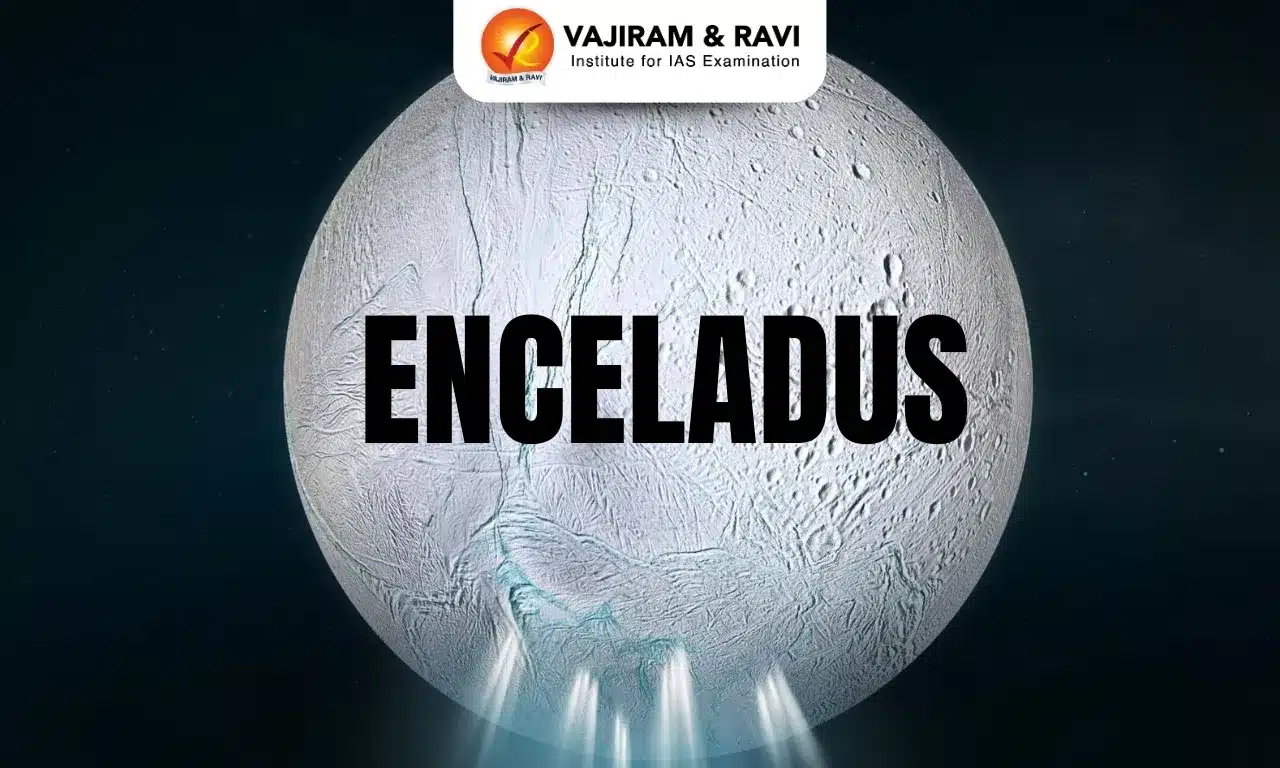
- It is the second nearest of the major regular moons of Saturn and the brightest of all its moons.
- It is Saturn’s sixth-largest moon.
- It was discovered in 1789 by the English astronomer William Herschel and named for one of the Giants (Gigantes) of Greek mythology.
- It measures about 500 km in diameter.
- It orbits Saturn in a prograde, nearly circular path at a mean distance of 238,020 km.
- Enceladus is tidally locked with Saturn, keeping the same face toward the planet.
- It continually spews out a concoction of water and simple organic chemicals into space.
- Its surface, which reflects essentially all of the light that strikes it (compared with about 7 percent for Earth’s Moon), is basically smooth but includes cratered and grooved plains.
- The surface is almost pure water ice, with trace amounts of carbon dioxide, ammonia, and light hydrocarbons.
- Because Enceladus is coated in clean, highly reflective ice, it has the brightest surface of any object in our solar system.
- Like other icy moons that orbit gas giants, it’s thought that Enceladus maintains a liquid subsurface ocean through tidal heating.
- It is one of the most promising potential sites in the solar system for hosting life.
- Scientists believe Enceladus possesses the chemical ingredients needed for life and has hydrothermal vents releasing hot, mineral-rich water into its ocean, the same type of environment that may have spawned Earth’s first living organisms.


Key Facts about Cassini Spacecraft
- It is a joint project of NASA, the European Space Agency, and the Italian space agency (ASI).
- Cassini was a sophisticated robotic spacecraft sent to study Saturn and its complex system of rings and moons in unprecedented detail.
- It was launched on October 15, 1997. It was one of the largest interplanetary spacecraft.
- The mission consisted of NASA’s Cassini orbiter, which was the first space probe to orbit Saturn, and the ESA’s Huygens probe, which landed on Titan, Saturn’s largest moon.
Source: SD

 Last updated on Sep, 2026
→ UPSC 2027 Notification will be released on 13 January 2027 at upsconline.nic.in.
→ Asian Games 2026 are being held in Aichi-Nagoya, Japan, from 19 September to 4 October.
→ Check out the latest UPSC Syllabus here.
→ Download UPSC Model Answers for Mains 2026
→ UPSC Mains Question Paper 2026 is out now for Essay & GS Paper 1, 2, 3 & 4.
→ UPSC Calendar 2027 has been released.
→ Enroll in Vajiram & Ravi’s UPSC Mains Test Series 2027 for structured answer writing practice, expert evaluation, and exam-oriented feedback.
→ Join Vajiram & Ravi’s UPSC Mentorship Program 2027 for personalized guidance, strategy planning, and one-to-one support from experienced mentors.
→ Go through the UPSC Mains Previous Year Papers to enhance your preparation.
→ UPSC has released UPSC Toppers List 2025 with the Civil Services final result on its official website.
→ Also check Best UPSC Coaching in India
Enceladus FAQs
Q1. Enceladus is a moon of which planet?+
Q2. Who discovered Enceladus in 1789?+
Q3. What is the approximate diameter of Enceladus?+
Q4. What primarily makes Enceladus the brightest object in the Solar System?+
Tags: enceladus prelims pointers upsc current affairs upsc prelims current affairs