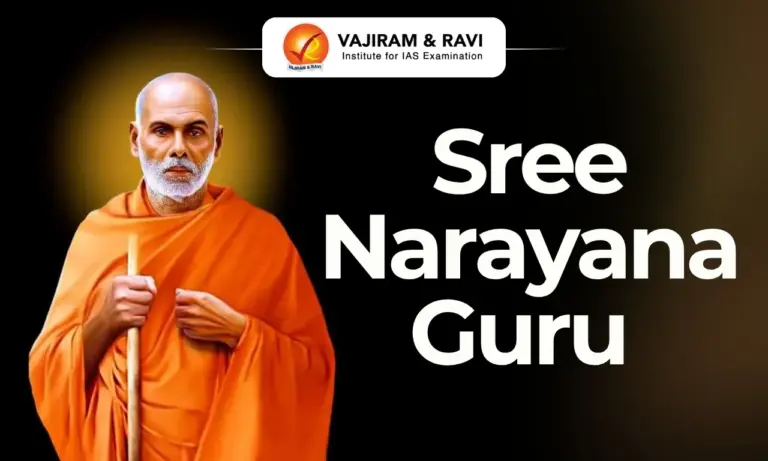
Sree Narayana Guru (28 August 1856-20 September 1928) was a saint, philosopher, poet, spiritual leader and social reformer from Kerala. He challenged caste discrimination and promoted social equality, education, self respect and spiritual development. His central message was “One Caste, One Religion, One God for Mankind.” He worked to create inclusive institutions for communities facing social exclusion.
Sree Narayana Guru Jayanthi 2026
Sree Narayana Guru Jayanthi 2026 is observed on 28 August every year to mark his birth anniversary. In 2026, it will mark the 170th birth anniversary of Sree Narayana Guru. The occasion remembers his lifelong efforts against caste based inequality and his emphasis on education, organisation, economic progress and universal human dignity.
Sree Narayana Guru Biography
Sree Narayana Guru was born in Chempazhanthy near present day Thiruvananthapuram in an Ezhava family. He was known as Gurudevan among his followers. His early life combined Sanskrit learning, Ayurveda, yoga, meditation and Vedantic study.
- Family Background: His parents were Madan Asan and Kuttiyamma. His Ezhava community faced severe caste restrictions in Kerala, including exclusion from temples and limited access to social institutions.
- Early Education: He studied Malayalam, Tamil and Sanskrit and later learned the Vedas, Upanishads and Sanskrit literature under Raman Pillai Asan. He also received Ayurveda training from his uncle.
- Spiritual Training: Chattampi Swamikal introduced him to Ayyavu Swamikal, from whom he learned yoga and meditation. Guru later spent eight years in meditation and ascetic practice at Maruthwamala.
- Teaching and Ascetic Life: After returning to his village in 1881, he briefly worked as a teacher. He later left home and travelled through southern India as a wandering ascetic.
- Aruvippuram Pratishta: In 1888, he consecrated a Shiva lingam at Aruvippuram. The act challenged caste based restrictions that prevented lower caste communities from establishing and accessing places of worship.
- Spiritual Philosophy: Sree Narayana Guru stressed self purification, simplicity, compassion and universal love. He taught that liberation comes through knowledge and ethical living rather than blind faith.


Sree Narayana Guru Contributions
Sree Narayana Guru combined spiritual reform with social transformation. His institutions promoted education, organisation, economic development and dignity among marginalised communities.
- Caste Equality: His famous principle, “One Caste, One Religion, One God for Mankind,” rejected caste hierarchy and promoted equality among all human beings.
- Temple Reform: Guru established more than 40 temples across Kerala and Tamil Nadu. Several were open to people of different castes and challenged traditional restrictions on worship.
- SNDP Yogam: In 1903, the Sri Narayana Dharma Paripalana Yogam was established with Guru as founder president and worked for educational, social and economic upliftment of the Ezhava community.
- Education: Guru considered education essential for human progress. He promoted schools and free education for disadvantaged communities and supported access to knowledge irrespective of caste.
- Advaita Ashram: He founded the Advaita Ashram at Aluva in 1913. It was associated with the principle “Om Sahodaryam Sarvatra,” meaning all human beings are equal in the eyes of God.
- Sivagiri Institution: Guru established his ashram at Sivagiri in 1904. The Sivagiri movement later promoted education, cleanliness, devotion, organisation, agriculture, trade, handicrafts and technical training.
- Vaikom Satyagraha: Sree Narayana Guru supported the Vaikom Satyagraha of 1924-25 against untouchability and caste discrimination. T. K. Madhavan, K. P. Kesava Menon and K. Kelappan were among its pioneering leaders.
- Religious Harmony: In 1923, Guru organised an All Religions Conference at Aluva Advaita Ashram. Its objective was dialogue and mutual understanding rather than religious argument.
- Literary Works: His important works include Atmopadesa Satakam, Daiva Dasakam, Anukampa Dasakam, Brahmavidya Panchakam, Advaitha Deepika, Bhadrakaliashtakam and Asramam.
- Economic Empowerment: Guru promoted organisation and productive work alongside education. His approach connected social progress with agriculture, handicrafts, trade, industry and economic self reliance.
Sree Narayana Guru Death and Samadhi
Sree Narayana Guru died on 20 September 1928 at Sivagiri, Kerala, at the age of 72. His death anniversary is observed as Sree Narayana Guru Samadhi and is a public holiday in Kerala.
- Final Years: Guru continued his social and spiritual activities despite declining health. His final public activities included work connected with the SNDP Yogam and the Sivagiri pilgrimage.
- Sivagiri Samadhi: He was laid to rest at Sivagiri. The site later became an important centre associated with his teachings, institutions and continuing social legacy.
Sree Narayana Guru Recognitions and Honors
Sree Narayana Guru received lasting recognition through national commemorations, postage stamps, commemorative coins, statues and public observances.
- Indian Postage Stamp: India issued a commemorative postage stamp featuring Sree Narayana Guru on 21 August 1967 with a denomination of 15 nP.
- Sri Lanka Stamp: Sri Lanka Post issued another commemorative stamp honouring Sree Narayana Guru on 4 September 2009, recognising his wider spiritual influence.
- Commemorative Coins: Commemorative ₹5 and ₹100 coins depicting Guru were issued for his 150th birth anniversary by the Reserve Bank of India and Security Printing and Minting Corporation of India.
- National Recognition: President Droupadi Murmu inaugurated the observance of the Mahasamadhi centenary of Sree Narayana Guru at Sivagiri Mutt, Varkala, Kerala, on 23 October 2025.
- Public Observance: Sree Narayana Jayanthi and Sree Narayana Guru Samadhi are observed as public holidays in Kerala. His legacy continues through educational, spiritual and social institutions.

 Last updated on Oct, 2026
→ UPSC 2027 Notification will be released on 13 January 2027 at upsconline.nic.in.
→ Asian Games 2026 are being held in Aichi-Nagoya, Japan, from 19 September to 4 October.
→ Check Nobel Prize 2026 Winners List here.
→ Download PIB PRiSM Monthly Magazine 2026 here.
→ Check UPSC Monthly Current Affairs Magazine The Recitals here.
→ Check out the latest UPSC Syllabus here.
→ Download UPSC Model Answers for Mains 2026
→ UPSC Mains Question Paper 2026 is out now for Essay & GS Paper 1, 2, 3 & 4.
→ UPSC Calendar 2027 has been released.
→ Enroll in Vajiram & Ravi’s UPSC Mains Test Series 2027 for structured answer writing practice, expert evaluation, and exam-oriented feedback.
→ Join Vajiram & Ravi’s UPSC Mentorship Program 2027 for personalized guidance, strategy planning, and one-to-one support from experienced mentors.
→ Go through the UPSC Mains Previous Year Papers to enhance your preparation.
→ UPSC has released UPSC Toppers List 2025 with the Civil Services final result on its official website.
→ Also check Best UPSC Coaching in India
Sree Narayana Guru FAQs
Q1. Who was Sree Narayana Guru?+
Q2. What was the main message of Sree Narayana Guru?+
Q3. When is Sree Narayana Guru Jayanthi 2026?+
Q4. What was the Aruvippuram Pratishta?+
Q5. When did Sree Narayana Guru die?+
Tags: important day important day 2026 sree narayana guru sree narayana guru jayanthi sree narayana guru jayanthi 2026