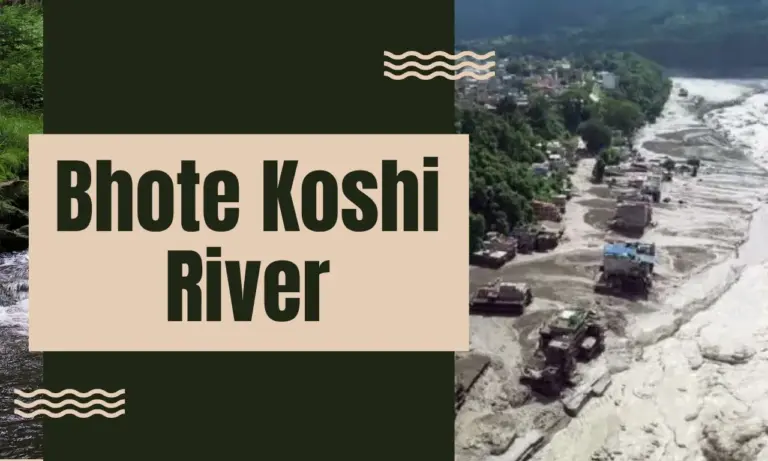
The Bhote Koshi River recently came into focus after a flash flood struck Nepal’s Rasuwa district on 26 August 2026near the Nepal-China border. The event is significant for India because the river system ultimately connects with the Gandak and Ganga drainage systems, linking Himalayan hazards in Nepal with downstream regions of India.
About the Bhote Koshi River
The Bhote Koshi is a Himalayan river associated with the high-altitude regions of Tibet and Nepal and is part of the wider drainage network that connects the Himalayas with the Ganga basin.
- The name Bhote Koshi is used for two different rivers in Nepal, each belonging to a different downstream river system.
- The Rasuwa Bhote Koshi is part of the Trishuli-Narayani-Gandak system.
- The Sindhupalchok Bhote Koshi is part of the Sun Koshi-Sapta Koshi-Kosi system.
- The wider Kosi river system is around 720 km long and extends from Tibet through Nepal and India, eventually draining into the Ganga.
Bhote Koshi River Systems
The two rivers known as Bhote Koshi follow different courses after entering Nepal and therefore connect with different major river systems.
Rasuwa Bhote Koshi
The Rasuwa Bhote Koshi flows through northern Nepal and is connected to the Trishuli-Narayani-Gandak system.
- It enters Nepal from the Tibet-Nepal border in Rasuwa district.
- It flows through the Himalayan region and joins the Trishuli river system.
- The Trishuli forms part of the Narayani system, which enters India as the Gandak River and eventually reaches the Ganga.
- This is the Bhote Koshi associated with the 26 August 2026 flash flood.
Sindhupalchok Bhote Koshi
The Sindhupalchok Bhote Koshi follows a different route and forms part of the Sun Koshi-Sapta Koshi-Kosi system.
- It originates near the Zhangzangbo Glacier in Tibet and is called Poiqu or Boqu on the Chinese side.
- It flows into Sindhupalchok in Nepal and joins the Sun Koshi River.
- The Sun Koshi, Arun Koshi and Tamur Koshi are the three principal rivers that converge at Triveni in Nepal to form the Sapta Koshi.
- The Sapta Koshi passes through the Chatra Gorge and enters India through Bihar as the Kosi River.
- The Kosi eventually joins the Ganga.


Bhote Koshi Features
The Bhote Koshi is part of a river system with a steep Himalayan course and a very high sediment load, which makes the wider river system highly dynamic.
- The wider Kosi river system drops from about 8,000 metres to around 60 metres above sea level as it reaches the plains of India.
- The young Himalayas are highly erodible, so large amounts of soil and rock enter the river system as sediment.
- At Chatara in Nepal, the wider Kosi system carries around 100 million tonnes of sediment every year, according to the International Centre for Integrated Mountain Development (ICIMOD).
- When the river reaches the flatter plains, its ability to carry this sediment decreases, causing sediment to accumulate in the riverbed and floodplains.
- This accumulation can raise the riverbed and make the river channel unstable, increasing the possibility of the river changing its course.
- The Kosi is an antecedent river, meaning its major rivers continued to follow their earlier courses even as the Himalayas rose around them.
- Over time, repeated sediment deposition and changes in the river’s course have created the Kosi megafan, covering roughly 15,000 sq km.
Bhote Koshi River and Flood Risk
The flood risk in the Bhote Koshi region arises from sudden Himalayan hazards, while downstream flooding is also influenced by the large sediment load of the wider river system.
- Avalanches and landslides can obstruct mountain streams and lead to sudden releases of water and debris.
- Glacial Lake Outburst Floods (GLOFs) can release large volumes of water from high-altitude glacial lakes within a short period.
- Cloudbursts and intense rainfall can rapidly increase river discharge in the Himalayan catchment.
- The steep Himalayan terrain allows floodwaters to move rapidly through narrow valleys, increasing their destructive force.
- Further downstream, the heavy sediment carried from the Himalayas is deposited as the river enters flatter areas. When sediment builds up and the river channel becomes unstable, the river can suddenly shift to a new course, a process known as avulsion.
The combination of sudden high-altitude hazards, heavy sediment deposition and unstable channels makes the wider river system highly vulnerable to flooding.
Bhote Koshi River and Major Flood Events
The wider Kosi system has experienced repeated and severe flooding over several decades.
- Major floods occurred in 1954 and 1968, affecting large parts of the Kosi basin.
- The 2008 Kusaha disaster affected around 3.3 million people in Bihar.
- During the 2008 event, the Kosi breached its eastern embankment near Kusaha in Nepal and shifted around 120 km eastwards towards its earlier course.
- The event demonstrated how changes in the river channel can produce large-scale flooding in the Bihar plains.
- The 26 August 2026 flash flood in Rasuwa highlighted the vulnerability of the upper Himalayan reaches to sudden high-altitude flood events.
Bhote Koshi River Significance for India
The Bhote Koshi is important for India because it forms part of the wider Himalayan river systems that flow from Tibet and Nepal into India and eventually drain into the Ganga.
- Water and sediment carried by these rivers from the Himalayas eventually reach the Indian plains, affecting downstream water flow and flood conditions.
- The Sindhupalchok Bhote Koshi joins the Sun Koshi and becomes part of the Sapta Koshi-Kosi system, which enters India through Bihar.
- The Kosi is particularly important for northern Bihar, where it is known for frequent flooding during the monsoon.
- The Kosi carries a very large amount of sediment from the young Himalayas, which is deposited as the river enters the plains and contributes to unstable channels and changing river courses.
- This makes flood prediction and management difficult in northern Bihar because the river can suddenly change its course and spread across large areas.
- The 2008 Kusaha disaster demonstrated the downstream impact of such changes, when the Kosi changed its course and caused extensive flooding in Bihar, affecting around 3.3 million people.
- These transboundary linkages make regular river monitoring, timely flood forecasting and India-Nepal cooperation important for reducing downstream flood risks.
- The Kosi Agreement of 1954, revised in 1966, provides a framework for India-Nepal cooperation on the Kosi, particularly for flood control and water management.

 Last updated on August, 2026
→ UPSC Mains 2026 commenced on 21st August 2026 and will continue through 30th August 2026, as per the official examination schedule.
→ UPSC Mains Question Paper 2026 is out now for Essay & GS Paper 1, 2, 3 & 4.
→ UPSC Mains GS Paper 1 2026 is out now.
→ UPSC Mains GS Paper 2 2026 is out now.
→ UPSC Mains GS Paper 3 2026 is out now.
→ UPSC Mains GS Paper 4 2026 is out now.
→ Check out the latest UPSC Syllabus 2026 here.
→ UPSC Mains Admit Card 2026 is now out.
→ Enroll in Vajiram & Ravi’s UPSC Mains Test Series 2027 for structured answer writing practice, expert evaluation, and exam-oriented feedback.
→ Join Vajiram & Ravi’s UPSC Mentorship Program 2027 for personalized guidance, strategy planning, and one-to-one support from experienced mentors.
→ Go through the UPSC Mains Previous Year Papers to enhance your preparation.
→ Download UPSC Mains Essay Paper 2025, UPSC Mains GS Paper-I 2025, UPSC Mains GS Paper-II 2025, UPSC Mains GS Paper-III 2025, UPSC Mains GS Paper-IV 2025, UPSC Mains English (Compulsory) Paper 2025, UPSC Mains Hindi (Qualifying) Paper 2025 here.
→ UPSC has released UPSC Toppers List 2025 with the Civil Services final result on its official website.
→ UPSC Calendar 2027 has been released.
→ Also check Best UPSC Coaching in India
Bhote Koshi River FAQs
Q1. How many rivers are known as Bhote Koshi in Nepal?+
Q2. Where does the Sindhupalchok Bhote Koshi River originate?+
Q3. Which river system does the Rasuwa Bhote Koshi belong to?+
Q4. Which river system does the Sindhupalchok Bhote Koshi belong to?+
Q5. Why is the Bhote Koshi river important for India?+
Tags: bhote koshi river