The List of Middle East Countries includes the region around Western Asia as well as Northern Africa. This region has been the hub of international affairs over many years. It is known for its ancient civilizations, rich culture, and strategic location. The region is especially important because of its large oil reserves, major trade routes, and religious sites. For UPSC aspirants, understanding the Middle East is important because it affects India’s foreign policy, energy needs, and relationships with other countries.
Middle East Countries Name
The Middle East Countries are culturally and strategically important region connecting Asia, Africa, and Europe through trade and history.
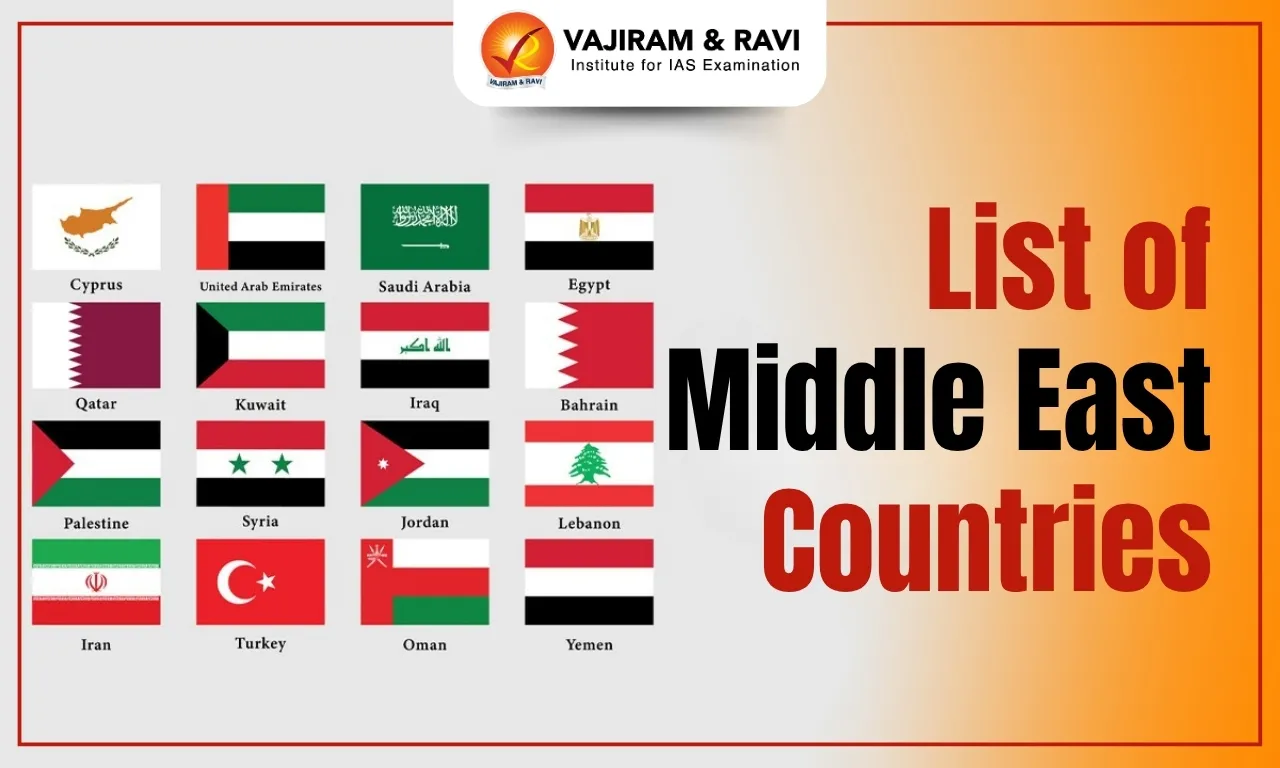
- Saudi Arabia, Kuwait, Bahrain, Qatar, Oman, Yemen, and the United Arab Emirates form the Arabian Peninsula, a major part of the Middle East.
- Iraq, Iran, Turkey, and Egypt are widely included in the Middle East because of their historical, political, and geographical importance.
- Syria, Lebanon, Israel, Jordan, the West Bank, and the Gaza Strip are part of the Levant region of the Middle East.
- Cyprus is sometimes included in Middle East country lists due to its strong historical and cultural links with the eastern Mediterranean region.
- In broader definitions, countries such as Afghanistan, Pakistan, Azerbaijan, Kazakhstan, Uzbekistan, Tajikistan, Kyrgyzstan, and Turkmenistan may also be included.
- Some studies use the term MENA (Middle East and North Africa), which additionally includes Morocco, Algeria, Tunisia, Libya, and Western Sahara.
Middle East Countries List and their Capitals
The List of Middle East Countries includes about 25 widely accepted countries including Israel, Iran and Iraq. All Middle East Countries have capital cities which act as an important centre of government. Some of these countries and their capitals are Tehran in Iran, Baghdad in Iraq, Jerusalem in Israel. Following below is the list of Middle East Countries along with their capitals:
| S.No | Country | Capital |
|
1 |
United Arab Emirates |
Abu Dhabi |
|
2 |
Algeria |
Algiers |
|
3 |
Jordan |
Amman |
|
4 |
Turkey |
Ankara |
|
5 |
Greece |
Athens |
|
6 |
Iraq |
Baghdad |
|
7 |
Azerbaijan |
Baku |
|
8 |
Lebanon |
Beirut |
|
9 |
Egypt |
Cairo |
|
10 |
Syria |
Damascus |
|
11 |
Qatar |
Doha |
|
12 |
Pakistan |
Islamabad |
|
13 |
Afghanistan |
Kabul |
|
14 |
Sudan |
Khartoum |
|
15 |
Kuwait |
Kuwait City |
|
16 |
Bahrain |
Manama |
|
17 |
Oman |
Muscat |
|
18 |
Cyprus |
Nicosia |
|
19 |
Saudi Arabia |
Riyadh |
|
20 |
Morocco |
Rabat |
|
21 |
Yemen |
Sanaa |
|
22 |
Georgia |
Tbilisi |
|
23 |
Iran |
Tehran |
|
24 |
Libya |
Tripoli |
|
25 |
Tunisia |
Tunis |


Middle East Countries Geopolitical and Economic Importance
The Middle East Countries play an important economic and geopolitical role in international affairs across the globe. The Middle East Countries are important because:
- Location is Strategic: The Middle East regions cover major sea choke points including Suez Canal, Strait of Hormuz and Bab-el-Mandeb.
- Energy Sources: 48% of the oil reserves of the world are held by the Middle East Nations, providing them a central role in energy security.
- Religious Importance: Mecca, Medina, Jerusalem and Bethlehem are some of the important places in the Middle East Countries.
Middle East Countries War and Conflicts
Middle East Countries War and Conflicts have shaped regional politics and international relations for over a century. The origin, history and major developments of the conflict has been discussed below:
- The roots of many Middle East conflicts lie in the period after World War I, when new national boundaries were created following the decline of the Ottoman Empire.
- The creation of Israel in 1948 led to the first Arab-Israeli war and became a major turning point in the region’s political and security landscape.
- The Six Day War of 1967 changed control over several territories and significantly influenced future disputes, diplomacy and regional security concerns.
- The Islamic Revolution in Iran in 1979 transformed regional politics and increased geopolitical competition between Iran, Israel and several Arab countries.
- Over time, conflicts shifted from direct wars between countries to disputes involving armed groups and regional alliances in areas such as Lebanon, Gaza, Syria and Yemen.
- In recent years, tensions between Iran, Israel and their regional partners have led to missile attacks, drone operations and growing security concerns across West Asia.
- Important maritime routes such as the Strait of Hormuz have become strategically significant because they handle a large share of global oil and energy trade.
- Ongoing conflicts continue to affect global energy prices, trade routes, economic stability, humanitarian conditions and international diplomatic efforts in the Middle East.
Also Read: OPEC
India-Middle East-Europe Economic Corridor (IMEC)
The India-Middle East-Europe Economic Corridor (IMEC) is an ambitious initiative aimed at creating a seamless and secure transportation network that connects India with the Middle East and Europe. The corridor holds significant geopolitical and economic value, especially in strengthening India’s strategic positioning and integrating it more deeply into global value chains.
- Components of the IMEC:
- Railway Infrastructure: Establishing a modern rail network to link India and the Arabian Gulf with Europe, reducing both shipping costs and transit time.
- Digital Connectivity: Laying high-speed internet cables to improve digital infrastructure and communication across the corridor.
- Energy Infrastructure: Developing clean energy channels, such as green hydrogen pipelines, to support a sustainable energy exchange.
- Sustainability Measures: Prioritising renewable energy usage and eco-friendly logistics to reduce carbon emissions and promote green trade practices.
- Benefits of the IMEC: The benefits of India- Middle East Economic Corridor includes:
- Better Global Supply Chain: The corridor will help link India, Middle East and Europe through rail and sea links, enabling better movement of products. This will also bring down the dependency on ocean routes, for both energy and basic goods.
- Strategic Position: India having a central location, gets the benefit of connecting with Europe and West Asia, decreasing its dependency on China-predominant routes like the Belt and Road Initiative.
- Economic Growth: The convenience in movement will lead to more job opportunities in industries like infrastructure, energy, logistics and digital connectivity.
- Food Security: For developing nations, especially in Africa and Asia, the corridor offers a reliable and efficient logistics framework for transporting agricultural produce and essential goods—thereby strengthening food security and supply chain resilience.
- Green Energy and Sustainability: The inclusion of clean hydrogen pipelines reflects a strong commitment to green energy. This focus on sustainability aligns with global climate action efforts, promoting environmentally responsible infrastructure and reducing carbon emissions across the corridor.

 Last updated on Oct, 2026
→ UPSC 2027 Notification will be released on 13 January 2027 at upsconline.nic.in.
→ Check Nobel Prize 2026 Winners List here.
→ Download PIB PRiSM Monthly Magazine 2026 here.
→ Check UPSC Monthly Current Affairs Magazine The Recitals here.
→ Check out the latest UPSC Syllabus here.
→ Download UPSC Model Answers for Mains 2026
→ UPSC Mains Question Paper 2026 is out now for Essay & GS Paper 1, 2, 3 & 4.
→ UPSC Calendar 2027 has been released.
→ Enroll in Vajiram & Ravi’s UPSC Mains Test Series 2027 for structured answer writing practice, expert evaluation, and exam-oriented feedback.
→ Join Vajiram & Ravi’s UPSC Mentorship Program 2027 for personalized guidance, strategy planning, and one-to-one support from experienced mentors.
→ Go through the UPSC Mains Previous Year Papers to enhance your preparation.
→ UPSC has released UPSC Toppers List 2025 with the Civil Services final result on its official website.
→ Also check Best UPSC Coaching in India
Middle East Countries FAQs
Q1. Is India part of Middle East Countries?+
Q2. What is the difference between the international and Middle East version?+
Q3. What are the names of Middle East Countries?+
Q4. Is Pakistan a Middle East Country?+
Q5. Who is classified as Middle Eastern?+
Tags: international relations middle east countries